How food aid, Cold War and China shaped India-US relations under Nehru
Note: In Part 1 of this series tracing India-US relations, we looked at how the American Revolutionary War laid the foundation of the relationship and
Note: In Part 1 of this series tracing India-US relations, we looked at how the American Revolutionary War laid the foundation of the relationship and how both countries influenced each other before formal ties were established in 1947. Read Part 1 of the article here. During his first visit to the United States in October 1949, India's first Prime Minister, Jawaharlal Nehru, addressed the Press Club in Washington, DC. The speech offered an early glimpse into the foreign policy doctrine that would shape India's engagement with the world for decades. Read Full Story "If there are means of cooperation between India and the USA, I would like to explore them. Such cooperation would be to our mutual advantage. But India does not intend to become involved in the Anglo-American Cold War with Russia if it can possibly avoid it. We try to view world affairs in their broader context. It is important not to be tied up too closely with immediate problems," he said. Nehru made clear that while India was open to cooperation with the United States, it would not align itself with either the Western or Soviet bloc. The remarks foreshadowed India's leading role in the Non-Aligned Movement that emerged in the 1950s. Washington viewed non-alignment with considerable skepticism. Then US Secretary of State John Foster Dulles famously described the policy as "immoral", a perception that contributed to the on-again, off-again character of India-US ties for much of the Cold War. INDIA-US 'AID' RELATIONS For all practical purposes, India ranked low on Washington's priorities, given New Delhi's refusal to join its strategy of containing the Soviet Union. That, however, did not prevent the two countries from building a substantial economic relationship around aid, food security and development assistance. Despite political disagreements, the United States emerged as one of India's largest development partners during the 1950s and 1960s. Faced with recurring food shortages, foreign exchange constraints and the enormous challenge of nation-building, India increasingly relied on American economic assistance.
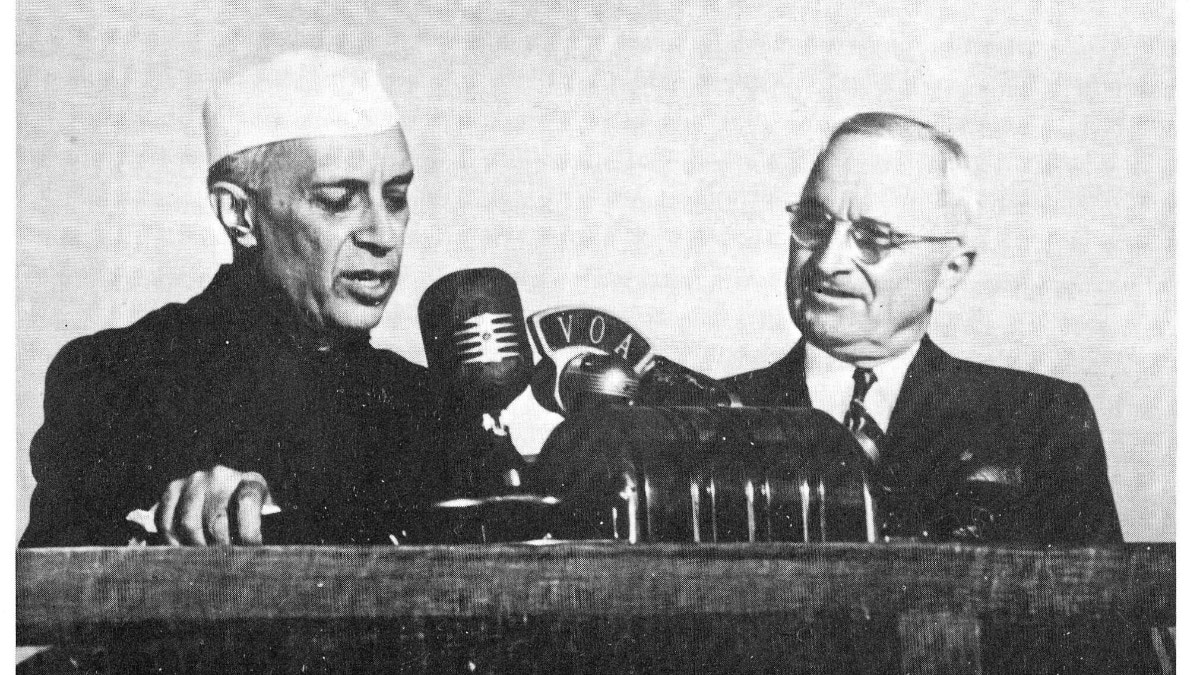
A key pillar of this relationship was the Public Law 480 programme, also known as "Food for Peace". Introduced in 1954, it allowed India to import American wheat and other food grains while paying in Indian rupees rather than scarce foreign currency. PM Jawaharlal Nehru addressed the US House of Representatives in October 1949. Nehru made two more trips to the United States in 1956 and 1961. Over time, India's dependence on American grain became so significant that officials described the situation as a "ship-to-mouth" existence, where imported wheat was consumed almost as soon as it arrived at Indian ports. Between the early 1950s and the late 1960s, India received billions of dollars in American assistance, including food aid and development loans. The US also played a direct role in shaping one of India's premier educational institutions. Under the Kanpur Indo-American Program, nine American universities collaborated to mentor IIT Kanpur, helping it become a globally recognised institution. The relationship was not without its tensions. Nehru was often uncomfortable with the scale of India's dependence on foreign food assistance, even as economic realities forced New Delhi to accept it. "Substantial aid might well create certain upsets in our internal economy. What was more serious, to my mind, was that our people should not develop the habit of dependence on external aid," Nehru wrote to Ministry of External Affairs officials in 1954. Yet, despite ideological differences and periodic diplomatic friction, aid created a durable foundation in India-US ties at a time when the two democracies frequently disagreed on global politics. THE PAKISTAN AND CHINA FACTOR If aid brought India and the United States together, Pakistan and China frequently drove them apart. One of the biggest irritants during the Nehru years was Washington's decision to make Pakistan a frontline ally in its Cold War strategy. Beginning in the 1950s, Pakistan joined US-backed military alliances such as SEATO and CENTO and received substantial American military assistance. From New Delhi's perspective, the partnership was deeply troubling.
 The BriefWire