Inequality is elementary to Germany's school system
Children's paths through Germany's school system are often determined before their first day of kindergarten, according to the national report on education. An elementary school
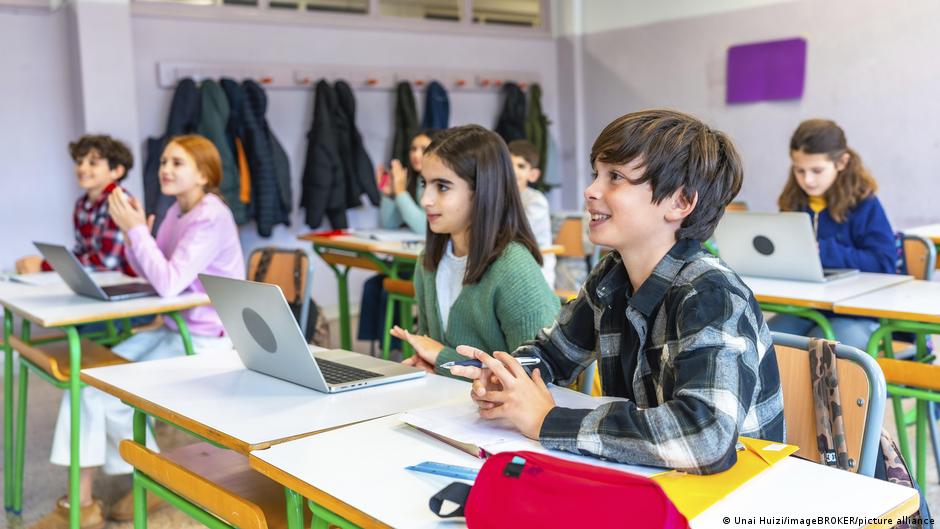
Children's paths through Germany's school system are often determined before their first day of kindergarten, according to the national report on education. An elementary school in Bonn is offering a new model for kids. The Kettelerschule, a primary school located in the northern part of the western German city of Bonn, is not in a wealthy neighborhood. Nearly all of the 250 students come from families who have migrated to Germany within a generation. Many do not speak German at home. One in three students requires individualized support. However, the school has consistently scored above average on achievement tests in the state of North Rhine-Westphalia. Germany's two-tier educational system sorts children into a university track or trade-school track by the time the reach their teens. At the Kettelerschule percentage of students who transfer to university-track institutions after four years of elementary school has risen from 0.5% to 30% in the past 20 years. A major part of this success is Christiane Lang-Winter, who joined the Kettelerschule as a young teacher in 2004, rose to become principal and began "turning everything upside down." "It became clear to me pretty quickly that either I would leave or the school would have to change," Lang-Winter told DW. "I want our children to be able to learn everything here so that later on they'll have the same opportunities as children from families where kids are given plenty of opportunities right from the start." As one of her first official acts, Lang-Winter implemented a system of teaching students grouped into "learning families" that span multiple grade levels.
This means that 6- and 9-year-olds learn together and support one another. Lang-Winter helped turned the Kettelerschule into a success story Image: Oliver Pieper/DW Lang-Winter's team of teachers, social workers and special-needs educators has prioritized reading, especially for first-graders. "We need high-quality language support for all children living in this country so that they can speak German really well," Lang-Winter said. "Otherwise, education won't work: If I don't have language, I can't be educated." The Kettelerschule works closely with nearby day cares. On Mondays and Wednesdays, preschoolers visit the Kettelerschule for 90 minutes. Kids from the elementary school visit the day cares to read aloud to the smaller children. "I want to know everything I can about these children beforehand so I can support them as early as possible," Lang-Winter said. 'The educational gap' According to Germany's national report on education, success at school is largely predetermined by students' social backgrounds, especially their parents' income and level of education. A UNICEF study ranks Germany 20th out of 43 developed countries when it comes to math and reading skills for 15-year-olds. Teenagers from socially disadvantaged families are five times more likely than their privileged peers to fail to meet the minimum standards in reading. The consequences are dire: The proportion of young people in Germany who leave school without a diploma has risen to 8%. German Education Minister Karin Prien is alarmed. She told the German public broadcaster ARD that such problems arise well before children start school. "What we're seeing now is that the educational gap essentially begins at birth, widens by age 6 and then doesn't narrow again," Prien said.
 The BriefWire