'Can 150 Million Users Be Silenced For An Exam?': Delhi HC Questions Govt's Telegram Ban Ahead Of NEET Retest
'Can 150 Million Users Be Silenced For An Exam?': Delhi HC Questions Govt's Telegram Ban Ahead Of NEET Retest Written By, Last Updated: June 18
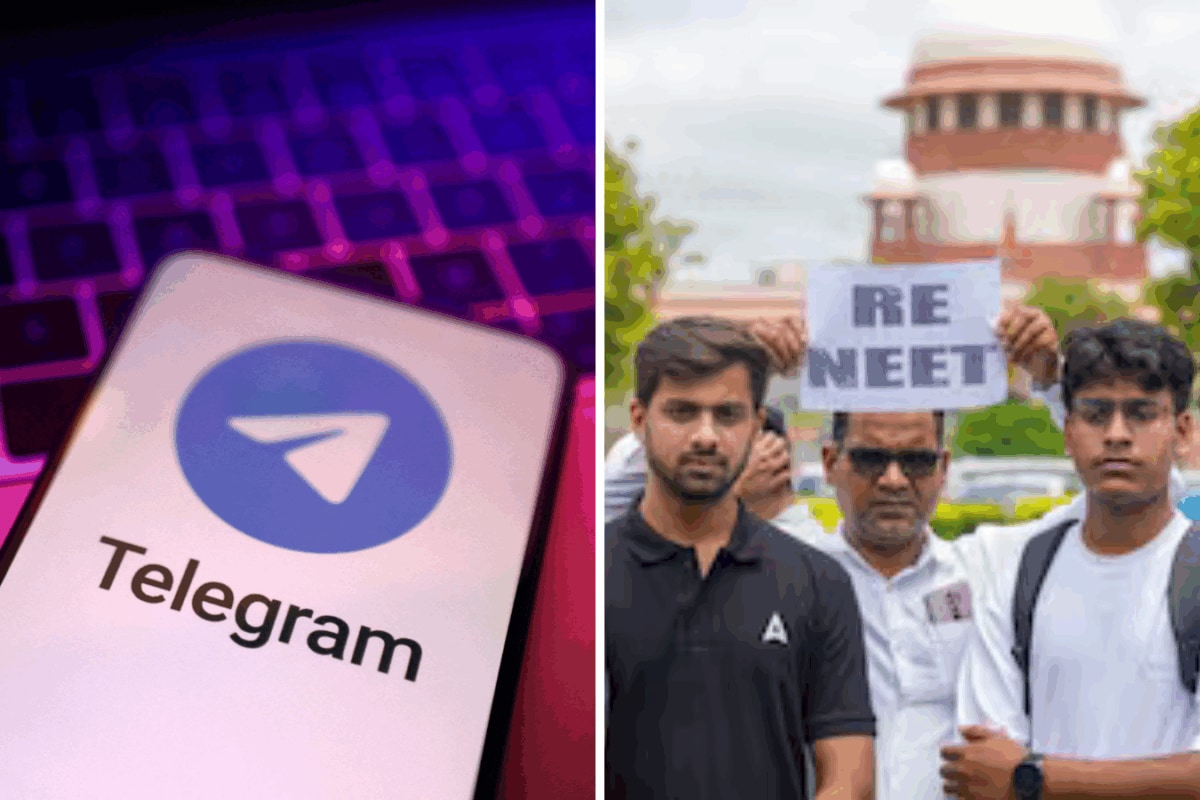
'Can 150 Million Users Be Silenced For An Exam?': Delhi HC Questions Govt's Telegram Ban Ahead Of NEET Retest Written By, Last Updated: June 18, 2026, 18:04 IST After hearing arguments from both sides, the court reserved its judgment on Telegram’s plea against the decision to restrict its access prior to the June 21 NEET-UG retest The Centre has told the Delhi High Court that Telegram is being widely exploited for a range of illegal activities, including terrorism, cybercrime, drug trafficking, child exploitation, and financial fraud. (Image: Reuters/PTI) Questioning the proportionality of the central government’s emergency blocking mandate, the Delhi High Court on Thursday reserved its verdict on a high-stakes petition filed by Dubai-based messaging giant Telegram. A vacation bench led by Justice Tejas Karia heavily scrutinised the Ministry of Electronics and Information Technology’s (MeitY) decision to enforce a blanket, nationwide suspension on the application until June 22, a move explicitly engineered to prevent potential question paper leaks ahead of the scheduled Eligibility cum Entrance Test (NEET-UG) 2026 re-examination on June 21. During a fiercely contested afternoon session, the court pushed back against the absolute nature of the blocking order, highlighting the unprecedented disruption caused to ordinary citizens who rely on the platform for non-academic purposes.
Justice Karia pointedly asked the government’s legal team how the statutory rights of approximately 150 million Indian users could be completely suspended simply because a specific subset of citizens was preparing to sit for a competitive national entrance examination. The bench directed both sides to submit their final written arguments to resolve the digital rights standoff. “How can we stop the rights of 150 million people just because one set of citizens are appearing in examinations? Is it not technologically possible to execute targeted, individual blocking rather than shutting down the entire platform?" the judge said. Technical Vulnerabilities and Public Unrest Justify Emergency Action Defending the state’s aggressive administrative measure, Solicitor General Tushar Mehta presented confidential data compiled by the Indian Cybercrime Coordination Centre (I4C), characterising Telegram’s underlying cloud-based network as fundamentally incompatible with real-time law enforcement monitoring. The government argued that the platform’s architectural allowances enable a single account to deploy up to 40 automated bots simultaneously—compared to more restrictive limits on competing applications—allowing criminal cheating syndicates to operate completely anonymously. Mehta argued that the temporary restriction, invoked under Rule 9 of the Information Technology Blocking Rules, represents a crucial preventative safeguard to insulate over 22 lakh medical aspirants from further psychological distress.
The central government warned that if fraudulent channels successfully disseminated simulated or leaked papers on the eve of the re-test, the ensuing public panic could precipitate severe law and order challenges across multiple states. The state further revealed that Telegram handles were actively utilising message-backdating features to fabricate post-facto evidence of leaks, purposefully designed to manipulate public perception. Irreparable Financial Hardship vs Intermediary Due Diligence Appearing for Telegram, Senior Advocate Dhruv Mehta argued that the emergency directive suffered from a severe lack of independent application of mind by the designated authority, claiming the government had effectively “thrown the baby out with the bathwater". The platform asserted that it had proactively cooperated with law enforcement by eliminating more than 900 links containing objectionable content since May. Telegram maintained that the wholesale ban violates constitutional guarantees of equal protection and free speech, severely penalising independent educators, digital businesses, and students who utilise the platform legally. However, the High Court countered by reminding the platform of its independent statutory obligations under Section 79 of the Information Technology Act. The bench noted that safe harbour immunities are strictly conditional upon rigorous intermediary due diligence, leaving the final determination of whether the government’s pre-emptive blockade represents a legally valid, proportionate check against digital crime to the reserved judgment.
News18 Newsletter Handpicked stories, in your inbox A newsletter with the best of our journalism submit About the Author Pathikrit Sen Gupta Pathikrit Sen Gupta is a Senior Associate Editor with News18.com and likes to cut a long story short. He writes sporadically on Politics, Sports, Global Affairs, Space, Entertainment, And Food. He tra... Read More First Published: June 18, 2026, 18:04 IST News india 'Can 150 Million Users Be Silenced For An Exam?': Delhi HC Questions Govt's Telegram Ban Ahead Of NEET Retest Disclaimer: Comments reflect users’ views, not News18’s. Please keep discussions respectful and constructive. Abusive, defamatory, or illegal comments will be removed. News18 may disable any comment at its discretion. By posting, you agree to our Terms of Use and Privacy Policy Loading comments...
 The BriefWire