What Happens To The 50,000 US Troops In West Asia? Clause 4 Of Iran MoU Raises Questions
What Happens To The 50,000 US Troops In West Asia? Clause 4 Of Iran MoU Raises Questions Published By, Last Updated: June 18, 2026, 17:57
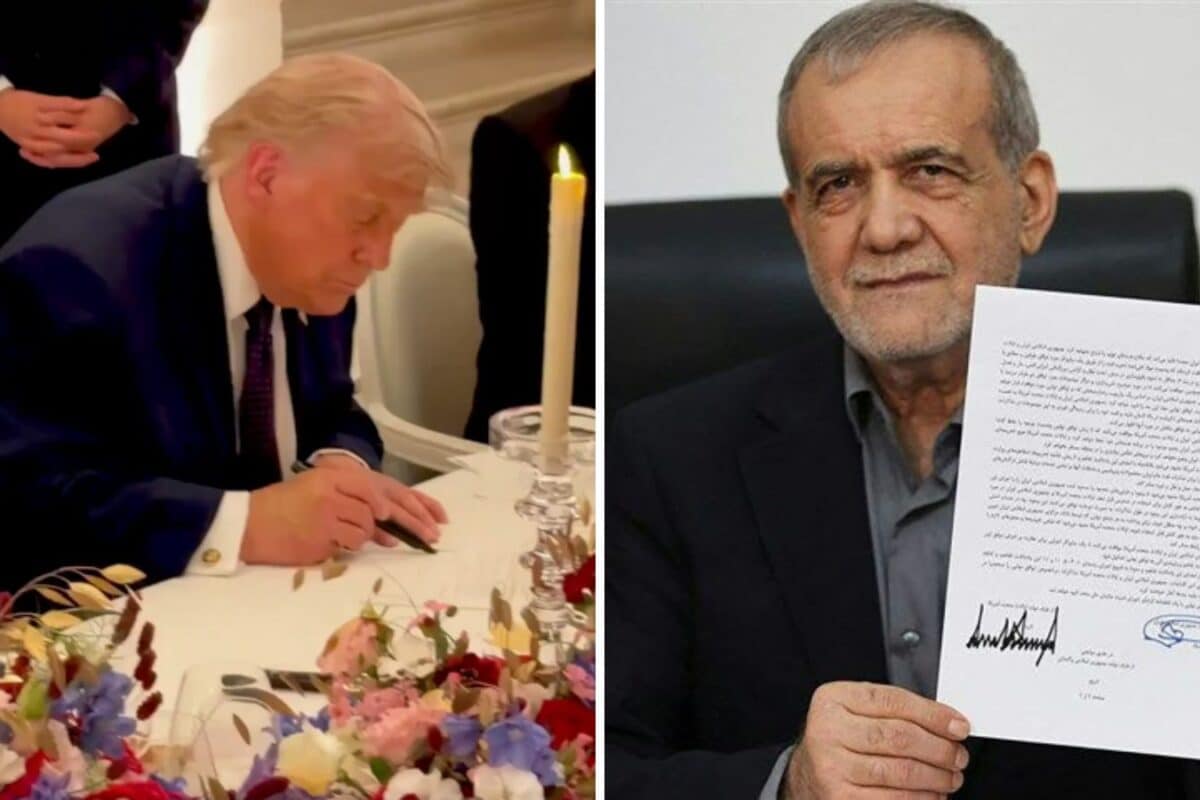
What Happens To The 50,000 US Troops In West Asia? Clause 4 Of Iran MoU Raises Questions Published By, Last Updated: June 18, 2026, 17:57 IST Under the MoU, Tehran and Washington have committed to negotiating and concluding a comprehensive deal within 60 days, with the deadline extendable by mutual consent. Donald Trump signing of a deal with Iran to end the Middle East war inside the Chateau de Versailles, in Versailles (R). Iran's President Masoud Pezeshkian holding a document showing a memorandum of understanding he signed to end the Middle East war. The United States and Iran have signed a 14-point Memorandum of Understanding (MoU), ending weeks of uncertainty over the conflict in West Asia. Documents released by both sides show that the US has agreed to withdraw its forces from the “proximity" of Iran within 30 days of a final agreement being signed. Under the MoU, Tehran and Washington have committed to negotiating and concluding a comprehensive deal within 60 days, with the deadline extendable by mutual consent. The two countries, along with their respective allies, have declared “an immediate and permanent termination of military operations on all fronts, including in Lebanon". They have also pledged not to initiate military action against each other and to respect Lebanon’s territorial integrity and sovereignty. Iran, for its part, has committed to ensuring the safe passage of commercial vessels through the Persian Gulf and the Sea of Oman for 60 days without charges.
Maritime traffic will resume immediately and is expected to be fully restored within 30 days after the Strait of Hormuz is cleared of mines. How Many US Troops Are Deployed In Middle East? The United States currently has more than 50,000 troops deployed across the Middle East following the recent buildup during the conflict with Iran. America’s first major presence in the region came during World War II, when it established the Persian Gulf Command in 1942 and deployed thousands of personnel to Iran and Iraq to operate the “Persian Corridor", a key supply route to the Soviet Union. Modern US military involvement began in 1958, when President Dwight D. Eisenhower launched Operation Blue Bat and sent around 14,000 troops to Lebanon, marking the emergence of the US as the dominant Western military power in the region. Washington avoided large permanent deployments until the 1980s, when the Iran-Iraq War prompted Operation Earnest Will in 1987 to protect oil tankers in the Persian Gulf, entrenching America’s role as a guarantor of maritime security. The biggest expansion came after Iraq invaded Kuwait in 1990. Under Operation Desert Shield, the US deployed over 500,000 troops to the Gulf and, after the war, established long-term bases in countries such as Qatar and Bahrain. These bases became the foundation of the extensive US military presence that continues today.
What Happens To US Troops Now? Despite the signing of the MoU, US troops are not expected to leave the Middle East immediately. The agreement is only an initial framework, with a 60-day window set aside to negotiate a final deal covering issues such as Iran’s nuclear programme and the complete lifting of US sanctions. During this period, Washington has committed not to deploy additional forces to the region. Any troop withdrawal is tied to the final agreement, not the current MoU. Once a comprehensive deal is signed, a 30-day countdown will begin for the redeployment of US forces from the “proximity" of Iran. However, the wording of the MoU leaves several questions unanswered. It calls for the withdrawal of forces from the “proximity" of Iran rather than from the Middle East as a whole. The US maintains military bases in Oman, Iraq, Kuwait, Bahrain, the UAE and Saudi Arabia — all countries that host American forces and were targeted by Iran during the recent conflict. As a result, defining what constitutes “proximity" to Iran is likely to become a key issue during negotiations. While the agreement points to a reduction in the American military footprint around Iran, it does not necessarily imply a complete US withdrawal from the region. What Trump Said About Troop Withdrawal On June 7, US President Donald Trump said he had no plans for an immediate withdrawal of American troops from the region.
“I think we’ll keep them there until such time as we have a completion," Trump told NBC News. “It costs us very little to keep them there," he added. For now, the agreement signals a de-escalation rather than a complete end to America’s decades-long military footprint in the Middle East. News18 Newsletter Handpicked stories, in your inbox A newsletter with the best of our journalism submit About the Author Saurabh Verma Senior Sub-editor Saurabh Verma covers general, national and international day-to-day news for News18.com as a Chief Sub-editor. He keenly observes politics. You can follow him on First Published: June 18, 2026, 17:57 IST News world What Happens To The 50,000 US Troops In West Asia? Clause 4 Of Iran MoU Raises Questions Disclaimer: Comments reflect users’ views, not News18’s. Please keep discussions respectful and constructive. Abusive, defamatory, or illegal comments will be removed. News18 may disable any comment at its discretion. By posting, you agree to our Terms of Use and Privacy Policy Loading comments...
 The BriefWire