'US, India In A Foot Race On AI': E US Envoy Says Modi-Trump Meeting Signals Bigger Tech Push
'US, India In A Foot Race On AI': E US Envoy Says Modi-Trump Meeting Signals Bigger Tech Push Published By, Edited By Last Updated: June
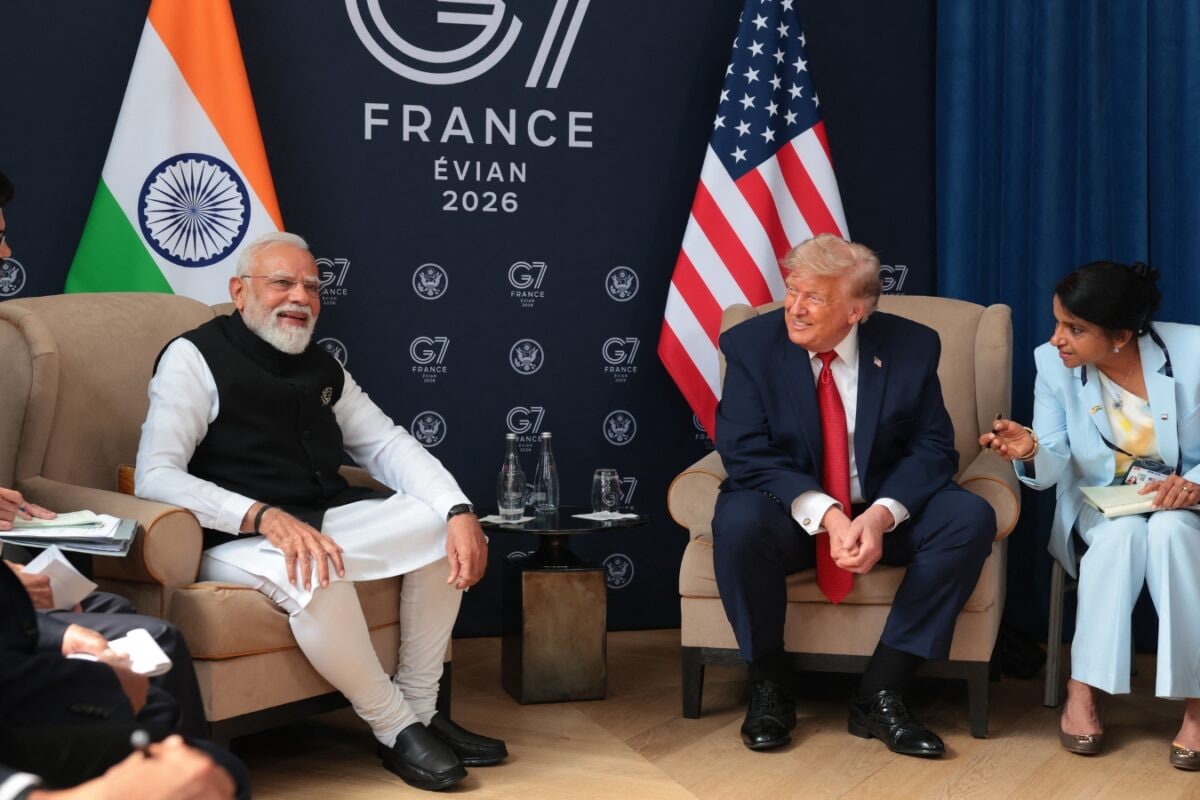
'US, India In A Foot Race On AI': E US Envoy Says Modi-Trump Meeting Signals Bigger Tech Push Published By, Edited By Last Updated: June 17, 2026, 22:10 IST US Ambassador Atul Keshap says India and America are racing China on AI, with 11,000 of 12,000 tariff lines cleared and a $500 billion trade framework within reach. Rapid Read U.S. President Donald Trump (C-R) and Indian Prime Minister Narendra Modi during a bilateral meeting at the G7 Summit on June 17, 2026 in Evian-les-Bains, France. Leaders from the Group of 7 (G7) countries convened in Evian, France, near the Swiss border, for their annual summit to discuss challenges to peace and security for Ukraine and Europe, the situation in the Middle East, and other geopolitical issues. (Image Courtesy: Anna Moneymaker/AFP) US Ambassador to India Atul Keshap said Wednesday that the first face-to-face meeting between Prime Minister Narendra Modi and President Donald Trump since February 2025 puts the world’s two largest democracies in position to finalise a trade framework worth up to $500 billion, even as he warned that the two countries are in a direct AI competition with rival powers that neither can afford to lose. Keshap, now President of the US-India Business Council (USIBC), made the remarks in an exclusive interview with CNN-News18, speaking from a moment of rare bilateral momentum: the India-UK trade deal is set to take effect on July 15, and US Trade Representative Jamieson Greer is expected in New Delhi next week to work through the final thousand of the 12,000 tariff lines on the table.
#TheRightStand | “When the leaders of the world’s two biggest democracies meet and hold talks, it sends a very powerful signal to the rest of the world.." says AMB (R) Atul Keshap @AnchorAnandN ‘Powerful & Positive Symbol To The World’ Keshap was unambiguous about the France summit’s significance. “It sends a very powerful and positive signal to the world that our two countries are talking," he told CNN-News18. The meeting came after months of tough negotiations and a gap of nearly four months since the two leaders last met in person, a stretch during which the absence of any formal trade architecture between Washington and New Delhi had become an increasingly visible problem for businesses on both sides. 11,000 of the 12,000 tariff lines between the two countries are now resolved. The remaining thousand, Keshap suggested, need a particular kind of discipline. “Isolate wherever there are disagreements or problems that cannot be overcome for a future date," he said, “but at least put together the vast majority of the tariff lines in a way that can empower and unlock even greater prosperity for both countries." Greer’s arrival next week will test whether that discipline holds. No Framework Means No Recourse The absence of a bilateral trade framework is not an abstract problem.
Right now, Indian companies operating in the United States and American companies operating in India have no formal recourse when disputes arise. Keshap described that gap as the single biggest obstacle to growing the relationship to its stated $500 billion target. “The most important thing about the agreement is that it creates predictability," and “a framework for investors and traders in both directions," he said. Without it, the confidence necessary for trade to scale simply does not exist. AI, Energy, Nuclear, & Defence Keshap went beyond trade to name four areas where he said the two countries have the least margin for error: artificial intelligence, energy, nuclear cooperation, and defence. On AI, he said, “The US and India are in a foot race together on AI against other rival powers and it is important that we get it right," he said. That foot race also connects to India’s energy needs. Powering an AI-capable India at scale will require the kind of energy and nuclear cooperation that only a partnership with the United States can fully provide, he added. “India is rising rapidly on the global stage," Keshap said. “We need to ensure that India and America win the AI race against China while also helping power India’s future." Greer lands next week.
The clock on that race is already running. News18 Newsletter Handpicked stories, in your inbox A newsletter with the best of our journalism submit About the Author Anoshito Banerjee Anoshito Banerjee is a digital journalist at CNN-News18, specialising in Indian foreign policy, global diplomacy, South and West Asian geopolitics, and strategic affairs. His reporting spans hard news... Read More First Published: June 17, 2026, 22:06 IST News india 'US, India In A Foot Race On AI': E US Envoy Says Modi-Trump Meeting Signals Bigger Tech Push Disclaimer: Comments reflect users’ views, not News18’s. Please keep discussions respectful and constructive. Abusive, defamatory, or illegal comments will be removed. News18 may disable any comment at its discretion. By posting, you agree to our Terms of Use and Privacy Policy Loading comments...
 The BriefWire