Ebola and the US patient spotlight global health 'injustice'
The story of the US doctor who survived Ebola with experimental treatment in Germany highlights wider inequities in global health. It also reveals how sharply
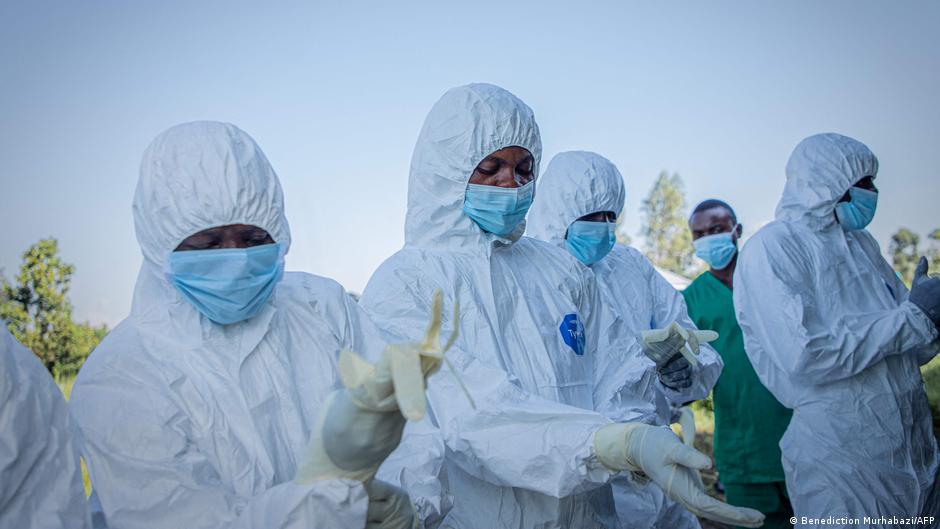
The story of the US doctor who survived Ebola with experimental treatment in Germany highlights wider inequities in global health. It also reveals how sharply medical standards can differ between African countries. "It was heartbreaking to see what was going on in the Democratic Republic of the Congo and, at the same time, to see how many resources can be mobilized to get this one patient from the DRC to Germany," said Thomas Cronen, a senior physician and infectious diseases expert in intensive care at the Charité — Berlin University Hospital. Cronen and his colleague Maximilian Gertler were in Nairobi, Kenya, when we spoke. They were there to exchange knowledge about treating Ebola with 50 clinicians from the eight member states of the East African Community (EAC). We had got onto the topic of the US-American missionary medic, Peter Stafford, who was evacuated from the DRC in mid-May for treatment at the Charité because, as the US government said at the time, Germany was closer than the US. Others speculated that the Trump administration refused to allow Stafford into the US, with Secretary of State Marco Rubio later promising to keep all cases of Ebola out of the country. Stafford had been helping people with Ebola in the DRC when he contracted the highly contagious and often-fatal disease. In Berlin, Stafford received an "experimental" treatment — experimental only in the sense that the drug, known as MBP-134, is still in clinical trials and has not been approved for human use. Reports at the time made it sound as though he could only have received the treatment outside of Africa. This was not strictly true. In an emergency meeting on May 15, 2026 — before Stafford's evacuation — the World Health Organization and the Africa Centres for Disease Control and Prevention had decided to prioritize two drugs for experimental treatment in the DRC Ebola outbreak, one of which was MBP-134.
What exactly is MBP-134? MBP-134 is a combination of two antibodies that were taken from a survivor of a West African Ebola outbreak that began in 2013. The antibodies in MBP-134 are reproduced in a lab and are, therefore, known as monoclonal antibodies (or mAbs). Monoclonal antibodies have been around since the 1980s. The first was approved as a drug to prevent kidney transplant rejection. However, it is only in the past 10 years that we've seen a growth in their use, from 30 approved mAbs in 2014 to about 144 approved mAbs by 2025. One of the most talked about uses of monoclonal antibodies is the drug lecanemab for Alzheimer's, a form of dementia. In that sense, mAbs offer many novel treatments in medicine. They are still not as widespread as they could be. In lab studies, MBP-134 has been tested on ferrets and cynomolgus monkeys, both of which survived infections with different Ebola-causing viruses, including Bundibugyo, which caused the 2026 DRC outbreak. It has also been tested in humans. So, MBP-134 was known to be a promising drug. But access to monoclonal antibodies in Africa is limited. "It takes more than a drug," said Gertler, an epidemiologist and tropical and emergency medicine expert, with years of experience in the field. "These medications require a certain level of clinical care, a setting where you can store them, where you can properly provide it to the patients, where you can monitor the medication," he said. The other drug deemed suitable for trial in the DRC outbreak was Remdesivir. Remdesivir is an antiviral originally developed as a potential treatment for hepatitis C and later tested against COVID-19 during the pandemic. The 'injustice is obvious' Cronen and Gertler saw a clear case of inequity between German or European hospitals and the conditions they knew in East Africa.
Even among the EAC nations, standards differ. Rwanda, for example, has "a higher level of care available" compared to South Sudan, said Cronen. "Questions come up and there isn't always a good answer. You can recommend certain other diagnostics. For instance, if they say, 'We don't have a CT scan,' we teach them that in certain situations, you can use an ultrasound machine since ultrasound machines are more readily available than CT scans." There is, agreed Cronen, an injustice in global public health. "It's obvious. But when you look at other diseases [other than Ebola], you have this injustice as well. If you look at what we are investing in oncology, hematology, what we are able to treat for hundreds of thousands of dollars... And here that's absolutely not possible. It's so clear to everyone," Cronen said. How Africa manages despite foreign aid cuts African nations and their medics have handled Ebola epidemics in the past, despite the obvious differences — the lack of money, medical machines and medicine. "[Past] Ebola outbreaks — whether it was 20 cases or 30,000 cases — were all contained by non-pharmacological measures, by collaboration between research, public institutes and populations," he said. "Cases were isolated, contacts were traced, and health education was implemented. We can do quite a lot about epidemics if we really want and if we collaborate." But that spirit of collaboration appears to be in retreat. The US is again considering cuts to foreign financial assistance, with a proposal to fundamentally change how the US Office of Management and Budget awards grants. In short, and if the new rules are brought into effect, no money will be allowed to leave the US unless it explicitly helps Americans in America.
That's in addition to the US having already cut 83% of USAID programs and withdrawn from the WHO. And few European countries stepped up to fill the gap. "This epidemic evolved on a fertile ground of instability, insufficient healthcare. Healthcare and monitoring have been weak for years. And they have been weakened again by these cuts," said Gertler. "We know from colleagues — and I know it from my stay in DRC in 2025 — healthcare centers have closed; many staff contracts were not extended; cuts in stocks of medication. All this has been visible over the past year." These effects may soon also be felt elsewhere. "When it comes to diseases with epidemic potential," said Gertler, "there's also a public interest far away from the outbreak region." We saw that during COVID, when a local outbreak became a regional epidemic and then a global pandemic. More recently, we saw people's fear in Spain when the Caribbean cruise ship carrying hantavirus patients docked at the Canary Islands. And it appears the Trump administration knows it, too. Perhaps that's why they wanted Stafford to receive his treatment anywhere but in the US. "It is painful to see," said Gertler. "Yes, the [Ebola] diseases are rare. But we must raise the question as physicians and witnesses of this situation: Why do we stand by so blankly?" Edited by: Richard Connor
 The BriefWire