Mithun Chakraborty: The unsung hero of BJP's West Bengal blockbuster show
"In 2026, the masnad (throne) will be ours [BJP's], and we will do everything to achieve the goal." That was what Mithun Chakraborty predicted after
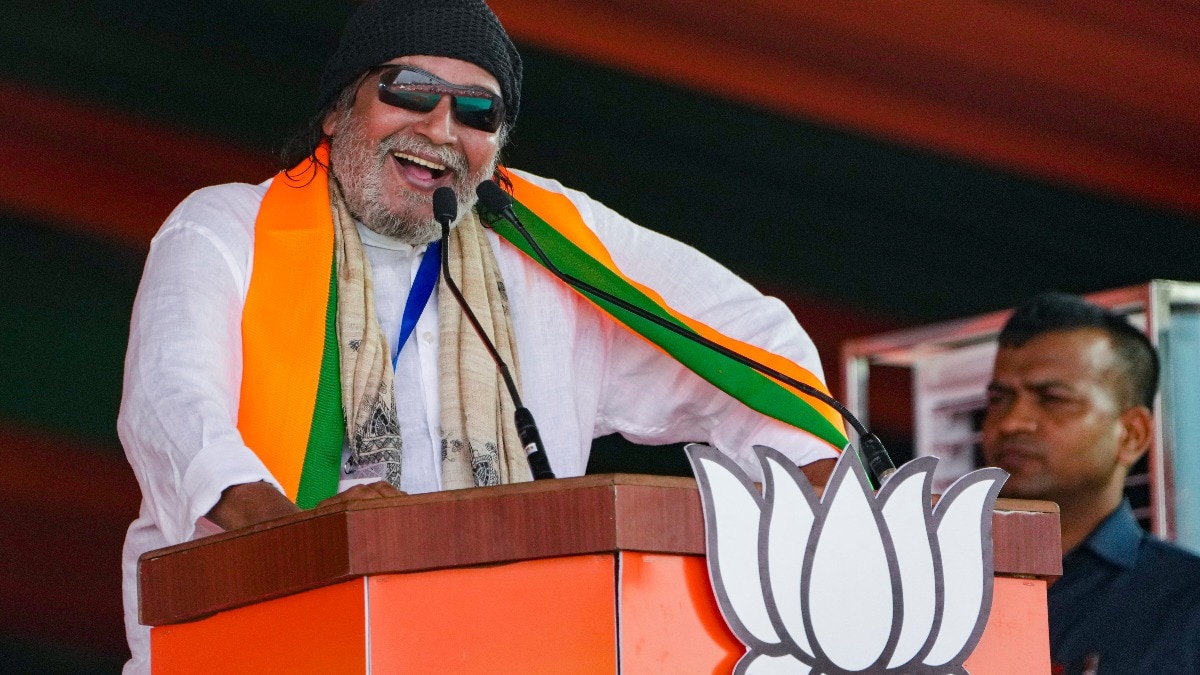
"In 2026, the masnad (throne) will be ours [BJP's], and we will do everything to achieve the goal." That was what Mithun Chakraborty predicted after the BJP's setback in West Bengal in the 2024 Lok Sabha election. The BJP did ascend the Bengal throne in 2026. And Mithun emerged as one of the silent heroes of the victory. It's been over a month since the BJP won the Bengal Assembly polls, ending the TMC's 15-year rule. But in the saffron party's breakthrough victory, Mithun Chakraborty stands out as the figure whose role has not been discussed much. Read Full Story Mithun, fondly known as Mithun Da, embodied the overlap between Bengal's cultural influence and politics. Throughout the Assembly polls, Mithun did not operate like a conventional neta. It was his screen legacy and the nostalgia attached to it that stayed alive in public memory. While the BJP's campaign itself revolved around Prime Minister Narendra Modi as the party's central face, anti-incumbency sentiment, and the BJP's long push into Bengal, Mithun's contribution seemingly worked in different ways. He was not the loudest voice in the room, nor the most visible face on the ground. His presence, though, seemingly had emotional familiarity, especially among millennials and older Bengali voters who grew up watching him dominate cinema screens through the 1980s and 1990s. Mithun is the Mahanayak. In Bengal, where cinema and politics have historically overlapped, that kind of recall matters a lot. The optics after the BJP's victory, with Mithun standing beside Modi and the Prime Minister leaning in to whisper in the veteran actor's ear, became symbolic in itself. Such proximity to the top leadership is often read as a marker of value and trust. In politics, these visuals carry their own weight beyond formal roles. That positioning also sits within his broader connect with the RSS. In 2019, he met RSS Sarsanghchalak Mohan Bhagwat at the RSS headquarters in Nagpur for an hour-long discussion. In February 2021, he hosted Bhagwat for breakfast at his Mumbai residence. The BJP tried to make inroads into West Bengal for decades, struggling to move beyond single-digit seat tallies. In that context, Mithun's proximity to the party's top leadership suggested that even if he did not campaign extensively, he was viewed as more than a celebrity face — someone who could help soften the BJP's image in a state that has been resistant to BJP's brand of politics.
Ahead of the 2026 Bengal Assembly election, Mithun took a hard stand against illegal immigration from Bangladesh. "As long as people like Mithun Chakraborty have a drop of blood in their body, this state will never become Bangladesh," he said. After the results, it seems even his son, Mahaakshay Chakraborty, by sheer coincidence, is also witnessing a better time professionally. Mahaakshay-starrer Haunted 3D: Echoes of the Past has performed better-than-expected at the box office. MITHUN'S JOURNEY FROM A NAXAL TO A FILMSTAR TO A POLITICIAN Mithun Chakraborty's own journey has seemingly mirrored Bengal's political moods. Both have shifted quite drastically over the decades. Born Gouranga Chakraborty in Kolkata in 1950, he was briefly associated with the Naxalite movement during the turbulent late 1960s and early 1970s. Like many young Bengalis of that generation, he was drawn toward radical Left politics at a time when rebellion carried intellectual and emotional appeal. Personal tragedy was involved, and accounts mention the death of his brother in an accident, which reportedly pushed him away from that Naxal world. Cinema is where he reinvented himself. After training at FTII Pune, he made a remarkable debut in Mrinal Sen's Mrigayaa (1976), playing a tribal hunter trapped within structures of exploitation and power. The role earned him the Film Award for Best Actor and immediately established him as a serious performer. Interestingly, his early filmography still reflected the anti-establishment themes that aligned with his youthful politics. Even The Naxalites (1980) kept him connected to that imagery of rebellion. But Mithun's true transformation came in the 1980s, when he shifted from parallel cinema to mass stardom. Disco Dancer (1982) turned him into a phenomenon not just in India, but across the Soviet Union and parts of Eastern Europe. Suddenly, he was no longer merely an actor with critical acclaim. He had become a pop-cultural export. In 2024, he was awarded the prestigious Dadasaheb Phalke award. Unlike many stars who remained confined to metropolitan audiences, Mithun's appeal spread deep into smaller towns and working-class belts in Uttar Pradesh, Bihar, and West Bengal. That became especially important in his home state. By the 2000s, Bengali cinema was going through one of its many identity crises, caught between fading mainstream formulas and niche urban storytelling. Mithun stepped into that vacuum with films like Yuddho (2005), MLA Fatakeshto (2006), and Tulkalam (2007). Critics in elite circles often dismissed these films as loud or unsophisticated, but they connected powerfully with audiences across West Bengal.
Mithun was following a formula here. He played men who fought corrupt systems, protected families, defended women, and punished political wrongdoing. He was often framed less as a glamorous superstar and more as a dependable elder-brother figure. He was angry, emotional, and morally certain. That image translated surprisingly well into politics. MITHUN CHAKRABORTY'S NON-LINEAR POLITICAL JOURNEY Mithun Chakraborty's political journey has never been ideologically linear. In 2014, Mamata Banerjee nominated him to the Rajya Sabha as a Trinamool Congress (TMC) representative. At the time, he was seen as close to the TMC ecosystem and had even reportedly played a mediating role between Mamata Banerjee and Pranab Mukherjee during the 2012 presidential elections. But by 2021, Bengal's politics had changed dramatically. The BJP was aggressively attempting to position itself as the primary challenger to the TMC, and Mithun joined the party at a high-profile rally attended by PM Modi in Kolkata. His induction immediately generated buzz, because he brought something the BJP had long struggled to cultivate in Bengal. Organic cultural familiarity. At one point, he even showed CM ambitions, but it seemingly died down. On the sidelines of a conclave of ABVP, the RSS's students' organisation, in Kolkata in 2023, Chakraborty declared that he would change West Bengal in six months if he became CM. Unlike imported campaigners or purely ideological faces, Mithun already belonged to Bengal, and had an emotional connect. Just two years before this, during the 2021 campaign, he was already leaning heavily into his cinematic identity, using famous dialogues and punchlines from his films to energise election rallies. "Ami joldora o noi, belebora o noi. Ami ekta cobra. Ami jaat gokhro, ek chhobol-ei chhobi." [I am neither a harmless water snake, nor a grass snake. I am a pure cobra. One bite, and you become a photograph (dead).] "Marbo ekhane, lash porbe shoshaney." [I will hit you here (on the spot), but your dead body will fall in the crematorium.] There was energy around the campaign, but the BJP lost the polls. But it significantly expanded its footprint in the state. Mithun's role was not necessarily measurable in seats, but it definitely helped the party appear less alien to sections of Bengali voters. By 2026, his campaigning was understandably less intense. Age had reduced the relentless roadshow politics and political attacks seen in 2021. Yet his symbolic value arguably increased. Even limited appearances generated attention. When he voted in Belgachia and publicly expressed confidence about the BJP's prospects, it reinforced the sense that he was emotionally invested in the BJP's Bengal goal.
And after the victory, the optics mattered once again. Mithun in his signature maroon beret with a star insignia and silver goggles, his towering frame beside PM Modi, as the Prime Minister warmly patted his arm, speaking to him, congratulating him. The visuals went viral. MILLENNIALS STILL REMEMBER MITHUN, HIS FILMS, AND THE NOSTALGIA ATTACHED TO THEM Mithun's appeal today is rooted less in Gen Z and more in generational memory. Millennials and older audiences remember Mithun as a constant presence during the era of VHS tapes, satellite television, and dubbed action cinema. In many households across eastern India, his films played repeatedly for years. Even when critics mocked the low-budget aesthetics of some of his films, audiences remained loyal because Mithun represented resistance, masculinity, family honour, and survival. Critics argue that his switches between parties reflect opportunism. Instead, with the BJP, he positioned himself as a loyal campaigner who repeatedly said he was "not a leader" but someone following one — PM Modi. As a matter of fact, after the BJP's drubbing in the 2021 Assembly and the 2024 Lok Sabha elections, while several familiar faces deserted the party, Mithun remained loyal. In some of the election rallies that he addressed ahead of the 2026 Assembly election, he was very vocal against illegal immigration, which was one of the biggest poll planks of the BJP in Bengal. "Attempts are being made to turn West Bengal into West Bangladesh," Mithun said at an election rally in January in Cooch Behar. "They may think it has become Bangladesh, but that day will never come. As long as people like Mithun Chakraborty have a drop of blood in their body, this state will never become Bangladesh. We believe in the Constitution, and that is why we have kept ourselves under control," he said. But ultimately, Mithun Chakraborty's political relevance lies not in vote-banks, but in what he represents. The BJP's Bengal victory was built by deep strategy and organisational efforts of decades, but it was also helped by people like Mithun with whom the voters could emotionally, beyond the party's ideology. Mithun was one of the silent heroes in the BJP's Bengal sweep. Ends
 The BriefWire