Monica Juma: Steering global cooperation at a time of converging threats
The new head of the United Nations Office on Drugs and Crime says global cooperation is essential and already adapting as criminal networks become more
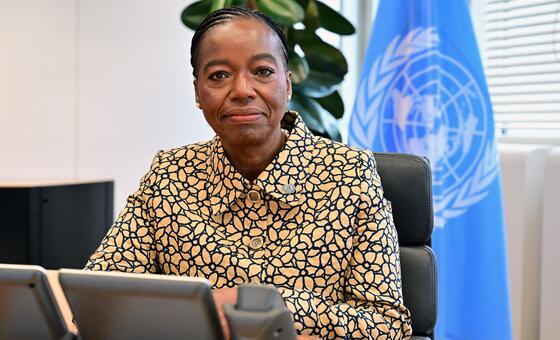
The new head of the United Nations Office on Drugs and Crime says global cooperation is essential and already adapting as criminal networks become more complex, sophisticated and interconnected. Monica Juma has taken up the dual role of Executive Director of the United Nations Office on Drugs and Crime and Director-General of the United Nations Office at Vienna. A former national security adviser, minister, diplomat and academic, she brings experience spanning defence, security, foreign affairs and multilateral cooperation. Ahead of the UN Crime Congress in Abu Dhabi, she is calling for stronger cooperation to confront organized crime, corruption, terrorism, trafficking and technology-enabled threats. After decades in public service in her home country, Kenya, Monica Juma now steps onto a wider stage, assuming two of the United Nations’ most consequential roles As Director-General of the UN Office at Vienna (UNOV), she represents the Secretary-General in one of the Organization’s major duty stations beyond its New York Headquarters. And as Executive Director of the UN Office on Drugs and Crime (UNODC), she leads global efforts to strengthen crime prevention and criminal justice. That mandate, she told UN News, is rooted in helping countries confront drugs, corruption, terrorism, human trafficking and transnational organized crime – with the ultimate aim of delivering “safety, protection and justice for all”. Juma formally took office last month and was sworn in by Secretary-General António Guterres last Thursday, succeeding Ghada Fathi Waly of Egypt. She says she was honoured to take on the dual role “at a critical time for multilateralism” and looked forward to contributing to the UN’s efforts to build “a safer, more just world”. UN Photo/Manuel Elías Experience in security, diplomacy and governance Few arrive in Vienna with as broad a portfolio of experience.
Before joining the United Nations, Ms. Juma served as Kenya’s first Security Adviser and Secretary to the Security Council. Earlier roles included senior ministerial and principal secretary positions across foreign affairs, defence, interior and energy. Her career has also been shaped by multilateral diplomacy and academic research. In her interview, she reflected on the value of “multi-agency cooperation” in managing complex challenges. As national security adviser, she said, she closely tracked “trends of risks, vulnerabilities and opportunities” at national, regional and global levels. That experience, she hopes, will help her build the consensus required among Member States, particularly in a system where progress often depends on a shared understanding of what constitutes the “global public good”. A mandate that meets the moment After her first weeks in office, Ms. Juma said her initial impressions were encouraging. She pointed to what she described as a “general consensus” around UNODC’s “value proposition” – namely, that its mandate is highly relevant “in terms of the risk portfolio that is facing the world over”. At the heart of that consensus, she said, is a growing recognition that “no single sector, no single country, no single region can do it alone”, a realization that forms “a nucleus for building stronger international cooperation and multilateralism”. She also underlined the strength of the institution itself, describing UNODC staff as “a cohort of extremely competent professionals who are at the forefront” of efforts to make communities safer, protect people and advance sustainable development, “and that gives me hope”. That optimism, however, is tempered by the speed at which threats are evolving. Criminal networks now operate across borders, sectors and technologies. Drug trafficking, illicit financial flows, money-laundering, corruption, trafficking in persons and terrorism are increasingly intertwined, “creating webs of engagement” that demand equally connected responses.
In her engagements with partners, she has sensed “a big appetite to contribute positively to the work of UNODC”, particularly in sharing “the right information in a world that is characterized by disinformation”, and in helping Member States make informed decisions. Yet she also pointed to structural challenges. Much of UNODC’s work relies on voluntary, often tightly earmarked funding, while the threats it addresses remain fluid and adaptive. Transnational organized crime, she noted, “goes into ungoverned spaces and can manipulate those spaces”. To keep pace, she argued, donors must be encouraged to adopt a broader perspective — moving beyond “pet projects” and towards more flexible support that allows the Office to scale up its impact in line with the accelerating nature of global risks. UN Photo/Eskinder Debebe Looking to Abu Dhabi This shifting landscape will shape the next United Nations Crime Congress, to be held in Abu Dhabi in September. Convened every five years, the Congress provides a forum for governments and partners to assess trends in crime prevention and criminal justice, and to set priorities for the years ahead. Ms. Juma said it will offer Member States the opportunity to devise plans and “lay the framework” for future cooperation. She pointed to the recent unanimous adoption of three resolutions – sextortion, fraud and trafficking in persons for criminal activity – at the Commission on Crime Prevention and Criminal Justice (CCPCJ) in Vienna as evidence that, even under pressure, multilateralism can still deliver consensus. The Abu Dhabi gathering is expected to bring together a wide range of actors, including Governments, the private sector, civil society, young people and women’s groups. That breadth, she said, is essential, given that effective criminal justice depends on cooperation across investigations, evidence collection, prosecution, digital forensics, asset recovery and legal assistance.
“So, it is a whole ecosystem that we have to think about.” Governing technology in a fast-moving world Among the issues rising to the top of the agenda is the impact of the digital age. Juma described technology as “a double-edged sword”, noting that “the reality is that innovation is running ahead of governance”. Bridging that gap, she said, will require closer collaboration between governments and industry. The questions facing policymakers are both immediate and far-reaching: what constitutes ethical artificial intelligence; how technology can safeguard human rights and dignity; and how countries with fewer resources can build the capacity to respond. “AI-aided” trafficking, she noted, is already reshaping patterns of criminal activity and prompting new coalitions of response. The aim in Abu Dhabi, she added, is not simply to “just discuss the problems”, but to secure commitments to “concrete activities that will follow through the Abu Dhabi Declaration”. A message beyond Vienna Beyond the formal responsibilities of her post, Ms. Juma is acutely aware of the symbolic weight of her appointment. Many of the messages she received, she said, came from young people and women, particularly in Kenya and across East Africa, expressing a sense of pride and possibility. Her appointment, she reflected, is also a recognition of the region’s capacity to contribute to global governance through the United Nations. Her ambition now is to “vindicate their confidence” by helping UNODC expand its reach and effectiveness in line with the pace of today’s challenges, while keeping justice, protection and human dignity at the centre of its work.
 The BriefWire