If You Can't Beat Them, Copy Them: US Copies Iran's Playbook To Move Oil Through Hormuz
If You Can't Beat Them, Copy Them: US Copies Iran's Playbook To Move Oil Through Hormuz Published By, Last Updated: June 16, 2026, 23:48 IST
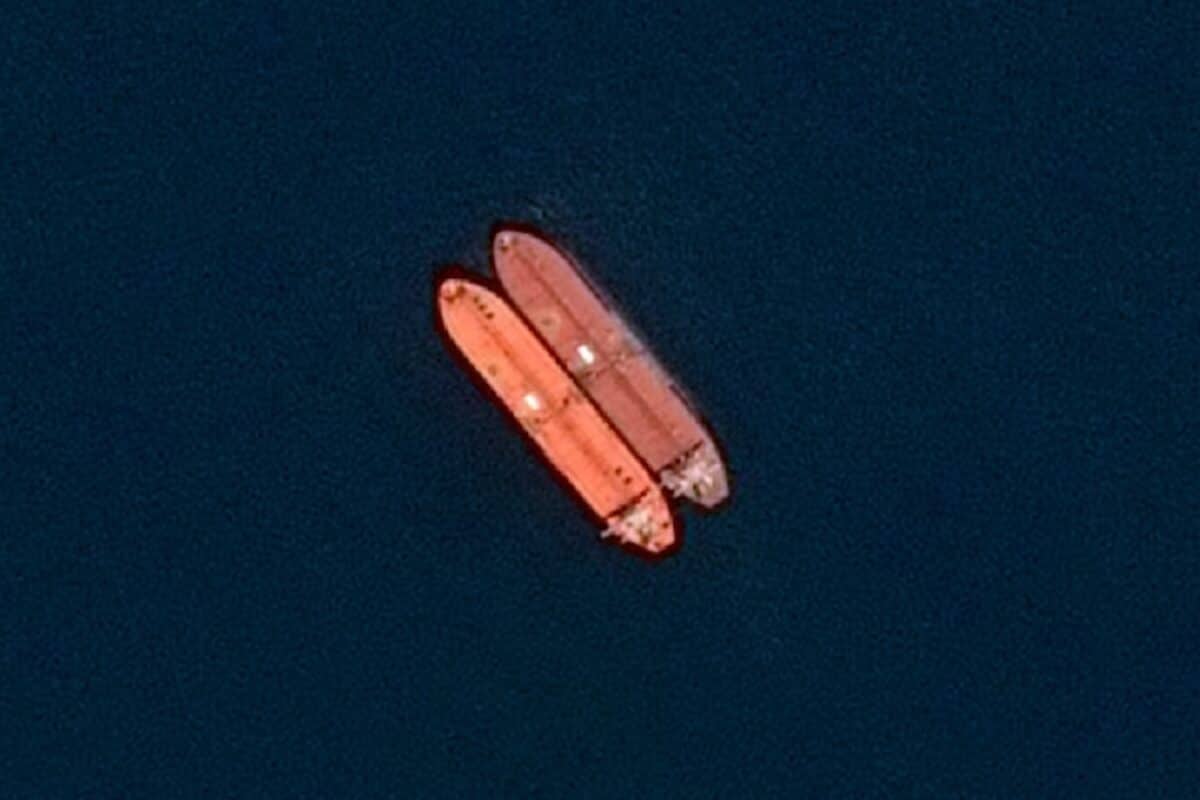
If You Can't Beat Them, Copy Them: US Copies Iran's Playbook To Move Oil Through Hormuz Published By, Last Updated: June 16, 2026, 23:48 IST The US military has run covert ship-to-ship oil transfers near the Strait of Hormuz since May, using a tactic Iran pioneered to dodge sanctions A satellite image of side-by-side ships at sea, off the coast of Sohar, Oman, June 9, 2026. (Image Courtesy: Airbus via Reuters) The United States military has been overseeing a covert operation since early May to move Gulf oil out of the Strait of Hormuz through secretive ship-to-ship transfers, borrowing a leaf from Iran’s guidebook on bypassing international sanctions, Reuters reported Monday. The operation, run near the exit of the strait off the coasts of the UAE and Oman, has involved at least 92 ships and may have moved roughly 90 million barrels of crude oil and petroleum products since it began, according to satellite imagery and shipping data reviewed by Reuters. How The Operation Works The mechanism is deliberately covert. Tankers sail to a designated meeting point before the strait, stagger their departures roughly 3,000 to 4,000 meters apart, kill their transponders, and dim their lights. They then proceed to one of two transfer sites, one off Fujairah in the UAE and another off Oman’s port of Sohar, where they pull alongside Very Large Crude Carriers and pump across their cargo.
Each transfer takes between 24 and 40 hours, after which the empty tankers then shuttle back through the strait, while the loaded carriers sail onward. Eight sources, including a private security contractor directly involved in the transfers, told Reuters that the operation is fully controlled by the US military. Operators seeking access must submit geospatial tracking histories, beneficial ownership disclosures, and cargo documentation to the US Navy’s Naval Cooperation and Guidance for Shipping office in Bahrain, and are assigned transit windows only after clearing a compliance review. The Apache Connection An Apache helicopter that was shot down by Iran on June 9, which then triggered retaliatory US bombings, was involved in the same mission, according to four sources including a former US official with knowledge of the attack. Both crew members were rescued by a drone boat. Reuters counted six pairs of tanker ships clustered together off Sohar the day the Apache was downed. A US defense official said that no Central Command forces were participating in any offshore ship-to-ship oil transfer operation. Reuters could not independently confirm the role played by the gunship. Iran’s Own Tactic, At Scale The ship-to-ship transfer technique is not new. Iran has used it for years to move oil under sanctions, typically running one pair of ships at a time to avoid detection, given its relatively low prewar export volumes.
The US-led operation runs scores of pairs simultaneously. As recently as June 11, satellite images reviewed by Reuters showed 17 pairs of ships carrying out simultaneous transfers at the two sites. Michael Froman, president of the Council on Foreign Relations, noted the ironical elements in a note on Friday, “the United States has adopted the same dark fleet techniques that China, Russia, North Korea, and Iran pioneered to evade American and UN sanctions." Risks And Limitations The operations do carry real dangers however. Ships travel at night with transponders off and lights dimmed, at speeds that leave little room for manoeuvring, raising the risk of collision, according to multiple shipping industry officials. Iranian drone and missile attacks remain a live threat. “You just don’t know when Iran might just decide to start using drones or even gunboats in order to prevent even those ships from transiting the strait," Noam Raydan, a senior fellow at the Washington Institute who specializes in maritime risk, told Reuters. UAE state oil company ADNOC has been among the most active participants, according to six sources. The Kuwait Oil Tanker Company has also been involved; on June 6, around 2.3 million barrels of crude were transferred from one of its vessels off Sohar, with the receiving ship subsequently tracked heading for China. The volumes moved, while significant, remain well short of the pre-blockade average of 20 million barrels that passed through the strait daily.
Trump said this week the strait would reopen Friday under a framework peace deal with Iran, though details remain vague and Reuters could not determine whether the announced deal has affected the transfer operation. “I don’t see a permanent solution in all of this," Raydan said. “This is a temporary solution amid exceptional times." News18 Newsletter Handpicked stories, in your inbox A newsletter with the best of our journalism submit About the Author Anoshito Banerjee Anoshito Banerjee is a digital journalist at CNN-News18, specialising in Indian foreign policy, global diplomacy, South and West Asian geopolitics, and strategic affairs. His reporting spans hard news... Read More First Published: June 16, 2026, 23:35 IST News world If You Can't Beat Them, Copy Them: US Copies Iran's Playbook To Move Oil Through Hormuz Disclaimer: Comments reflect users’ views, not News18’s. Please keep discussions respectful and constructive. Abusive, defamatory, or illegal comments will be removed. News18 may disable any comment at its discretion. By posting, you agree to our Terms of Use and Privacy Policy Loading comments...
 The BriefWire