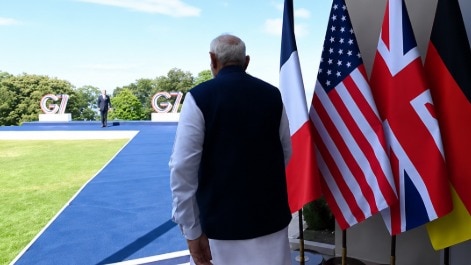
What is the blue carpet that PM Modi walked on at the G7 summit in France?
When French President Emmanuel Macron welcomed Indian Prime Minister Narendra Modi at the G7 Summit in vian-les-Bains on June 16, the customary choreography of diplomacy
When French President Emmanuel Macron welcomed Indian Prime Minister Narendra Modi at the G7 Summit in vian-les-Bains on June 16, the customary choreography of diplomacy appeared to contain an intriguing deviation. Instead of the familiar crimson pathway associated with state ceremonies and official welcomes, observers noticed a blue carpet laid out for the Indian PM. Notably, the same blue carpet has also been used to welcome several world leaders. Read Full Story The visual immediately sparked curiosity among diplomatic watchers and social media commentators alike. For decades, the red carpet has been synonymous with state honours, ceremonial protocol and distinguished receptions. Yet here was a blue carpet at one of the world's most consequential gatherings of political leaders. Was it a special honour? Did it signify a higher diplomatic status? Or was it merely an aesthetic choice by the hosts? The answer lies in the fascinating world of diplomatic symbolism, where colours, gestures, seating arrangements, flags and even the length of handshakes can communicate subtle messages without a single word being spoken. THE ORIGINS OF THE RED CARPET TRADITION The phrase "red carpet treatment" has become deeply embedded in global political and cultural vocabulary.
Its origins trace back more than two millennia. Historical records suggest that one of the earliest references appears in the ancient Greek play Agamemnon, where a crimson pathway was rolled out for a victorious king. Over centuries, red became associated with royalty, prestige, authority and power. In modern diplomacy, the red carpet evolved into a protocol instrument. Whether welcoming heads of state, monarchs, presidents or prime ministers, governments often use red carpets as a visible expression of respect and sovereign recognition. The symbolism is straightforward: the guest is being accorded the highest ceremonial courtesy available under diplomatic protocol. This is why state visits to capitals such as Washington, London, Paris and New Delhi frequently feature red-carpet ceremonies accompanied by military honours, guard inspections and national anthems. WHY WAS THE BLUE CARPET USED? Contrary to popular assumptions, a blue carpet does not automatically signify a status superior to a red carpet. Diplomatic protocol experts note that carpet colours often depend on the host nation's event design, venue aesthetics, institutional identity and symbolic messaging. Blue occupies a unique place in international diplomacy.
It is the colour most closely associated with multilateralism, international cooperation and global governance. The flags and visual identities of institutions such as the United Nations and the European Union prominently feature blue, reflecting ideals of peace, stability, unity and collective action. At large international summits, hosts increasingly favour blue-themed visual settings because the colour projects calmness, consensus-building and cooperative engagement rather than hierarchy and grandeur. In diplomatic psychology, blue is often viewed as the colour of trust, reliability, dialogue and institutional legitimacy. THE LANGUAGE OF COLOURS IN DIPLOMACY Diplomacy has always relied on symbolism. Just as flags communicate sovereignty and national identity, colours can convey subtle political narratives. Red Authority and state power Ceremonial prestige Historical tradition Formal state honours Blue Multilateral cooperation Stability and trust International governance Peaceful engagement White Neutrality and peace Humanitarian values Reconciliation efforts The growing prominence of blue in summit diplomacy reflects the contemporary international order, where collaborative frameworks increasingly shape global decision-making. WAS PM MODI GIVEN SPECIAL TREATMENT? There is no evidence that the blue carpet represented a protocol rank above the traditional red carpet.
Diplomatic precedence is determined through formal protocol mechanisms such as A carpet's colour alone does not alter diplomatic rank. However, symbolism matters. India's invitation to the G7 itself carries significant diplomatic weight. Though not a member of the grouping, India has become a recurring invitee, reflecting its growing geopolitical influence and economic importance in global affairs. The episode highlights a broader trend in contemporary international relations: the rise of visual diplomacy.In the digital era, diplomatic imagery travels faster than diplomatic communiqus. A handshake, a seating arrangement, an embrace between leaders, or even the colour of a carpet can generate global discussion within minutes. The blue carpet at the G7 therefore served another purpose: it created a visual identity distinct from traditional state ceremonies and aligned the summit with themes of international cooperation, collective leadership and multilateral dialogue. And perhaps that is why this seemingly simple strip of blue fabric attracted such attention. In diplomacy, even colours can tell a story. Ends
 The BriefWire