Artist JR's wrapped bridge opens in Paris in nod to Christo
After a weather-delayed start, the French street artist's cavernous optical illusion takes over one of the most iconic bridges in Paris. It's a tribute to
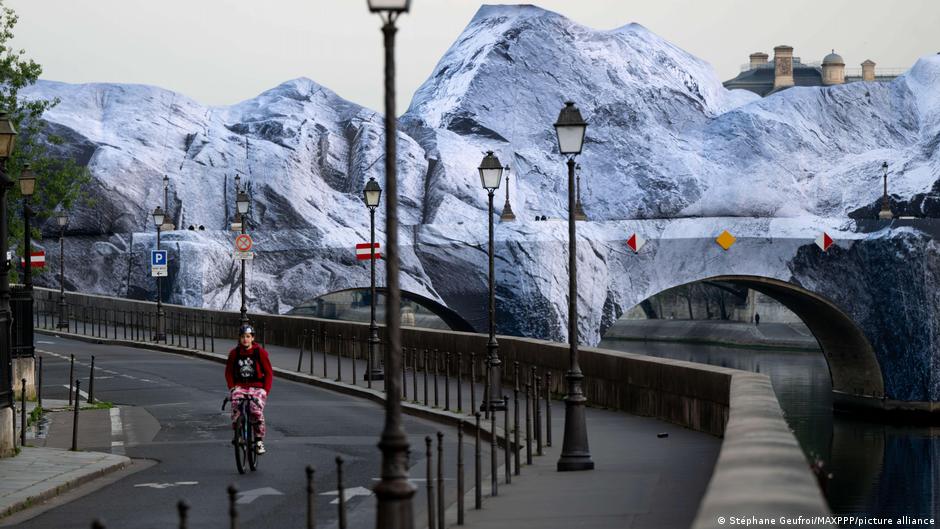
After a weather-delayed start, the French street artist's cavernous optical illusion takes over one of the most iconic bridges in Paris. It's a tribute to Christo and Jeanne-Claude's famous "Pont Neuf Wrapped." "La Caverne du Pont Neuf," an installation in Paris by French street artist and photographer JR, has opened on Monday after a delay because strong winds had damaged the artwork. It is on show until June 28. With the largest project of his career to date, JR has said that he aims to shift how people experience France's capital. It's an ode to late artist duo Christo and Jeanne-Claude's "The Pont Neuf Wrapped," which celebrated its 40th anniversary in 2025. Images of rugged rock make up the installation titled "La Caverne du Pont-Neuf," rising above the river in black and white to cover the 232-meter-long (761-foot-long) bridge. The "cave" is made up of 80 canvas arches filled with air. JR also took inspiration from the quarries in the Paris basin from which the bridge's stones were extracted. Built entirely of Lutetian limestone, also known as "Paris Stone," the Pont Neuf or "new bridge," completed in 1607, was the first in Paris not to be made of wood. The artist, who often uses photographic images, aimed for a striking juxtaposition between the roughness of the raw material and the refined elegance of the French capital, known as the City of Light.
An architectural landmark transformed into a pure object of art In September 1985, the duo Christo and Jeanne-Claude wrapped the same bridge in their work "The Pont Neuf Wrapped," using 41,800 square meters (almost 450,000 square feet) of golden-sandstone polyamide fabric and 13 kilometers of rope. As with many of their works, it took them years of political negotiation and technical planning to make the vision a reality. 'The Pont Neuf Wrapped' was installed in 1985 by Christo und Jeanne-Claude. It took them a decade to prepare the work Image: 1985 Christo and Jeanne-Claude Foundation, Photo: Wolfgang Volz The press response was mixed and often critical. Some commentators in France called the project wasteful and inappropriate, questioning the idea of covering up such a historically important bridge in the first place. Despite the criticism, millions of visitors came to see it, and even skeptical commentary in French media often acknowledged its impact on how people viewed the bridge and the city: The normally passive experience of crossing the landmark bridge was turned into active engagement with the temporary transformation of the structure and its surroundings. Throughout their career — Christo passed away in 2020 and Jeanne-Claude in 2009 — the duo transformed many familiar landmarks through their large-scale installations. In the summer of 1995, they wrapped the German Reichstag, the seat of the German parliament, in silver fabric. In 2005, they installed "The Gates," a series of saffron-colored fabric panels in New York City's Central Park.
Meanwhile, "L'Arc de Triomphe, Wrapped," was posthumously completed in Paris in 2021. "I admire the legacy of Christo and Jeanne-Claude, and I share their idea that the mission of art is to make us think, to question what is familiar to us," JR said in a press release. After all, "art is a transformation, and a way of renewing the way we look at the world around us," he added. Christo and Jeanne-Claude next to a model of their 'Pont Neuf Wrapped' at an exhibition in 2006 Image: Jens Büttner/dpa/picture alliance A history of large installations The installation's large size means it can be seen from multiple vantage points from around the city, whether one is walking along the banks of the Seine or cruising the river on a boat. In an interview in The Guardian, JR said the work was "100% the most challenging thing I've ever done." Typically seen wearing his sunglasses, JR is not completely anonymous: His first name is Jean-René Image: Thomas Padilla/AP Photo/picture alliance The 43-year-old artist is no stranger to large-scale, popular installations that combine photography and architectural landmarks. In his project "Women Are Heroes," he pasted enormous portraits of women onto buildings and rooftops in communities around the world. The "Inside Out Project" is JR's global initiative inviting people to submit portrait photographs that are then displayed in public spaces. In another optical illusion, he blew off the top off the Great Pyramid in 2021.
Perhaps his most famous work is "Giants, Kikito" (2017), which featured a massive image of a toddler peering over the border wall between Mexico and the United States. JR has also been busy in Paris in the past. In 2019, to mark the 30th anniversary of the Louvre Museum's iconic pyramid, he created an optical illusion of paper strips that appeared to give added depth to the iconic structure and make it seem as if it was emerging from a quarry. Around 400 volunteers spent days pasting more than 2,000 10-meter strips on the ground to make the project come to life. Previously, in 2016, he made the famous museum's pyramid seem to disappear by papering its glass segments with images of the Louvre Palace across from it. 'A symbolic crossing' The interior of "La Caverne du Pont-Neuf" is accessible free of charge, 24 hours a day throughout the installation period. The passage provides an experience of its own, with sound design by former Daft Punk member Thomas Bangalter. It's "a symbolic crossing, a step into the unknown, a journey within oneself," JR said. "I designed the crossing of La Caverne as an experience where fullness and emptiness exist in balance." Edited by: Elizabeth Grenier
 The BriefWire