Leipzig Bach festival: Encouraging dialog
Talking, debating and listening are skills we can all learn, particularly in the light of current global conflicts. The Leipzig Bachfest shows how Johann Sebastian
Talking, debating and listening are skills we can all learn, particularly in the light of current global conflicts. The Leipzig Bachfest shows how Johann Sebastian Bach's music can serve as a model here. Can the music of Johann Sebastian Bach encourage dialogue? Absolutely, says Burkhard Jung, lord mayor of Leipzig and former president of Eurocities, a network of major European cities. In his opening address at the 2026 Leipzig Bachfest, he cited the fast-paced nature of our modern lives, where so much happens simultaneously. "The world is full of voices, but they don't really talk to one another," Jung emphasized. Bach's music is polyphonic; layers of distinct voices with their own melodies, all given equal importance as part of the piece as a whole. Sometime these voices take turns in a kind of question-and-answer interplay; sometimes they follow one another at intervals — as in a fugue — or they go their own melodic ways, only to come together again at the end. "In Bach's works, one can see how voices should interact," Jung emphasized, expressing the hope that Bach's melodic structure could serve as a model for political debates and discussions. An intergenerational dialog The Leipzig Bachfest opens every year with the St. Thomas Boys' Choir and the Gewandhaus Orchestra performing at St. Thomas Church in Leipzig, under the baton of the current choir director, Andreas Reize.
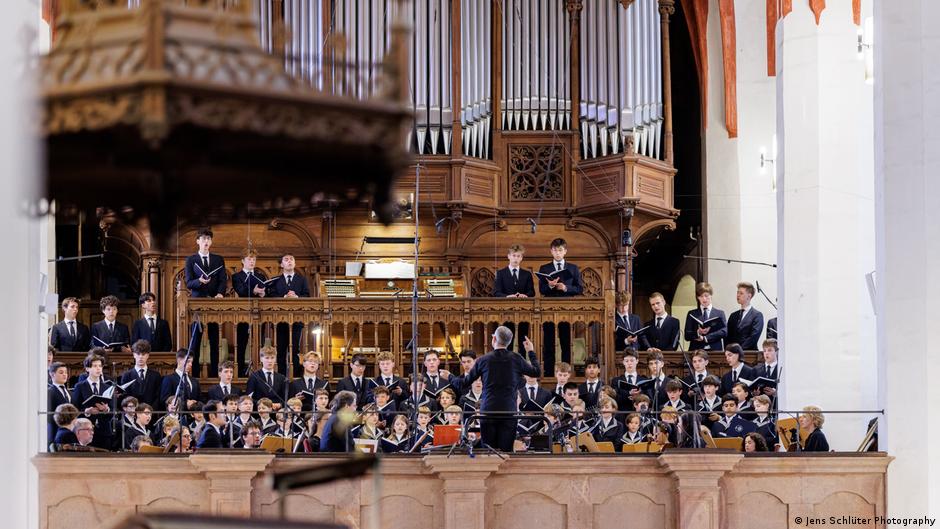
The Marian Vespers through the centuries: A thrilling challenge for the St. Thomas Boys Choir Image: Jens Schlüter Photography Adhering to the festival's "In Dialogue" theme, Reize conceived an extraordinary Marian Vespers service, with works from four centuries. The Marian Vespers is the evening liturgy of the Divine Office, featuring a specific sequence of hymns and psalms. These hymns and psalms from the Bible have inspired many composers to create their own works. The best known of these is Claudio Monteverdi's (1567–1643) "Vespers for the Blessed Virgin Mary." Excerpts from this work were performed during the opening concert. "I then looked to see which younger generation composer had set a psalm to music that would complement the 'Vespers for the Blessed Virgin Mary,'" explained Andreas Reize. Choir director Andreas Reize enthralled his singers with works by Claudio Monteverdi and Vytautas Miskinis Image: Jens Schlüter/Bachfest The selection included, among others, the motet "Let him kiss me" by the Swedish composer Jan Sandstrom and works by the Lithuanian composer Vytautas Miskinis. The boys of the St. Thomas Choir performed his "Laudate pueri, Dominum" with particular sensitivity, their voices delicate and ethereal. "This is a conscious choice to present a dialogue in a completely different contemporary musical language, a 21st-century soundscape," Reize told DW.
And the audience was delighted. Dialogue between performers and instruments One of the highlights of this year's Bach festival, which regularly attracts over 70,000 visitors to Leipzig, is the marking of the 300th anniversary of Bach's "Clavier-Übung" (Keyboard Practice). Johann Sebastian Bach wrote these exercises in 1726 for music-loving connoisseurs, for "lovers of music, for the delight of the soul." For Bachfest director Michael Maul, Bach's music is 'highly democratic' Image: Jens Schlüter Photography Sir Andras Schiff and Mahan Esfahani are performing the cycle in a series of concerts kicked off by Hungarian star pianist Schiff. As one would expect, he played Bach's Partitas — a sequence of stylized dances — with masterful concentration and precision on modern grand pianos. In the late-night recital, Iranian-American harpsichordist Mahan Esfahani interpreted Bach's Partita No. 1 on the harpsichord in a completely different, yet highly sophisticated manner. Listening to Bach with fresh ears Esfahani is the Bach festival's artist in residence and scheduled to give a total of seven concerts featuring Bach's music, as well as pieces from the contemporary repertoire. All performances will be on an instrument many associate with the Baroque era. "Everyone says the harpsichord is only for early music, but that's not true.
The harpsichord is so versatile; you can play anything on it," said Esfahani in an interview with DW. Johann Sebastian Bach's work remains his chief focus, however. He is currently recording all of Bach's piano works for the harpsichord and clavichord on the Hyperion label. Iranian-American harpsichordist Mahan Esfahani demonstrated virtuosic control of his intrument Image: Alex Kozobolis Through distinctive phrasing and dramatic pauses in his playing, Esfahani breathed new life into Johann Sebastian Bach's Partitas during the concert, bringing evident joy to the audience. He incorporated a subtle call-and-response interplay through the shifting between high and low registers. "What fascinates me most about him (Esfahani) is that he really delves deep into the works and engages very intensively with the pieces, their origins and their structure," says Bach Festival director Michael Maul. Deutsche Welle recorded the concert in its capacity as Bach Festival media partner. The recording will be available shortly on the DW Classical Music YouTube channel. This article was originally written in German.
 The BriefWire