Charging ahead: EVs outpace growth predictions
Electric cars are getting cheaper, more efficient and can travel farther than ever. China is driving the transition, but Europe and other countries are catching
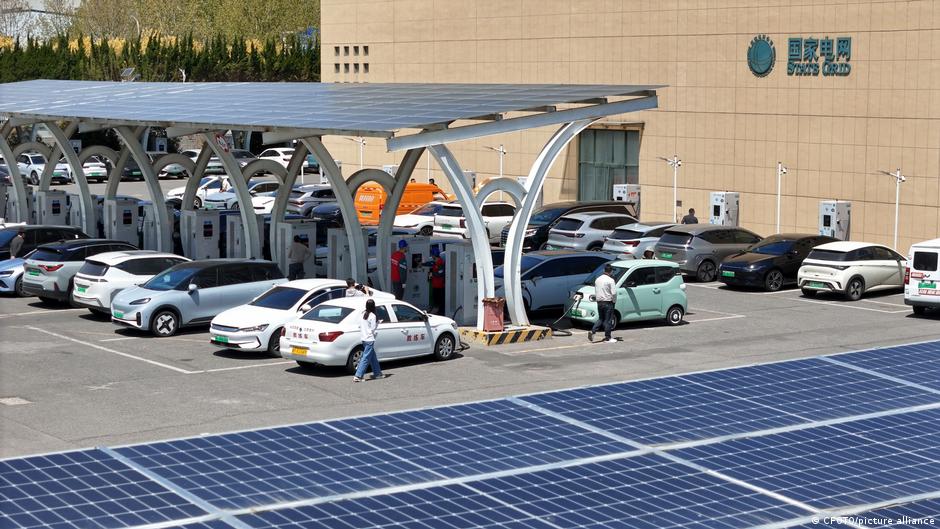
Electric cars are getting cheaper, more efficient and can travel farther than ever. China is driving the transition, but Europe and other countries are catching up fast. The global market for electric vehicles (EVs) is growing much faster than expected. In just six years, sales have increased tenfold, with around 21 million electric cars sold worldwide in 2025. In 2019, EVs made up just 1% of new car sales globally In 2025, that figure rose to 25% By May 2026, 63% of new cars sold were electric Of the world's 1.4 billion cars, 85 million are now electric China and Europe are leading the charge, but the market is growing rapidly in other parts of the world too. China leads the way in electric mobility China has long been investing in solar and wind energy, as well as battery technology — the most critical component in electric vehicles. Thanks to advanced research and mass production, electric car battery costs have dropped dramatically. Today, they cost just a quarter of what they did ten years ago, and prices continue to fall. China is the world's largest car market, and consumers are reaping the benefits of their government's industrial strategy. EVs have cost less than combustion engine cars since 2024, the state has been rapidly expanding charging infrastructure for years, and electricity in China is very affordable. In 2015, electric vehicles made up just 1% of new car sales in China. By April 2026, that share had climbed to 61%. Not all EVs are equal Electric cars run on electricity and charge with a cable. Globally, two thirds of these EVs are so-called Battery Electric Vehicles (BEVs), which are powered by electricity alone. The remaining third also have a gas engine for backup on longer trips — these are known as Extended Range Electric Vehicles (EREVs) or Plug-in Hybrid Electric Vehicles (PHEVs). So-called Hybrid Electric Vehicles (HEVs), by contrast, always require gas or diesel to power their combustion engine.
An electric motor provides some assistance, with the electricity generated solely through regenerative braking. This technology reduces fuel consumption somewhat in city driving — but HEVs are not counted as electric vehicles in international statistics. One in three new cars in Europe is now electric In 2018, electric vehicles accounted for just 1% of new car registrations in the EU. By April 2026, almost one in three new cars sold was an EV. Northern Europe is taking the lead. In Norway, nearly all new cars sold are now electric (99%), followed by Denmark at 82% and Sweden at 65%. Governments across the region support climate-friendly mobility and are expanding charging infrastructure. Worker charging an electric truck at an Aral charging station. Image: ARAL In the UK, 39% of new cars registered in April 2026 were electric, followed by Germany at 37% and France at 32%. Across all three countries, EV sales doubled compared to the same month the previous year. Fewer electric cars in the USA The US market has stagnated in recent years. Between 2023 and 2025, EVs accounted for around 10% of new car registrations. By April 2026, that share had dropped to below 6%. Tesla is widely regarded as a pioneer of the modern electric vehicle industry. Its Model Y and Model 3 remain the best-selling electric cars in the world, though they are followed by a string of Chinese models. China dominates global EV production, manufacturing 71% of all electric vehicles worldwide. Europe is second at 17%, ahead of the US at just 5%. South Korea and Japan each account for 2%, with India at 1%. Momentum in Asia and Latin America In many developing and emerging economies, the share of EVs in new car sales is significantly higher than in the US. That's also the case elsewhere in Asia and Latin America. According to the International Energy Agency (IEA), several Asian countries are well ahead of the curve.
In Nepal, 68% of new registrations were electric in 2025, followed by Singapore (63%), Vietnam (41%) and Thailand (23%). In Turkey, the figure stood at 22%. Latin America is also seeing strong growth, with EV sales across the region tripling in just two years. Uruguay had the highest share of EVs in new car sales in the first quarter of 2026 at 31%, followed by Costa Rica (16%), Colombia (15%) and Brazil (10%). In Mexico, the US's southern neighbor, the figure was 6%. E-Pioneer in Africa: Ethiopa In Africa, Ethiopia stands out. In 2024, it became the first country in the world to ban the import of new and used combustion engine vehicles. Since then, the number of electric alternatives on its roads has nearly quadrupled to over 100,000. A man operates a Core EV charging station in Addis Ababa. Ethiopia became the first country in the world to ban the import of combustion engine vehicles in 2024. Image: DW Some 96% of Ethiopia's electricity comes from affordable hydropower, making EV driving around eight times cheaper than running a combustion-engine vehicle. The government's goal is to use domestically generated electricity to cut the country's costly dependence on imported oil. Cost of EVs versus gas cars Electric vehicles have historically carried a higher price tag than their combustion-engine counterparts. In 2025, according to the IEA, EVs were around 27% more expensive in the US, 19% more in Germany, and 11% more in Brazil and Turkey. But prices are falling fast. Some models in China are available for under €10,000, and in 2025 new electric cars there cost on average 20% less than comparable combustion engine models. In Europe, most EVs are still priced above €20,000. But cheaper models are increasingly coming to market, and government subsidies are helping to bring costs down further. Improved tech leads to greater range Premium electric vehicles once topped out at around 500 kilometers on a single charge, and fast-charging options were often limited.
Today, some high-end EVs can travel over 800 kilometers on a single charge. Fast-charging stations are being built at an increasing pace worldwide, and one premium BYD model can reportedly add 700 kilometers of range in just 10 minutes using what the manufacturer calls a "Flash Charger." Regular fast chargers take about 20 mins to add a 300 km range. EVs are efficient and cheaper to run Gas engines waste around 80% of their energy as heat, and diesel engines around 60%. Electric motors, by contrast, utilize 80% of their energy, losing no more than 20% as heat. This efficiency translates directly into lower energy consumption. A typical EV uses around 15 kilowatt-hours (kWh) per 100 kilometers, compared to 50 kWh for a comparable combustion engine vehicle, roughly equivalent to 6 liters of gas. Home charging is generally the cheapest option. In Europe and the US in 2024, it cost over 40% less than filling up at a gas station, and globally the saving averaged 60%. Public fast charging is considerably more expensive. But even then, driving electric is on average 15% cheaper than driving a combustion engine car. Iran war accelerates shift to electric vehicles Electric cars are quiet, produce no toxic emissions and no CO2 on the road — benefits for both public health and the climate. Many countries are actively encouraging the transition for these reasons. High oil prices driven by the Iran war, combined with falling battery costs, will push EV sales even higher, according to the IEA. The agency projects that around 23 million electric cars will be sold this year — nearly 30% of all new vehicles worldwide — with the trend continuing upward. According to Bloomberg New Energy Finance's Electric Vehicle Outlook, EVs could account for as much as 80% of global new car sales by 2030. This article was originally written in German.
 The BriefWire