Meet Harish-Chandra: The forgotten Indian mathematician who corrected a Nobel laureate and transformed modern physics
Harish-Chandra’s journey from Kanpur to Cambridge The student who corrected a Nobel laureate Building the mathematics of symmetry Contributions that changed mathematics The Harish-Chandra regularity
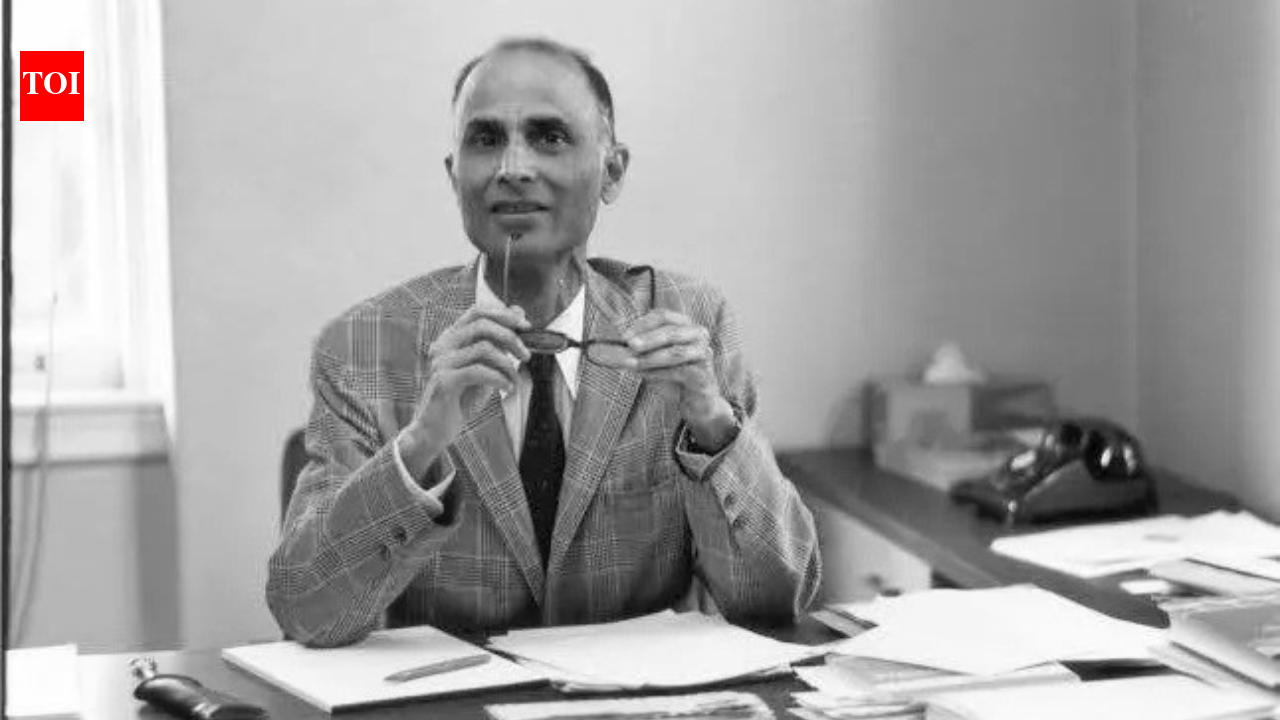
Harish-Chandra’s journey from Kanpur to Cambridge The student who corrected a Nobel laureate Building the mathematics of symmetry Contributions that changed mathematics The Harish-Chandra regularity theorem, a foundational result in harmonic analysis. The Harish-Chandra homomorphism, a key tool in representation theory. Groundbreaking work on discrete series representations. Major contributions to the theory of cusp forms and harmonic analysis. These achievements created a framework that mathematicians continue to build upon decades later. Why physicists still rely on his work A pioneer of ideas that shaped the Langlands program Recognition and legacy Some scientists make discoveries. Others create entirely new ways of understanding the universe. Harish-Chandra belonged to the latter group. Born in Kanpur in 1923, he began his academic career as a physicist and earned his doctorate at the University of Cambridge under Nobel laureate Paul Dirac. During this period, he identified a mathematical error in work by fellow Nobel Prize-winning physicist Wolfgang Pauli, an early indication of his extraordinary talent. He later left physics for pure mathematics, where his pioneering research on symmetry, Lie groups and representation theory transformed modern mathematics and provided essential foundations for theoretical and particle physics.Harish-Chandra was born on October 11, 1923, in Kanpur, then part of British India.
He studied physics at the University of Allahabad before joining the Indian Institute of Science in Bengaluru, where he worked under renowned physicist Homi J. Bhabha.In 1945, he moved to the University of Cambridge to pursue doctoral studies under Paul Dirac, one of the founders of quantum mechanics. His doctoral thesis focused on the representations of the Lorentz group, a mathematical structure central to Einstein's theory of relativity.While at Cambridge, Harish-Chandra became increasingly interested in the mathematical foundations underlying theoretical physics. His interactions with leading mathematicians eventually persuaded him to make a dramatic career shift from physics to pure mathematics.One of the most remarkable episodes from Harish-Chandra's early career involved Wolfgang Pauli, one of the most celebrated physicists of the twentieth century and a Nobel Prize winner.While studying advanced theoretical problems, Harish-Chandra identified a mathematical error in one of Pauli's calculations. The incident demonstrated his exceptional technical ability and the deep mathematical insight that would later define his career.Although correcting a Nobel laureate did not make him famous, it highlighted the extraordinary level at which he was already operating as a young researcher.Harish-Chandra's greatest achievement was developing the modern theory of representations of semisimple Lie groups.In simple terms, Lie groups are mathematical structures used to describe continuous symmetries.
These symmetries appear throughout physics, from the behaviour of elementary particles to the laws governing space and time.Before Harish-Chandra, many of the mathematical tools needed to study these symmetries were incomplete. He developed rigorous methods that allowed mathematicians to analyse highly complex and infinite-dimensional representations.His work transformed representation theory into one of the most important branches of modern mathematics.Harish-Chandra produced a series of landmark results that remain central to mathematics today.Among his most important contributions are:The Harish-Chandra character formula, which extended the concept of characters to infinite-dimensional representations.Although Harish-Chandra ultimately became a mathematician, his research had enormous consequences for physics.Modern quantum mechanics and quantum field theory depend heavily on symmetry principles. The Standard Model of particle physics, which describes the fundamental particles and forces of nature, is built around symmetry groups and their representations.Harish-Chandra's mathematical framework provided the rigorous tools needed to study these structures. As a result, his influence extends far beyond mathematics and into some of the most important theories in modern science.Harish-Chandra's work also helped lay foundations for the Langlands program, one of the most ambitious research programmes in modern mathematics.Often described as a "grand unified theory of mathematics," the Langlands program seeks connections between number theory, geometry, algebra and analysis.Many of the concepts and techniques developed by Harish-Chandra became essential components of this vast mathematical enterprise.Harish-Chandra's achievements earned him some of the highest honours in mathematics and science.
He received the American Mathematical Society's Cole Prize in 1954, was elected a Fellow of the Royal Society in 1973 and received India's Padma Bhushan in 1977.From 1963 until his death in 1983, he served as a professor at the Institute for Advanced Study in Princeton, one of the world's most prestigious research institutions.Today, mathematicians regard him as one of the founders of modern representation theory. While his name may not be as widely recognised as those of Dirac or Pauli, the mathematical structures he developed continue to underpin research in mathematics, quantum physics and particle theory around the world.
 The BriefWire