How slums are made and razed in Bengaluru
How do slums mushroom? In Bengaluru, this question is usually asked only after bulldozers arrive — once homes are razed, livelihoods disrupted, and families pushed
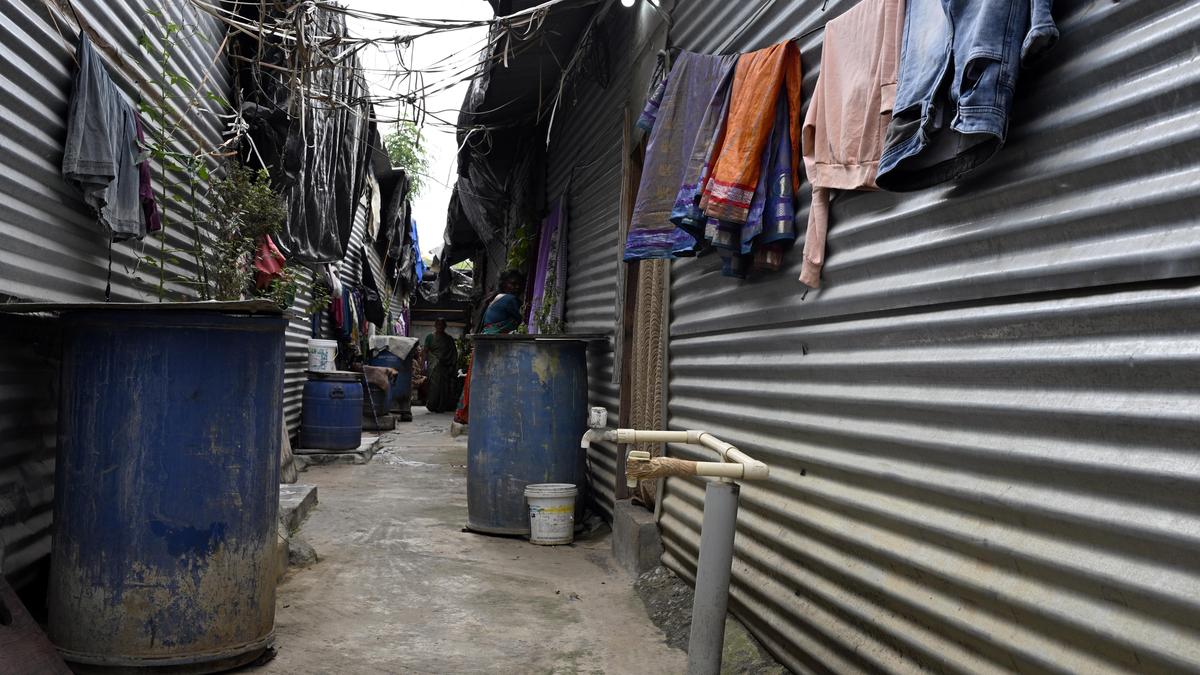
How do slums mushroom? In Bengaluru, this question is usually asked only after bulldozers arrive — once homes are razed, livelihoods disrupted, and families pushed out overnight. Delhi: Demolition drive near PM's residence removes three slum clusters after High Court order On December 20, the Bangalore Solid Waste Management Limited (BSWML), acting with the Greater Bengaluru Authority (GBA), demolished over 160 houses in Kogilu, north Bengaluru. Multiple surveys followed — by government agencies, the Housing Department, and NGOs, but nearly a month later, no rehabilitation or interim housing has been provided. Families remain displaced, living with relatives or on the margins of nearby neighbourhoods. How informal settlements emerge Unlike cities such as Delhi or Mumbai, where nearly half the population lives in informal settlements, Bengaluru has seen a sharp rise in such habitations in recent decades. This, Clifton D’Rozario, advocate and general secretary of the All India Lawyers’ Association for Justice,explained, is directly linked to the failure of successive Union and State governments to provide public housing. Despite repeated promises of “housing for all” and affordable housing policies, the State has consistently failed to ensure dignified housing for the urban poor. With rural distress, agrarian crisis, caste-based exclusion, and lack of livelihood opportunities pushing people out of villages, and cities pulling them in for labour, informal settlements become inevitable, he said. “Nobody wants to live next to a drain, under a tin roof or a tarpaulin sheet. People, their families, are forced into such conditions only when every option is closed off,” he says, stressing that demolitions without addressing public housing and agrarian distress will only perpetuate the cycle. Infrastructure projects require labour over several years. In Bengaluru, where projects are known to miss deadlines, work does not end, but only shifts, overlaps, and expands. Labour stays because work stays. A slum typically begins as a temporary shelter near a worksite. Gangaraju M., a resident of Vinayaka Layout, said his grandparents had migrated to the settlement from Narayanpet in Telangana around 35 years ago, when a tech park was coming up in K.R. Puram. He recalled that a contractor involved in the project had allowed families working under him to stay there. However, he said repeated representations to the Slum Board seeking official recognition of the area had yielded no result. “The government says the land is privately owned and asks us to approach the contractor, but the contractor says he has no control and is only letting us stay.” Over time, families such as that of Gangaraju settle, and what remains “temporary” in law becomes permanent in practice, said Nandini B.K., associated with the Dhudiyuva Janara Vedike, an activist group that advocates for the rights of marginalised and poor communities. These settlements grow not because people choose informality, but because the city externalises the cost of housing the workforce it depends on. Why people do not leave? This makes the persistent question — why don’t people leave once the work is over — deeply flawed. Work is rarely “over” in the way the question assumes. Construction labourers, domestic workers, drivers, sanitation workers, and scrap collectors move from one project to another, often within the same parts of the city. Returning to villages left years ago, frequently without land or livelihood, is not a reset but a regression. Staying close to work is not defiance, but the only rational response to a city that demands labour continuously but refuses to house it, experts say.
“Therefore, a comprehensive human development plan is required,” says L. Issac Arun Selva, founder of Slum Jagatthu, aKannada language monthly magazine for and by slum dwellers. Such a plan would ask where the workforce will live, how they will access food and public transport, whether children will have schools nearby, and how employment continuity will be ensured. “These questions are largely left unanswered. Migration, long-running infrastructure projects and the absence of affordable rental housing combine to produce informal settlements near work sites,” he added. Slum declaration & selective recognition Under Karnataka law, Issac explains, the government does have the power to notify an area as a slum even if the land is unauthorised or privately owned. “Slum declaration is recognised as a social measure rather than ownership recognition, allowing the state to extend basic services and rehabilitation. In practice, however, this power is applied selectively. Settlements located on high-value land or earmarked for future projects are often left undeclared, keeping residents outside the formal welfare system,” he added. When major projects begin, workers are mobilised through contractors for work that can last years. With no housing provision attached and rents far beyond their wages, workers settle close to the site. Temporary shelters gradually become stable communities, and families put down roots, he added. Demolitions without notice In most such demolition cases, like those seen recently in Fakeer Colony and Waseem Layout, families claimed that notices were never served. Clifton highlights the legal implications of such selective recognition. Notice, he explains, is not a procedural formality but a constitutional safeguard. It allows residents to explain how long they have lived on the land, under what circumstances they came there, and whether they possess documents that legitimise their occupation. In Karnataka, many residents hold interim orders issued by the Revenue Department under sections of the Karnataka Land Revenue Act, which regularise their occupation. Others may have purchased sites in good faith from individuals who claimed ownership of the land. “The purpose of notice is to understand these realities and to allow the state to respond with a humane policy solution, even in cases it calls encroachment,” he says. Fewer slums on paper Ironically, on paper, Bengaluru appears to have fewer slums today than it did a decade ago. Housing and Minority Minister B.Z. Zameer Ahmed Khan, during the recent winter session, told the Karnataka Legislative Assembly that 435 slums fall under the jurisdiction of the Karnataka Slum Development Board (KSDB) within the city. Yet, official data published by the KSDB, based on surveys aligned with the 2011 Census, recorded 597 slum areas in Bengaluru. Of these, 387 were formally notified under the Karnataka Slum Areas (Improvement and Clearance) Act, 1973. Statewide, the Board had identified 2,804 slum areas, housing an estimated 40.5 lakh people. This reflects a reduction of 162 slums, or approximately 27.1%, over the period. Chandramma, State convener of Savitribai Phule Mahila Sangathan, a women’s association for community development and awareness, says this decline reflects a shrinking of administrative recognition rather than an actual improvement in housing outcomes. “Bengaluru has not contracted in construction or labour-intensive activity and has only expanded. Metro projects, road widening, flyovers, stormwater projects, tech parks, gated communities and commercial hubs all depend on a floating workforce. The sharp fall in officially recognised slums is a reflection of the State not counting them, not of their disappearance,” she explained. Informal rent economy The Kogilu demolition was closely followed by a clearance drive in Thanisandra’s Tuba Layout, where the Bangalore Development Authority (BDA) razed dozens of homes on land it claimed ownership over.
While officials termed the structures “unauthorised”, residents maintained that they were not encroachers but tenants who had been paying rent to intermediaries they encountered at labour sites. This pattern has surfaced repeatedly in Bengaluru — government land is informally occupied or controlled by private actors, rented out to migrant labourers at affordable costs, and when evictions finally take place, it is the workers, not those who profited from the arrangement, who bear the consequences. Labourers employed in construction and allied work are abruptly rendered “illegal occupants” overnight, even as the informal systems that housed them operate unchecked for years. In Thanisandra, Syed Ismail, a scrap collector, repainted his house barely two months before demolition, spending his savings for his son’s wedding. “Soon after the wedding, the demolition drive happened,” he said. With no alternative accommodation, the family asked the bride’s parents to house the newlyweds. “The condition is such that even the scrap on the road is getting robbed at night. There is no idea of income and no answers from our owner. Even if I get my deposit back, about ₹30,000, it will only last a short time. After that, we have nothing,” he said. Behind Bengaluru slums, growth and demolition drives Manjula Akhilesh’s story mirrors this pattern across a different slum. After her family was relocated to Rajendra Nagar, she explained that the focus was only on survival. She was married off at a young age to a man 12 years older, reasoning that at least she would have a roof over her head. Her husband later died due to alcoholism, leaving her as the sole earner for three children, none of who attend school. Declared v/s undeclared slums Clifton emphasises that such outcomes are avoidable if the law is applied with intent. Karnataka slum law mandates formal declaration under Section 3, which triggers legal protections and rehabilitation obligations. Yet, only an estimated 20% to 30% of existing slums are declared. “By not declaring slums, the state avoids legal obligations, labels settlements ‘undeclared’ or ‘informal,’ and proceeds with demolitions. That is a clear dereliction of duty,” he says. Even in officially declared slums, residents face daily hardships. Spread across 60 acres, a KSDB colony houses more than 16,000 people, yet basic needs remain unfulfilled. Alamel M., a resident for over a decade, says water access is unreliable. “We have to pay for every drop. For every meal, we walk nearly 800 metres to fetch water and carry it back,” she lamented. Most undeclared slums have access to basic services only because of interventions by NGOs. In settlements such as Vinayaka Layout in T.C. Palya, where 35 families earn a living by collecting hair and making wigs, there were no toilet facilities, forcing residents to defecate in the open. Residents said the situation deteriorated to the extent that women were filmed in such instances. An NGO later intervened and constructed a toilet in the area. Similar conditions persist across many slums in the city. When questioned, Slum Board officials said the government does not have sufficient funds to pay corporations to maintain basic services and hence they cannot declare an area as a slum. Housing as a human development issue The broader structural context underscores the point Nandini makes — housing cannot be isolated from human development. It intersects with education, healthcare, transport, livelihood, and food security. Article 21 of the Constitution guarantees life with dignity, encompassing all of these aspects.
Yet Bengaluru’s urban poor are consistently treated as obstacles to development rather than citizens entitled to full participation. Historically, slums were not created as human settlements but as labour colonies, Nandini argued, explaining that these spaces were intended to temporarily house workers while construction took place. Once the work ended, workers were expected to vanish, leaving space for the next development cycle. This explains why the state repeatedly labels longstanding settlements as encroachments when land values rise. “The city depends on these communities for its very growth, yet refuses to recognise them when the land they occupy becomes profitable. Human development is subordinated to market value,” she further said. Redevelopment promises, stalled action At the first meeting of the GBA, chaired by the Chief Minister, Deputy Chief Minister D.K. Shivakumar said the government would study Mumbai’s cluster-based redevelopment model, citing the Dharavi revamp as a reference. But there is no clarity on timelines, feasibility, or how such a model would translate to Bengaluru’s different slum landscape. Minister Zameer Ahmed Khan during the same meeting had added that 480 slum settlements were awaiting redevelopment, acknowledging that earlier attempts had failed and that a committee had been formed to revive the issue. Despite this, concrete action remains absent. Displaced families in such cases, like those from Kogilu Layout, continue to await rehabilitation despite assurances of “good news” on housing. Across the city, slum redevelopment has stalled for years, and promises offered after demolitions risk becoming yet another pledge in a system weighed down by inaction. Relocation versus livelihood The city’s reliance on informal labour amplifies this contradiction. Workers are brought in to build infrastructure projects, but no planning is done for where they will live. Informal settlements emerge close to work sites because proximity is essential for survival. When these settlements are later demolished, relocation sites are often far from employment hubs, poorly connected by public transport, and lacking infrastructure. Workers are forced to choose between housing and livelihood, with children pulled out of schools and access to hospitals restricted. The failure, Mr. Selva explained, cannot be pinned on any one government or political party. Instead, it lies in how the system is designed. Housing and welfare policies assume that people already have access to information, transport, documents, and public services — things informal workers typically lack. As a result, even when schemes exist, the people who need them most are unable to benefit. A failure of planning Issac argued that housing is not just a structure. It is connected to transport, schools, hospitals, and access to work. Even when houses are provided, they are often located in areas with little infrastructure or economic opportunity, making them difficult to inhabit in practice. Some families return to informal settlements closer to work, not because they prefer informality, but because survival demands it. He argued that all of this points to the absence of a comprehensive human development approach. Cities plan infrastructure in detail, but fail to plan for the people who build it. Without integrating housing with employment, transport, education, and healthcare, relocation remains a temporary fix, and informal settlements continue to reappear — not as a failure of people, but as a failure of planning.
 The BriefWire