150 billion litres water a year: India wants to be AI superpower, but it comes with a bill
Artificial intelligence (AI) is rapidly emerging as one of the most transformative technologies of the 21st century, reshaping industries, economies and everyday life at an
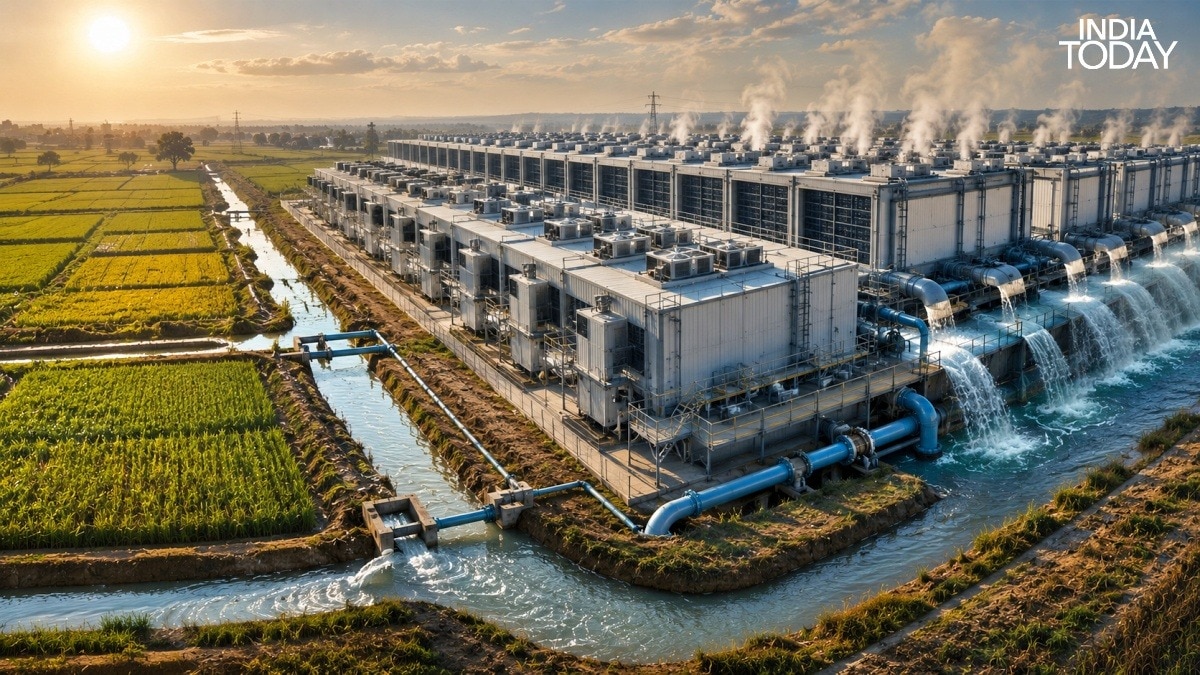
Artificial intelligence (AI) is rapidly emerging as one of the most transformative technologies of the 21st century, reshaping industries, economies and everyday life at an unprecedented pace. From drafting simple emails and generating lifelike images to powering advanced chatbots, deep research, and decision-making systems, AI is increasingly influencing how people work, learn, communicate and consume information. But, it has a cost, and this one isn't simply in dollars or rupees. Every AI prompt costs electricity, land, minerals, and enormous quantities of water. Read Full Story A recent report by the United Nations University Institute for Water, Environment and Health (UNU-INWEH) warns that the environmental footprint of AI is growing rapidly as the technology expands across the world. A man walks through an AI data centre. (Photo: Reuters) While much attention has focused on energy use and carbon emissions, another resource is increasingly coming under pressure: water. Water scarcity is already one of the biggest emerging concerns in the world's most populous country, and yet India is setting itself up to become one of the world's busiest AI hubs. But it also needs to consider the water cost that will come along with the rapid expansion of the AI infrastructure. WHY DOES AI NEED WATER? Every AI query begins inside a data centre, which is essentially a vast warehouse packed with servers that store, process and transmit information. Every prompt you enter into an AI chatbot to ask something, write something, create an image, or research, the system generates enormous heat to meet your demand and must be cooled continuously to keep functioning. Many data centres use evaporative cooling systems, where water absorbs heat from servers and is then released into the atmosphere. A substantial portion of that water is lost through evaporation during the cooling process.
Servers, networking devices and cables are seen in a data center. (Photo: Pexels) As AI models become larger and more powerful, the amount of cooling required also rises sharply. The scale of that increase is rather alarming. According to the UNU-INWEH report, training ChatGPT-4 likely required around 592 million litres of water. While training large AI models is resource-intensive, experts note that much of AI’s environmental footprint ultimately comes from the billions of interactions that take place after a model is deployed. According to a 2026 report by the Council on Energy, Environment and Water (CEEW), a typical 100-megawatt (MW) hyperscale data centre, which has thousands to hundreds of thousands of servers, can consume around 20 lakh litres of water per day for cooling, although actual consumption varies depending on cooling technology and local conditions. "The current industry standard for large-scale AI infrastructure is the 100-MW “AI factory” — hyperscale facilities designed specifically to support intensive AI workloads," said Daswin De Silva, Professor of Analytics and AI at La Trobe University, Australia. A technician works at an AI data center. (Photo: AP) As the industry shifts towards even larger MW-scale AI hubs, demand for both water and energy is likely to rise significantly, De Silva added. Estimates also show that India’s data centres consumed roughly 150 billion litres of water in 2024-2025 and could require around 358 billion litres annually by 2030 as digital infrastructure expands. "Water demand varies widely depending on design, cooling architecture and local climate conditions," noted Guillaume Dourdin, CEO of Veolia India, a multinational company specialising in waste and water management. Citing Deloitte estimates, he said that a 1-MW data centre can consume approximately 68,500 litres of water per day.
That is a concern for India, a nation scaling up AI infrastructure while also facing water scarcity in several regions. INDIA's AI BOOM MEETS WATER CRISIS India’s AI ambition has paved the way for a rapid expansion of digital infrastructure. According to government data, India’s data-centre capacity increased from about 375 MW in 2020 to 1500 MW in 2025. Industry forecasts suggest that figure could rise to between 8,000-10,000 MW by the end of the decade. Tech giants and domestic conglomerates are investing billions of dollars in new facilities. Google is developing a major AI data-centre hub near Visakhapatnam. A new milestone in India's AI journey Today, we broke ground on our landmark AI hub in Visakhapatnam, Andhra Pradesh This marks the construction phase of a $15 Billion investment to provide the foundational infrastructure for India’s growing digital economy. The project pic.twitter.com/TlRwkkEbNG— Google India (@GoogleIndia) April 28, 2026 Microsoft is expanding its cloud and AI footprint across multiple Indian cities. Amazon continues to add capacity in India, while Reliance Industries has partnered with Mark Zuckerberg's Meta to build its first AI data centre in India. According to CEEW, more than 65% of India’s existing data-centre capacity is concentrated in Mumbai, Chennai, Hyderabad, Bengaluru and Noida. While water remains the most immediate concern, De Silva noted that large data-centre developments can also have other environmental impacts, including rising energy demand, land use, heat-island effects, noise pollution and growing volumes of electronic waste. BUILT IN THE WRONG PLACE? The challenge is not just how much water data centres consume, but where they are being built. Data shows that a large majority of India’s data-centres are located in regions already facing varying degrees of water stress.
Graphic: WRI That raises concerns because several of India’s leading technology hubs have already experienced severe water stress. Bengaluru’s 2024 water crisis exposed how quickly a major city can run short of water when reservoirs decline and groundwater extraction outpaces replenishment. Hyderabad is projected to face significant future water shortages, while Chennai’s near-Day Zero crisis in 2019 remains one of India’s major examples of urban water stress. The UNU-INWEH report estimates that global data centres were associated with roughly 4.5 trillion litres of water consumption through electricity generation in 2025. If current trends continue, that figure could exceed 9 trillion litres annually by 2030. Climate change may further complicate the picture as the problem could become more acute as temperatures rise. Rising temperatures increase cooling requirements inside data centres, while increasingly erratic rainfall patterns can make water supplies less predictable. THE CHALLENGES AHEAD The problem seems insurmountable but is fixable if addressed early. According to the CEEW, measures such as greater use of treated wastewater and careful site selection can significantly reduce freshwater demand from data centres. Labourers look out from a window of a data centre building under construction in Gujarat. (Photo: Reuters) De Silva argued that future cooling systems should increasingly rely on reclaimed water, seawater, closed-loop liquid cooling and hybrid dry-cooling technologies rather than freshwater wherever possible. Such approaches, he added, can help reduce pressure on water-stressed regions as AI infrastructure inevitably expands. For a country already grappling with recurring water shortages and rising demand, the question is no longer about whether AI will consume water. It is about how much, where, and who will bear the cost. Ends
 The BriefWire