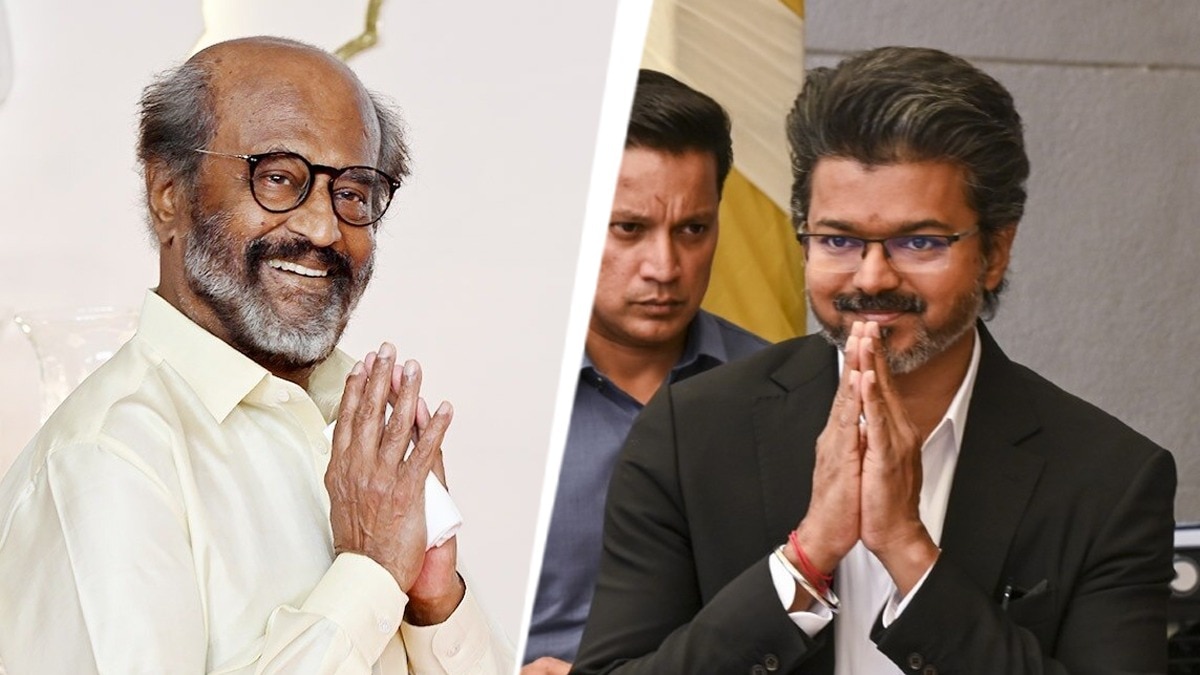
Thalaivar and Thalapathy: Superstar and successor?
For more than three decades, Tamil cinema has revolved around one towering figure: Rajinikanth. From the swagger of Baashha to the emotional grandeur of Padayappa
For more than three decades, Tamil cinema has revolved around one towering figure: Rajinikanth. From the swagger of Baashha to the emotional grandeur of Padayappa, Rajinikanth did not merely become a star. He became a phenomenon that redefined the idea of a Tamil superstar. His influence shaped not only cinema but also public discourse, fan culture and eventually conversations around politics. Read Full Story And among the stars who emerged in the decades that followed, none has been compared to him more than Vijay. Today, the Rajinikanth-Vijay conversation extends far beyond films. It sits at the intersection of stardom, fandom and political ambition, making it one of the most intriguing stories in modern Tamil Nadu. When Rajinikanth rose to dominance in the late 1980s and 1990s, he transformed the commercial hero into something larger than life. Films such as Annamalai, Baashha, Muthu, Arunachalam and Padayappa established the grammar of the Tamil mass entertainer. The underdog who rises. The hero who speaks truth to power. The punch dialogues that become political slogans. The larger social message hidden beneath commercial spectacle. Rajinikanth’s films often felt bigger than cinema. They became cultural statements. For an entire generation of actors, filmmakers and audiences, he was the benchmark. Vijay’s early years were defined by romance and family dramas.
Films such as Poove Unakkaga, Kadhalukku Mariyadhai and Thulladha Manamum Thullum established him as a dependable leading man. But the real transformation came through Ghilli, Thirupaachi, Pokkiri, Sivakasi and Velayudham. Gradually, Vijay adopted many elements associated with Rajinikanth’s stardom: the celebratory hero introduction, punch dialogues, social messaging and the image of a protector of ordinary people. Yet Vijay was never simply replicating Rajinikanth. Where Rajinikanth’s appeal emerged from unpredictability and style, Vijay’s strength came from accessibility. He increasingly positioned himself as a voice for young people, students and the middle class. The overlap became impossible to ignore during the 2010s. Rajinikanth’s films had long carried political undertones. Muthu, Arunachalam, Padayappa, Baba, Sivaji and Kaala all explored themes of power, governance, corruption and social justice. Vijay took the trend further. Mersal questioned healthcare systems. Sarkar focused on electoral politics and voter rights. Master dealt with youth reform. Leo reinforced the image of a reluctant leader carrying immense responsibility. For many observers, these films felt less like commercial entertainers and more like political positioning. The similarities to Rajinikanth’s trajectory became increasingly obvious. Despite decades of speculation, Rajinikanth never fully converted his political popularity into electoral power. For years, Rajinikanth’s statements shaped headlines. Every election cycle brought renewed speculation about his political entry.
Fan clubs evolved into grassroots networks waiting for a political signal. That signal never fully materialised. Health concerns, timing and changing political realities ultimately prevented Rajinikanth from making the leap many expected. Vijay, however, took a different route. Instead of keeping politics ambiguous, he gradually transformed his fan club structure into an organised political movement. What began as social service activities evolved into a political platform. Public speeches became more direct. Political messaging became more frequent. The actor, who once played anti-establishment heroes on screen, began positioning himself as a real-life alternative within Tamil Nadu politics. This is where comparisons between Rajinikanth and Vijay intensified. For decades, Rajinikanth was viewed as the actor most capable of translating cinematic popularity into political success. Vijay eventually entered the very space many believed Rajinikanth would occupy. For some fans, Vijay represented the completion of a journey that Rajinikanth had begun but never finished. For others, the comparison was unfair because the two stars emerged from entirely different political environments. Rajinikanth operated in a state dominated by powerful Dravidian parties and towering political figures. Vijay entered politics at a time when voters appeared increasingly receptive to new alternatives. The contrast between Jailer and Leo perfectly captures this moment. Jailer celebrates the mythology of Rajinikanth.
The film thrives on decades of audience memory, nostalgia and reverence. Leo, meanwhile, reflects a star attempting to build a future-oriented cinematic universe while simultaneously carrying political expectations. One film represents a legacy. The other represents transition. Both became major cultural events. Rumours of tension between Rajinikanth and Vijay have circulated for years, fuelled largely by fan wars and political speculation. Yet the larger story is not rivalry. It is succession. Rajinikanth created the modern superstar model that blended mass entertainment, social messaging and political symbolism. Vijay inherited many of those elements and adapted them for a new generation. Whether one views Vijay as Rajinikanth’s successor, political heir or cinematic evolution depends on perspective. What is undeniable is that the relationship between the two stars tells the story of Tamil cinema itself. One became the defining superstar of an era. The other transformed that legacy into a platform that eventually extended beyond cinema. And in doing so, Vijay entered the very arena where Rajinikanth’s influence had always loomed largest -- not the box office, but the political imagination of Tamil Nadu. Ends Published By: Prateek Chakraborty Published On: Jun 13, 2026 08:00 IST
 The BriefWire