World News in Brief: State-supported safe houses in Haiti, EU pact strengthens refugee protection, demand for ‘critical minerals’ intensifies
According to gender equality agency, UN Women, the new haven announced on Friday will provide survivors with protection, psychosocial support and assistance rebuilding their lives
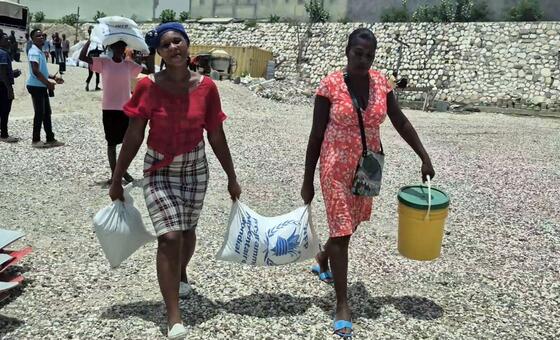
According to gender equality agency, UN Women, the new haven announced on Friday will provide survivors with protection, psychosocial support and assistance rebuilding their lives amid escalating gang violence. Tweet URL Speaking from Port au Prince, the agency’s Marie Goretti Nduwayo said that growing gang violence – which has caused rampant insecurity and mass displacement – used to be concentrated in the Haitian capital but was “now spreading across the country,” forcing thousands more from their homes. Lasting trauma The result is deep and lasting trauma, mainly for women and girls. Goretti Nduwayo cited data showing that sexual violence surged by 163 per cent in 2025, compared with the previous year. This includes approximately 1,670 women and nearly 200 girls. UN Women supports all women and girls in Haiti by working with the authorities to provide lifesaving assistance and help them rebuild their lives. Haiti’s first State-backed safe house represents an important milestone confronting gender-based violence, the agency said.
Race for critical minerals intensifies amid clean energy transition As countries race to build cleaner energy systems and expand access to digital technologies, it’s clear that a new global competition is taking shape around so-called “critical minerals”. The scare commodities – which include “rare earths” which are hard to mine in sufficient quantity – power everything from electric vehicles and batteries to semiconductors and data centres. A new UN trade and development agency (UNCTAD) report warns that demand for minerals including lithium, graphite, copper, cobalt and nickel, is set to surge over the coming decades. Lithium demand alone is projected to rise by more than 350 per cent by 2040. But the challenge is not only growing demand, it is who controls supply. Production and processing remain concentrated in a handful of countries. Tweet URL In 2025, the Democratic Republic of the Congo produced nearly three-quarters of the world’s cobalt, while China dominated graphite production and refining of several critical mineral sources.
Reliance on trade policy As a result, governments are increasingly making trade policy adjustments to secure supplies, strengthen domestic industries and reduce dependence on foreign markets. Since 2020, nearly 100 export-related measures have been introduced globally, including taxes, licensing requirements and export bans. For developing countries rich in mineral resources, the shift presents both opportunity and risk. While rising demand could attract investment and create jobs, UNCTAD warns that many countries continue exporting raw materials while higher-value processing happens elsewhere. With international partnerships rapidly expanding, the report says the next phase of the energy transition will depend not only on access to critical minerals, but on whether countries can turn mineral wealth into broader economic development. UN agencies say EU pact could strengthen refugee protection The UN refugee agency (UNHCR) and the International Organization for Migration (IOM) welcomed the entry into force of the European Union’s Pact on Migration and Asylum on Friday. The agencies described it as an opportunity to move beyond crisis-driven responses and build a more predictable and coordinated approach to migration and refugee protection across Europe.
The reforms could help make asylum systems more efficient and consistent, the UN says, reducing backlogs while giving refugees and asylum-seekers greater certainty and faster access to protection. “The priority is turning the reforms into practical results for States, communities, and people on the move,” said Amy Pope, IOM’s Director General. Right direction UN High Commissioner for Refugees Barham Salih called the pact “an important step in the right direction,” adding that implementation must ensure access to protection, uphold human rights and support safe returns for those not eligible for asylum. UNHCR and IOM highlighted measures including stronger legal assistance, earlier identification of vulnerable people and new monitoring mechanisms at external borders. They emphasise that implementation will determine whether the reforms deliver fair and humane outcomes.
 The BriefWire