Why bear attacks are rising fast in Japan
Experts say bears are less afraid of humans as hunter numbers fall, pushing them beyond their traditional habitats in search of food. Jeff Kingston credits
Experts say bears are less afraid of humans as hunter numbers fall, pushing them beyond their traditional habitats in search of food. Jeff Kingston credits his dogs with saving his life when he was attacked by a bear on a mountain track in central Japan, although the scars left by the creature's claws will always remain on his forehead, arms and shoulders. Like many residents of rural parts of Japan, he believes the uptrend in recent years in encounters between humans and bears is going to continue, perhaps with deadly consequences. "I guess I've encountered bears around 100 times in the mountains and been charged around 15 times," said Kingston, an American academic who likes to escape Tokyo on the weekend for his cabin in rural Gunma Prefecture. "And I think they are changing. They seem ornerier and hungrier than before." The incident that left Kingston scarred took place in 2014, when he was confronted by a bear that knocked him into the underbrush, he said. A zoo worker prepares a tranquilizer as they search for a black bear in Tochigi Prefecture on June 9 Image: Kim Kyung-Hoon/REUTERS The bear continued its attack until Kingston's dogs intervened and eventually chased it off. With blood still streaming down his face, he managed to reach a nearby hospital and receive nine stitches. The following year, he was better prepared and fought off another bear with repellent spray, but only after it got to within a meter of him. "Since then, I have been a less eager hiker in the summer months, from the end of June until early in September," Kingston told DW. Bear-human encounters surge across Japan The Japanese government's 2026 environment white paper, released last week, declares that bears have become "a serious threat to public safety and peace." The report says there were more than 50,000 sightings in the financial year to March 31, with a record 238 people injured in confrontations and 13 killed.
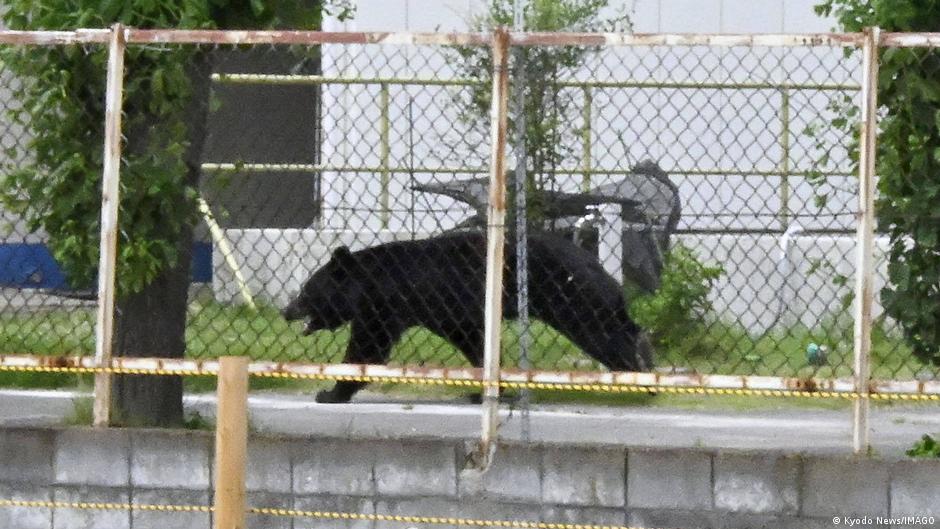
It already appears that record will be eclipsed this year, with 25 people injured in attacks since April 1 and four confirmed dead. And it is not just in the most remote parts of Japan where people are coming face to face with bears. A large bear was caught on security cameras running through a shopping arcade in the center of the country's northern city of Utsunomiya in the early hours of Sunday. The governor of Japan's Akita Prefecture last year requested formal military support to protect residents from bear attacks Image: Kim Kyung-Hoon/REUTERS A week earlier, a rampage by a black bear wounded four people in Japan's northeastern city of Fukushima, according to authorities and media reports. In May, a Russian hiker was seriously injured while hiking in the Okutama district of western Tokyo. "There are a combination of factors behind the increase in confrontations between bears and people, but no one at the national or prefectural levels seems to be able to come up with an effective plan for dealing with the problem," said Kevin Short, a naturalist and former professor of cultural anthropology at Tokyo University of Information Sciences. "One of the biggest contributing factors, I believe, is the loss of the bears' traditional feeding habitats," he said. "If the bears cannot access enough beech nuts or acorns, then they are going to extend their range into the farmland and paddy fields closer to villages and towns," Short added. "And they are finding apple and persimmon trees that they love, as well as garbage that provides them with easy meals." Fewer hunters fuel bear encounters Another factor that Short cited is the decline in hunters in rural communities, which has emboldened the bears to roam the suburbs more freely.
Short says research conducted on euthanized bears shows that the animals have become less fearful of humans, their stress levels are lower today and they are more willing to enter areas heavily populated by humans. "We are finding a new generation that grew up close to villages or suburban areas but had mothers that were still somewhat reluctant to get too close to human habitation," he said. "But that fear has gone with these animals." Yet another contributing factor, Short said, is the effects of global warming on the nuts and berries that the bears feed on in the months before they go into hibernation. In a bad year, bears have to forage far longer and become more aggressive as they try to bulk up to get through the winter. Equally, a relatively warm winter and early spring across Japan meant that bears emerged earlier than usual and set about replacing the weight they had lost, which led to them exploring suburban opportunities. The government's white paper called for more people in rural regions to take up hunting as a pastime as a partial solution, while others are turning to technology. A Hokkaido company has developed Monster Wolf, a larger-than-life animatronic scarecrow with long, shaggy hair and eyes that glow red when it senses something approaching. The company, Ohta Seiki, says it has received 50 orders since April 1, more than it usually sells in an entire year. AI tracks rising bear encounter risk Yusuke Fukazawa, an associate professor of applied machine learning at Sophia University in Tokyo, has developed a system that uses artificial intelligence (AI) to determine the possibility of encountering a bear within an area of 1 square kilometer (roughly 0.4 square miles).
The app applies a range of data points, including multiple environmental and historical factors, to determine the likelihood of a person encountering a bear in different parts of Japan. Fukazawa has increased the AI's accuracy rate up to 70%, but is aiming still higher. A keen runner and hiker, Fukazawa said he was motivated by the sharp increase in bear sightings in recent years, pointing to some 800 encounters in Japan's northern Akita Prefecture in 2022 to more than 3,910 incidents the following year. "Last year, there were a very high number of encounters, which has enabled me to improve the accuracy of my predictions," he said. A key factor is the availability of acorns and nuts, Fukazawa noted, with a plentiful year typically followed by a poor crop the following year and, consequently, greater confrontations between humans and bears. "Some scientists are saying that bears are no longer frightened of humans," he said. "In the past, a mother would keep her cubs away from people, but if they are hungry, then the priority is always going to be food and they are increasingly willing to take the risk of coming into contact with humans." 'Winter insomnia' – Why Himalayan bears are sleeping less To view this video please enable JavaScript, and consider upgrading to a web browser that supports HTML5 video Edited by: Keith Walker
 The BriefWire