Apple WWDC 2026: Developers reveal how Siri AI and Apple Intelligence tools could reshape app development
While WWDC is often viewed through the lens of flashy consumer features, the real story usually lies a layer deeper. Behind every new Siri capability
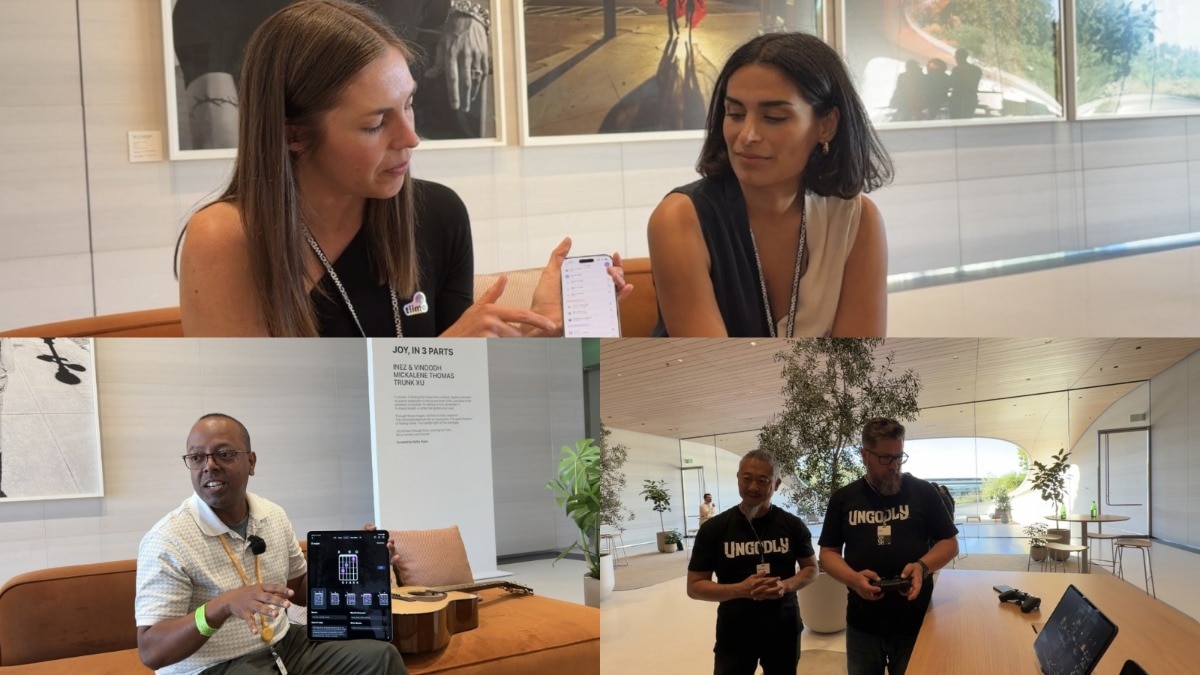
While WWDC is often viewed through the lens of flashy consumer features, the real story usually lies a layer deeper. Behind every new Siri capability, AI feature or software redesign is a set of tools that developers can use to build the next generation of apps. Most of these tools aren’t headlines for consumers but they play a key role in shaping Apple’s app universe. Read Full Story Walking around Apple Park after the keynote and entering the iconic Observatory, I spoke to several developers who are already experimenting with Apple's latest AI stack. Their message was remarkably consistent: Apple is giving them more intelligence, more system integration and more privacy-preserving tools–without requiring them to build and train large AI models of their own. In the months ahead, that shift could fundamentally change how apps are built on Apple's platforms. Apple wants developers to use and not build AI Melissa Wurtz Azari and Helene Lassen Norlem, co-founders of productivity app Timo. One of the most interesting conversations I had was with Melissa Wurtz Azari and Helene Lassen Norlem, co-founders of productivity app Timo. Timo is designed as a visual planner that helps users organise their day, prioritise tasks and track productivity. But increasingly, AI is becoming the engine underneath the experience. "We have integrated a lot of AI and foundation models to make planning effortless and take the tedious part out of creating your to-do list and schedule," Azari told India Today. The timing could not be better. One of WWDC's most significant developer announcements was Apple's continued expansion of on-device foundation models and improved Apple Intelligence capabilities. Instead of forcing developers to train expensive proprietary AI systems, Apple is effectively providing the intelligence layer while developers focus on building experiences around it. For Timo, that means users can simply "brain dump" tasks into the app and allow AI to organise them into a schedule. More importantly, future Apple Intelligence capabilities could allow the app to become far more proactive. Norlem explained that the company wants to combine planning data with contextual information such as sleep patterns, activity levels and other health indicators to help users build more realistic schedules. "If you had a really poor night's sleep, instead of having a very early workout, it can suggest moving things around," she said.
The vision is clear: apps that adapt to the user rather than forcing users to adapt to the app. Privacy as a feature, not limitation Building up to WWDC 2026, I could sense that AI has created a dilemma for developers. Smarter software often requires more personal information, but users increasingly want stronger privacy protections. Apple believes it has found a middle path. During my conversation with the Timo founders, I asked whether Apple's privacy restrictions create challenges for developers trying to build intelligent systems. Surprisingly, they argued the opposite. "What we do with Apple’s foundation models is actually on-device," Azari explained. "We don't send it to our backend.” The founders said they are not interested in training their own AI models. Instead, they would rather rely on Apple's models and other established AI systems like ChatGPT while focusing on creating useful experiences. For smaller development teams, that approach offers a significant advantage. Building state-of-the-art AI infrastructure is expensive and technically complex. If Apple can provide much of that intelligence layer while keeping user data on-device, developers can concentrate on solving actual user problems. That philosophy was visible throughout WWDC 2026. Whether it is Apple Intelligence, Siri AI or Private Cloud Compute, Apple continues to position privacy as a competitive advantage rather than a compromise. Siri AI as the next app interface Another recurring theme from developers was the growing importance of Siri AI. For years, developers largely built around touch interfaces. Users opened apps, tapped buttons and navigated menus. That may be changing with this year’s announcements. For example, Timo team highlights Siri AI as the most exciting WDC announcement this year. "I'd say both foundation models and Siri AI," Norlem said. "You will start using your phone more as a personal assistant." The implication is significant. Rather than opening an app and manually reorganising tasks, users could simply ask Siri to reschedule meetings, move workouts or adjust plans. This way, the app becomes less of a destination and more of a service that works through the upgraded Apple's intelligence layer. This is exactly the kind of future Apple appears to be building toward — one where Siri evolves from a voice assistant into a true operating system-level agent capable of interacting with third-party apps. The possibility becomes even more interesting as Apple expands integrations with external AI systems, including Google's latest AI technologies.
For developers, that means access to increasingly sophisticated intelligence without having to reinvent the wheel themselves. Building deeper into Apple’s ecosystem Bijoy Thangaraj, founder of music-learning platform Guitar Wiz. Not every developer was focused on AI at WWDC. Bijoy Thangaraj, founder of music-learning platform Guitar Wiz, offered a different perspective on why developers continue to build for Apple's ecosystem. For him, the advantage is less about artificial intelligence and more about platform integration. His app spans iPhone, iPad, Apple Watch, iMessage, widgets, Dynamic Island, Siri Shortcuts and even Live Activities. Rather than treating each device as a separate platform, he sees Apple's ecosystem as one interconnected experience. "The app is highly integrated with the Apple ecosystem," said Thangaraj. He demonstrated how tuning tools work on the Apple Watch, how lessons can be shared through iMessage and how the interface dynamically adapts across iPhone, iPad and Mac. WWDC's latest tools only strengthen that proposition. Developers are increasingly being encouraged to build once and extend experiences across Apple's growing family of devices. That continuity remains one of Apple's biggest advantages over competing platforms. This is one of the biggest reasons developers want to create on Apple platforms. The seamless integration across devices gives them that advantage to build seamless without worrying about device compatibility. Where Thangaraj sees the biggest AI opportunity is personalisation. The challenge for educational apps has always been that beginners and experts need different explanations. Traditionally, developers had to manually create multiple learning paths. Apple Intelligence changes that equation. Thangaraj explained that Guitar Wiz feeds its music theory framework into Apple's AI systems, which then tailor explanations based on a user's skill level. For example, a beginner receives a simplified explanation. An advanced musician receives a more technical breakdown. Jazz players even receive explanations framed through concepts familiar to jazz musicians. "The backend comes from my framework, but Apple Intelligence customises it for that specific user," he said. This is perhaps one of the most practical AI use cases emerging from WWDC 2026. Rather than generating entirely new content, AI acts as a translation layer that adapts information to individual users. Bringing console-quality experience to Apple users CEO Mark Otero and VP Philip Bang of Azra Games. AI may have dominated conversations at WWDC, but gaming developers face a different set of opportunities.
At Azra Games, CEO Mark Otero and VP Philip Bang are attempting something ambitious: delivering a AAA-quality role-playing game across iPhone, iPad, Mac and Apple Vision Pro. Historically, mobile hardware limitations forced developers to compromise. Fidelity was sacrificed in exchange for performance. Otero said that the company initially targeted the iPhone 14 and newer devices. However, engineering breakthroughs have allowed the game to run on devices as old as the iPhone 12 Pro. For developers, that wider compatibility matters enormously because it expands the potential audience without requiring multiple versions of the same game. Interestingly, Bang suggested that Apple's greatest contribution was not necessarily a new WWDC announcement but ongoing engineering support. "The Apple engineering team has been wonderful in supporting us to get the most out of the engine on iOS devices and across the Apple ecosystem," he said. That collaborative relationship is often overlooked when discussing Apple's developer strategy. The bigger picture When one looks at what developers across productivity, education and gaming, are saying, a common pattern emerges. Apple is not asking developers to become AI researchers. Instead, the company is providing a growing toolkit of foundation models, Apple Intelligence services, Siri AI integrations and privacy-preserving frameworks that developers can build upon. The result is a potentially powerful division of labour. Apple handles the underlying intelligence. Developers focus on creating unique experiences. The opportunities are obvious: smarter apps, deeper personalisation and more natural interactions. The challenge, however, will be ensuring these AI capabilities remain genuinely useful rather than becoming novelty features. While some of the AI announcements coming out of WWDC promise a more seamless journey for developers to integrate their tools and build on top of the AI, it’ll be interesting to see how some of the users adapt to these changes and whether they do add value to the overall experience. For now, developers at Apple Park appear optimistic. And if the conversations I had this week are any indication, WWDC 2026 may ultimately be remembered not for a single feature announcement, but for giving developers something far more valuable: a practical way to bring AI into their apps without losing sight of the user. Ends
 The BriefWire