Water crisis in Madhya Pradesh village forces women into 50-foot-deep rocky ravine
The saying "boond-boond se ghat bharat hai (many a little makes a mickle)" often describes patience and perseverance. But in a small village in Madhya
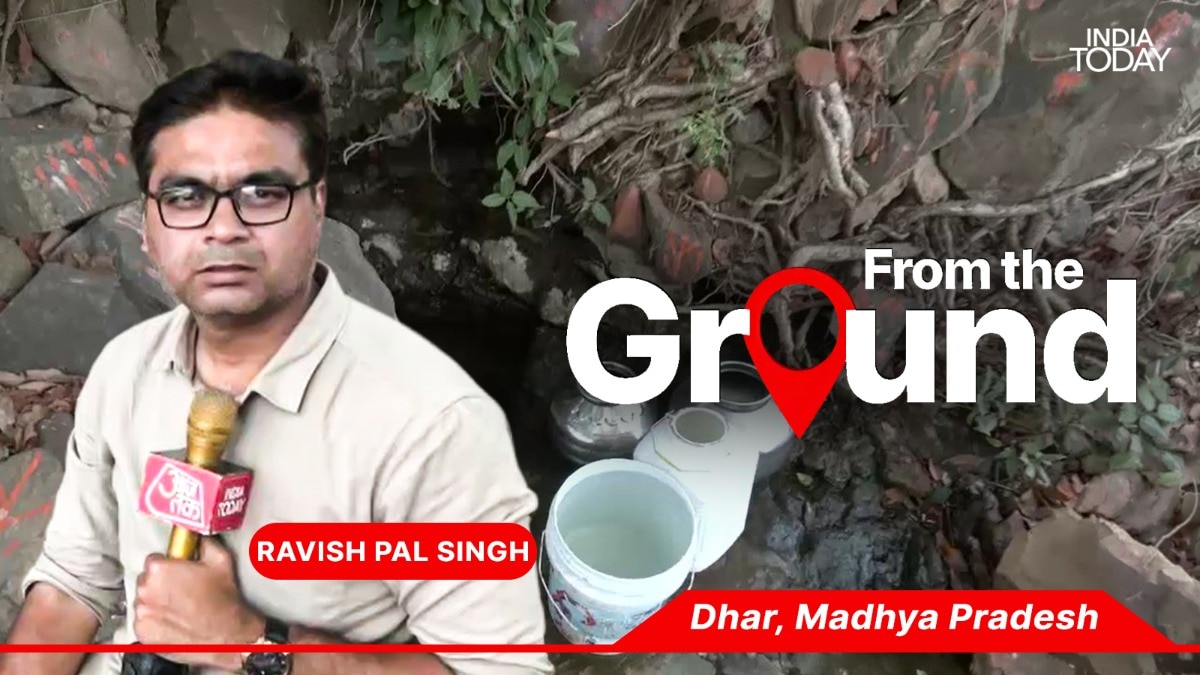
The saying "boond-boond se ghat bharat hai (many a little makes a mickle)" often describes patience and perseverance. But in a small village in Madhya Pradesh's Dhar district, the phrase is a harsh reality. Here, people quite literally collect water drop-by-drop to survive. India Today’s Ravish Pal Singh reached ground zero in Dhar and captured the situation that raises serious questions around the struggles people have to grapple with to fulfil needs as basic as water. Read Full Story Here is what he found When I arrived in Utawa village, I knew there was a water shortage. Reports had indicated that residents were struggling for drinking water. However, what I witnessed on the ground was far more disturbing than a simple water crisis. It was a glaring gap between official claims and reality—a gap that, quite literally, stretched 50-feet-deep into a rocky ravine. It was around noon when I reached the village. The sun was unforgiving, and the temperature had already crossed 43 degrees Celsius. As I walked through the settlement, I noticed a group of women carrying empty containers on their heads and making their way towards a barren stretch of land. Curious, I followed them. After a short walk, the terrain suddenly opened into a deep ravine surrounded by rugged cliffs and jagged rocks. The women pointed towards the bottom and told me that this was where they came every day to fetch water.
Just looking down from the edge was enough to make me feel uneasy. The descent appeared dangerous, with loose stones and steep slopes. Yet the women began climbing down with practised ease. Determined to understand their struggle, I followed them. Holding onto rocks and carefully placing each step, I descended into the ravine. The journey itself was exhausting and frightening. By the time I reached the bottom, I had begun to understand the price these women pay every single day for a bucket of water. What I found there was shocking. There was no well. No handpump. No stream. Instead, tiny droplets of water were slowly seeping out from cracks in the earth. The droplets collected in a small depression in the ground, forming a shallow pool. This was the village's water source. The flow was painfully slow. Once the accumulated water was scooped out, it took nearly two hours for the pit to fill again. The women sat quietly around the depression, waiting patiently for their turn. There was no alternative. Among them was Sushma, a resident of the village. As we spoke, she told me that fear accompanies every trip to the ravine. Pointing towards a dry, fallen tree nearby, she recalled a tragic incident from last year. Her sister-in-law had come here to collect water when a large branch of a tree suddenly fell on her.
The memory still haunted the family. The dangers are everywhere. Loose rocks, steep slopes, falling debris, and the constant risk of slipping while carrying water make every visit a gamble. Yet necessity leaves them with no choice. Nearly two hours later, the depression had collected enough water again. One-by-one, the women filled their containers. As the sun began its slow descent, they prepared for the journey back home. That was when I realised that fetching water was only half the battle. The climb back up was far more difficult. Balancing heavy containers filled with water on their heads, the women carefully made their way up the steep slope. One wrong step could send them tumbling onto the rocks below. As I watched, my attention was drawn to an elderly woman who appeared to be around 70-years-old. Despite her age, she was carrying a large water container and slowly making her way up the ravine. I could not simply stand and watch. "Amma, let me carry that for you," I said. She hesitated for a moment before handing over the container. I lifted it onto my head and began climbing. Within minutes, the weight became overwhelming. My legs felt heavy, and I struggled to maintain balance on the uneven terrain. At that moment, I understood something important. For me, carrying the container for a few minutes was exhausting.
For these women, this ordeal is a daily routine. What makes the situation even more troubling is that a water supply project already exists in the village. Assistant Engineer Vinod Mahajan told me that a pipeline had been laid under the Jal Jeevan Mission. According to him, the project was completed at a cost of Rs 1.17 crore and later handed over to the Gram Panchayat. However, this year, depleting groundwater levels have severely affected the source. A newly installed tubewell has failed to provide the expected yield, resulting in an acute shortage of water. On paper, crores of rupees have been spent and infrastructure has been created. But on the ground, the taps remain dry. As I left Utawa village, dust covered my shoes, my body was drained from the heat, and my throat was parched. Yet the greatest burden I carried back was a question that lingered at the edge of that ravine. If water has truly reached every household, then why are the women of Utawa still risking their lives every day to collect it drop-by-drop from the cracks in the earth? Ends
 The BriefWire