Scientists use rice's hidden weakness to create self-changing material
Scientists discovered a rare behaviour in rice Why does rice become weaker under rapid compression? Turning rice into a smart metamaterial A material that responds
Scientists discovered a rare behaviour in rice Why does rice become weaker under rapid compression? Turning rice into a smart metamaterial A material that responds on its own Potential uses in robotics Could it improve protective equipment? What happens next? Rice is one of the world's most important food crops, feeding billions of people every day. But scientists have now discovered that it possesses a surprising physical property that could help inspire future technologies. Researchers found that tightly packed rice grains behave in an unusual way under pressure, becoming weaker when compressed quickly rather than stronger. By harnessing this unexpected behaviour, the team created a new type of smart material that can automatically respond differently to slow movements and sudden impacts. The discovery could eventually lead to safer soft robots, improved protective equipment and other materials that adapt without the need for electronics or sensors.The research, led by the University of Birmingham and published in the journal Matter, focused on how rice grains behave when packed together and subjected to pressure.During experiments, the researchers observed that rice responded very differently depending on how quickly a force was applied.
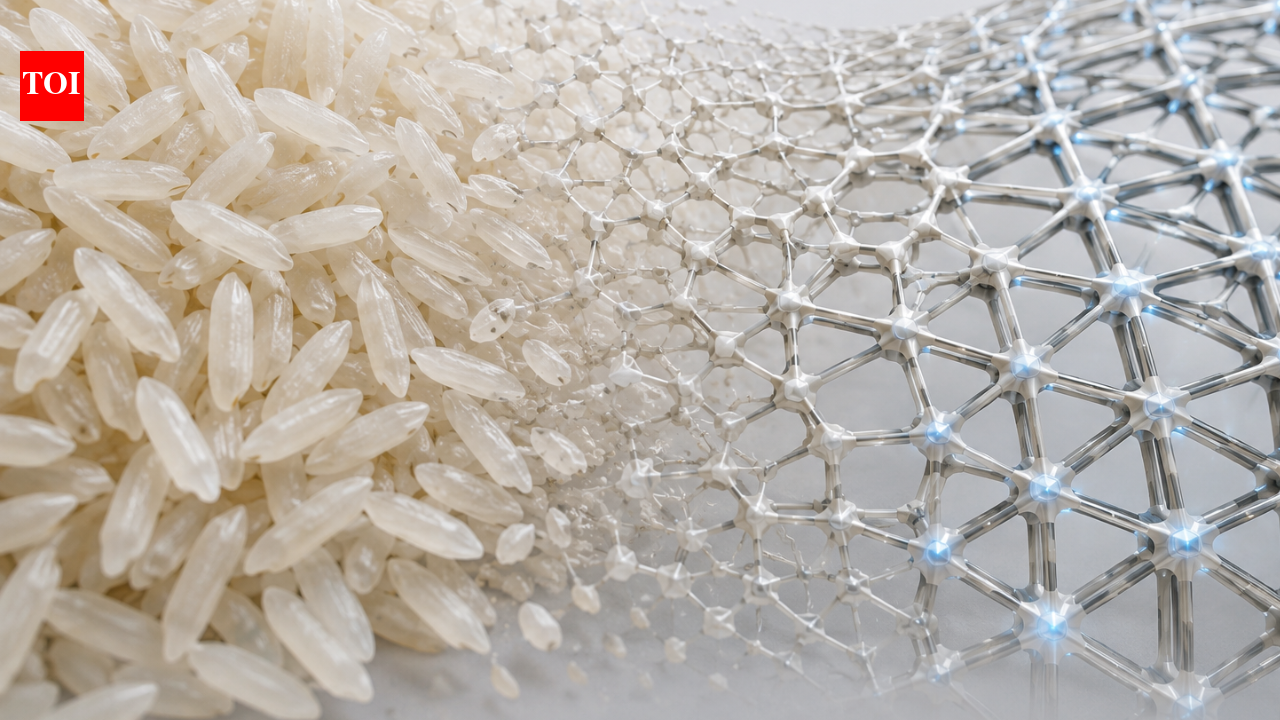
When compressed slowly, the grains remained relatively strong. However, when compressed rapidly, the material weakened significantly.This behaviour is unusual because most materials either maintain similar strength under different loading speeds or become stronger when subjected to sudden forces. Rice, however, exhibited what scientists call "rate softening", a tendency to become weaker as the loading speed increases.The researchers found that the phenomenon is linked to friction between individual rice grains.Normally, friction helps create networks of internal forces that allow granular materials to support weight and resist deformation. But in rice, the friction between grains drops sharply when pressure is applied quickly.As a result, the internal force chains become less effective, causing the packed rice to weaken under rapid loading. This unusual mechanical response is rarely seen in common materials and caught the researchers' attention as a potential engineering tool rather than just a scientific curiosity.Rather than stopping at the discovery, the team used rice's unusual behaviour to design a new granular metamaterial.Metamaterials are engineered structures whose properties arise from their design rather than simply from the materials they are made from.To create the new system, the researchers combined rice-based granular units with other materials such as sand, which tend to become stronger when subjected to rapid forces.
By carefully arranging these components, they produced a material that can react differently depending on the speed of an impact or movement.The result is a structure capable of changing its mechanical behaviour automatically, without requiring electronics, software or external controls.One of the most remarkable aspects of the new material is that it does not rely on sensors or power sources.Instead, its behaviour is governed entirely by physics. Depending on the situation, the material can bend, buckle or stiffen in different ways. Slow movements may trigger one response, while sudden impacts can trigger another.According to the researchers, this approach allows the material itself to determine how it should react, eliminating the need for complex control systems.The discovery could be particularly valuable in the field of soft robotics.Unlike conventional robots built from rigid metal components, soft robots are designed to be flexible and safer around people. Materials that can automatically adjust their behaviour could help future robots adapt to changing environments and interact more safely with humans.Such systems may eventually find applications in healthcare, manufacturing, search-and-rescue operations and even surgical assistance, where delicate and adaptive movement is essential.The researchers also believe the material could have applications in protective gear.Because it responds differently depending on the speed of an impact, it may be able to absorb energy or deform in controlled ways during collisions.
This could prove useful for helmets, sports equipment, industrial safety gear and other products designed to reduce injury risks.Importantly, these protective responses would occur naturally through the material's structure rather than through electronic monitoring systems.While the results are promising, the technology remains at an early stage. The researchers have demonstrated the concept in laboratory experiments, but further work will be needed before it can be incorporated into commercial products.Future studies will focus on refining the material, testing its durability and exploring how it can be manufactured on a larger scale. If successful, the discovery could help establish a new class of mechanically intelligent materials inspired by an everyday grain found in kitchens around the world.
 The BriefWire