Energy Prices To Jobs: What Was Discussed At NITI Aayog Meet Chaired By PM Modi?
Energy Prices To Jobs: What Was Discussed At NITI Aayog Meet Chaired By PM Modi? Published By, Last Updated: June 12, 2026, 09:56 IST For
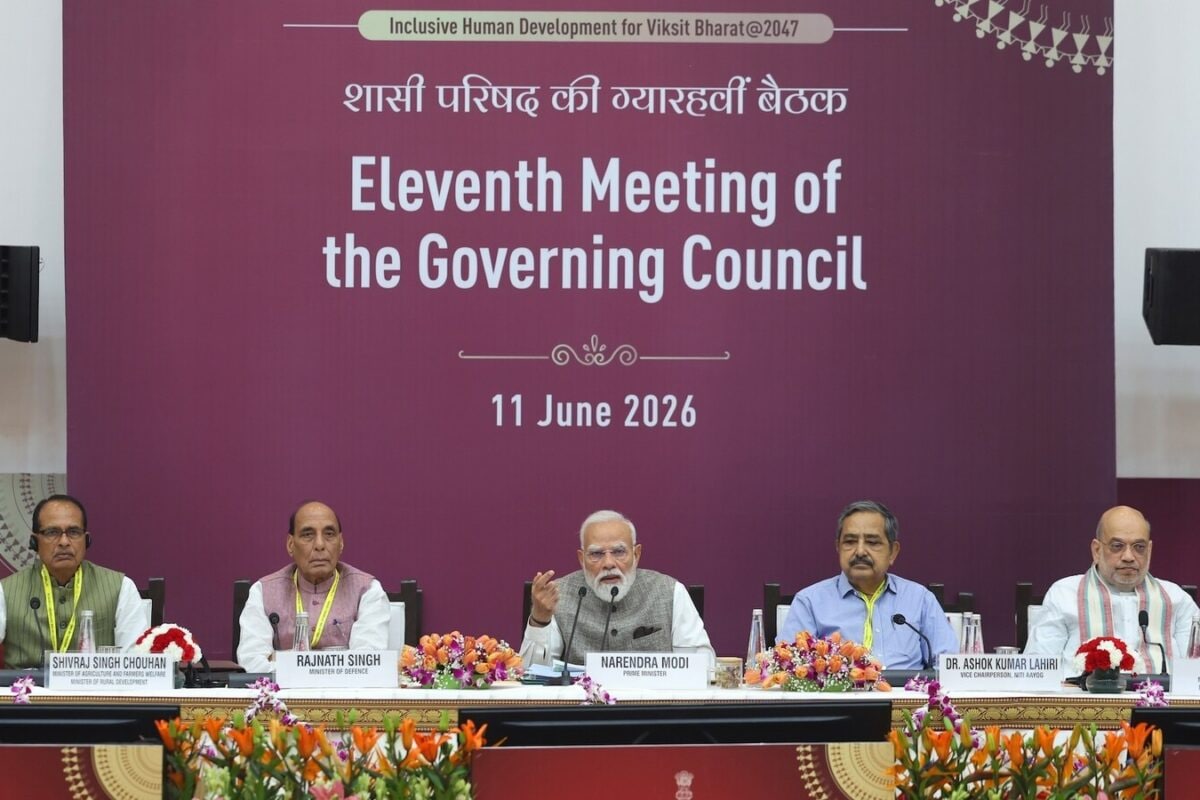
Energy Prices To Jobs: What Was Discussed At NITI Aayog Meet Chaired By PM Modi? Published By, Last Updated: June 12, 2026, 09:56 IST For the first time, Chief Ministers of all 28 states attended the NITI Aayog Governing Council meeting chaired by PM Modi, including those from seven Opposition-ruled states. Rapid Read PM Modi during the 11th meeting of the Governing Council of NITI Aayog, in New Delhi. Union Ministers Amit Shah, Rajnath Singh, Shivraj Singh Chouhan, NITI Aayog Vice Chairperson Ashok Kumar Lahiri also seen. (PTI) Prime Minister Narendra Modi on Thursday asked states to move faster on investment, manufacturing, skilling and district-level growth planning as the 11th Governing Council meeting of NITI Aayog took place against the backdrop of rising crude prices linked to the West Asia crisis. The meeting, chaired by the Prime Minister, was attended by Chief Ministers of all 28 states, including seven ruled by Opposition parties. This was the first time when Chief Ministers of all 28 states participated in the Governing Council Meeting of NITI Aayog. The theme of the meeting was “Inclusive Human Development for Viksit Bharat@2047". Energy Prices, Solar Push Discussed Amid West Asia Crisis Energy emerged as one of the main talking points at the meeting, with Chief Ministers raising concerns over the need for affordable and reliable energy at a time when global crude prices have risen due to the West Asia conflict. NITI Aayog Vice Chairperson Ashok Kumar Lahiri said there was a detailed discussion on making energy prices competitive and ensuring reliable energy supply. “On energy, there was a lot of discussion… on making energy prices competitive and making reliable energy available. The governing council members also talked about spreading solar energy on rooftops, in residential buildings, in schools, hospitals and government buildings so that dependence of households on grid electricity is reduced and the subsidy problem becomes manageable," Lahiri said. He also said India could not afford to slow down its development agenda because of external uncertainty. “Just because the West Asia crisis is there, we can’t be paralysed.
We have to keep doing our work, develop our human capital," Lahiri said. Lahiri said India was playing its role in managing the West Asia crisis, but added that the country, as one of the fastest-growing major economies, needed to “keep doing our homework", especially in developing human capital. PM Modi Pushes Self-Reliance, Renewable Energy Best Practices According to Lahiri, the Prime Minister underlined that India’s growth story continued to move forward despite uncertainty and economic stress in many major economies. “The Prime Minister emphasised how at a time when many major economies are facing uncertainty and economic challenges, India’s growth story continues to move forward with confidence and determination," Lahiri said. PM Modi also stressed the need to strengthen India’s resolve towards self-reliance and highlighted the importance of adopting global best practices, particularly in renewable energy. NITI Aayog member Abhay Karandikar said Chief Ministers also discussed nuclear energy and the SHANTI Act, which was passed last December and opened the sector to private players. “…this could become a good source of energy particularly when many of the states are looking forward to setting up data centres," Karandikar said. Manufacturing, Trade Deals And State-Level Investment Push Manufacturing was another major focus area of the meeting. Lahiri said the Prime Minister and most Chief Ministers were clear that India needed to scale up manufacturing. “The PM spoke about the next generation of manufacturing," Lahiri said. The Prime Minister also referred to India’s recently concluded trade agreements with several countries and encouraged states to create opportunities for youth and MSMEs so that they can benefit from these deals. According to a PIB release, PM Modi urged states to actively attract investments from partner countries. He asked them to address investor grievances quickly and pursue investment opportunities more aggressively. The Prime Minister also asked states to focus on One District One Product initiatives and develop export-oriented strategies around them. He identified defence manufacturing as an emerging sector where India was building a distinct identity and encouraged states to frame policies to make use of opportunities in the sector.
District-Level GDP Estimates For Grassroots Growth PM Modi also asked states to prepare district-level GDP estimates to understand and address growth-related challenges at the grassroots level. The idea, as discussed at the meeting, was to make planning more localised and data-driven so that states can identify which districts need sharper economic intervention, better infrastructure, stronger skilling or more investment support. Jobs, Skilling And India’s Youth Dividend Employment and skilling were also discussed in detail. Lahiri said the Prime Minister stressed the need to adapt to new technologies with changing times. “Another thing that the PM emphasised in the skill formation was partnership with industry. It was felt that a great collaboration between industry and a skilled institution is very important," Lahiri said. The Prime Minister also highlighted India’s demographic profile, noting that nearly 70 crore Indians are below the age of 25. He described this as a demographic dividend and urged states to turn it into a development dividend through education, skilling and capacity-building. States sought greater support for professional skilling, especially as AI, automation, green energy and other new industries change the nature of work. Jharkhand Chief Minister Hemant Soren sought Central assistance for an estimated Rs 800-crore project to set up a Skill University and a FinTech University in the state. Soren said rapid technological changes driven by AI, automation and the green economy were reshaping jobs and that states needed to prepare young people for future-ready work. He said Jharkhand was expanding training in solar technology, EV repair, drone operations, healthcare and digital services to improve employability. Women-Led Development And Lakhpati Didis The Prime Minister also put emphasis on women-led development. According to the official statement, he asked states to work towards increasing the number of Lakhpati Didis from 3 crore to 6 crore. He also stressed the importance of ensuring a safe and secure environment for Nari Shakti. The Lakhpati Didi initiative is linked to women’s economic empowerment through self-help groups and livelihood opportunities. By asking states to double the target, the Prime Minister placed women’s income generation within the larger Viksit Bharat framework.
What Chief Ministers Raised While Lahiri said there were no detailed state-specific demands raised inside the meeting, several Chief Ministers later put out details of issues they had discussed or flagged. Telangana Chief Minister Revanth Reddy said in a social media post that he requested the Prime Minister’s intervention in expediting approvals and support for projects including Hyderabad Metro Rail expansion, Regional Ring Road, a 12-lane expressway from Future City to Bandar seaport in Andhra Pradesh, and airports at Warangal and Adilabad. Jammu and Kashmir Chief Minister Omar Abdullah said in a post on X that he discussed key issues concerning J&K, including early restoration of statehood, the state of the economy and the pace of development. Abdullah said continued support from the Centre was needed to accelerate economic growth, strengthen connectivity, generate employment, expand infrastructure and improve public welfare across J&K. Lahiri said he was impressed with Tamil Nadu Chief Minister C Joseph Vijay, who said he wanted the state to grow into a 1.5 trillion economy by 2035. Asked about West Bengal Chief Minister Suvendu Adhikari, Lahiri said there was no elaborate discussion. “The CM tangentially mentioned that because of the history of the state, he may need support but nothing concrete," he said. News18 Newsletter Handpicked stories, in your inbox A newsletter with the best of our journalism submit About the Author Karishma Jain Karishma Jain, Chief Sub Editor at News18.com, writes and edits opinion pieces on a variety of subjects, including Indian politics and policy, culture and the arts, technology and social change. Follo... Read More First Published: June 12, 2026, 09:56 IST News india Energy Prices To Jobs: What Was Discussed At NITI Aayog Meet Chaired By PM Modi? Disclaimer: Comments reflect users’ views, not News18’s. Please keep discussions respectful and constructive. Abusive, defamatory, or illegal comments will be removed. News18 may disable any comment at its discretion. By posting, you agree to our Terms of Use and Privacy Policy Loading comments...
 The BriefWire