Inside India’s ethanol revolution in reverse
First E20, then E85, now E100 and finally, flex fuel vehicles—India is undertaking an audacious experiment to build a new multi-billion-dollar green mobility ecosystem. But
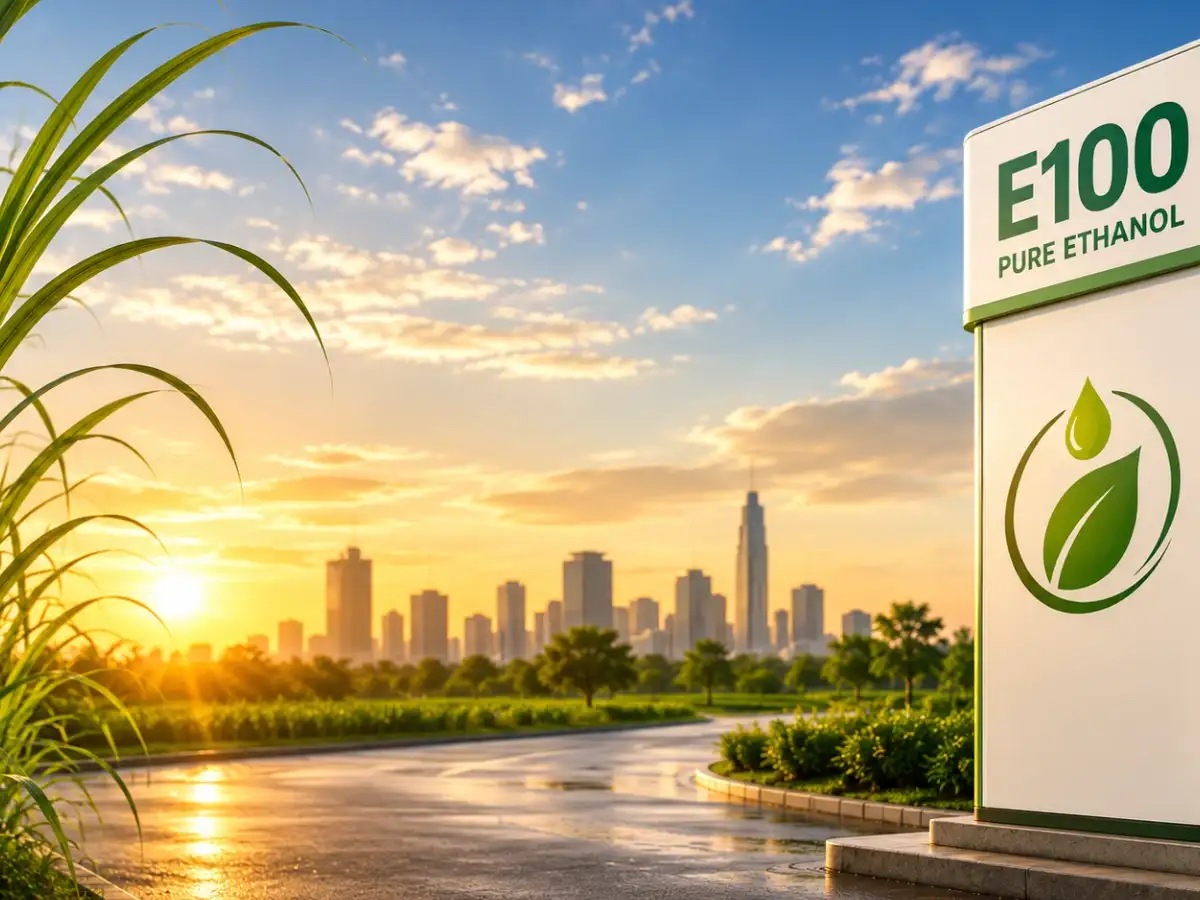
First E20, then E85, now E100 and finally, flex fuel vehicles—India is undertaking an audacious experiment to build a new multi-billion-dollar green mobility ecosystem. But here’s the catch: it’s playing the long game, completely in reverse.In standard industrial transitions, the market responds organically to vehicle demand by slowly introducing fuel infrastructure over time; for example, the way the country’s first electric vehicles were rolled out.However, under a recent order from the Central government, the infrastructure for E100 is essentially arriving first.Also Read | Maruti Suzuki launches India's first fle fuel car, bets on biofuels to boost energy securityDriven by a pressing need to secure national energy self-reliance and shield the domestic economy from volatile geopolitical crises—particularly the ongoing oil trade disruptions in West Asia—the Ministry of Petroleum and Natural Gas, alongside state-run oil marketing companies, has committed to laying down 5,000 dedicated E100 dispensing stations across the country over the next two years.“India imports a large quantity of crude oil every year, and biofuels like ethanol are an important pathway towards reducing this dependence while strengthening our rural economy. Fle Fuel Vehicles can create a strong and sustainable demand for ethanol, benefiting our farmers, industry, and the environment together,” Union Road Transport Minister Nitin Gadkari said at an event in New Delhi last week.“Today, we are facing an energy crisis due to the war in West Asia, so it is necessary for us to become self-reliant in the energy sector,” he had said earlier.The physical distribution network is springing up before fle fuel vehicles have even rolled off assembly lines, and there may be some questions.At the very heart of this systemic transformation sits the domestic sugar and distillation industry. Ethanol is fundamentally a high-purity alcohol. Just as traditional alcohol is created through fermentation, the bio-ethanol used to power cars is produced by capturing the natural chemistry of sugar and microscopic organisms.Deepak Ballani, the Director General of the Indian Sugar Mills Association (ISMA), views this massive transition not merely as a temporary patch for the automotive market, but as a structural overhaul of how India generates and consumes energy.Also Read | India waives excise duty on petrol with higher ethanolAccording to Ballani, the entire premise of the debate around biofuels needs to change.He points out that looking at ethanol as a mere substitute for petrol misses the larger economic picture.
“The premise assumes that ethanol is merely a substitute for petrol, whereas its value extends far beyond fuel price parity,” Ballani said.“Ethanol is a domestically produced renewable fuel that reduces India's dependence on imported crude oil, improves energy security, and creates a stable income stream for farmers and rural economies,” the ISMA chief added.Breaking the chicken-and-egg dilemmaFor decades, the global transition to alternative fuels has been plagued by a classic chicken-and-egg dilemma where automakers refuse to manufacture alternative fuel vehicles because there are no dispensing pumps, and fuel providers refuse to install pumps because there are no vehicles to buy the fuel.India has smashed this deadlock by moving the fuel supply mechanism ahead of the vehicle market.The country has already executed a rise under its Ethanol Blended Petrol Programme, lifting ethanol blending in standard petrol from a meagre 1.5% in 2014 to a ubiquitous 20% today.According to a PIB release this month, that 20% achievement alone has unlocked a staggering Rs 1.84 lakh crore in foreign exchange savings through the substitution of 302 lakh metric tonnes of imported crude oil.However, the leap from E20 to E100, which represents 100% pure ethanol, introduces some technical and structural complexities.Recognising that the infrastructure must act as the primary catalyst, Union Minister for Petroleum and Natural Gas, Hardeep Singh Puri, announced a hyper-accelerated rollout of 50 to 100 ethanol dispensing stations across the Delhi-NCR region and the Mumbai-Pune-Nagpur corridor.This regional pilot network is targeted to swell to 500 hundred stations by December 2026, culminating in a sprawling web of 5,000 across major cities by the end of 2027.Seeing the plan of physical pumps materialise, within days of E100 pump announcement, market leader Maruti Suzuki took the definitive first step.On June 4, the auto giant officially launched India’s first fle fuel passenger car, the Wagon R Flex Fuel that is able to operate seamlessly on any blend of petrol and ethanol between E20 and E100."A new chapter in India's energy journey,” is what Hisashi Takeuchi, Managing Director & CEO of Maruti Suzuki India termed the event.However, the Maruti Suzuki head called for some team effort."Large-scale adoption of fle fuel will take time and effort from all stakeholders. An entire ecosystem needs to be developed – from fuel availability to more model launches, from customer awareness to fuel and vehicle pricing.
In the absence of an ecosystem, it is the responsibility of the market leader to take the first step and encourage others,” he said.Once it reaches mainstream adoption, Takeuchi stressed that "Fle Fuel Vehicles have the potential to cut oil imports, carbon emissions, and local air pollution while enhancing domestic value addition and farmer incomes."Simultaneously, the two-wheeler segment has also entered the space as Hero MotoCorp recently debuted the country's first fle fuel motorcycles, launching E85-ready variants of its legacy commuter mainstays, the Splendor Plus and the HF Deluxe.Navigating technical realitiesNow, India has a new category in four-wheelers as well as two-wheelers. But what’s new?To the uninitiated, running a vehicle on ethanol sounds like a simple software recalibration. To an automotive engineer, it can be a challenge.According to the International Energy Agency, ethanol possesses distinct mechanical traits that make it highly corrosive, hygroscopic and lower in energy density than standard fossil fuels.The agency reports that because ethanol naturally pulls water out of the air, standard automotive fuel systems left untreated would face internal corrosion, leading to rusted fuel tanks, clogged fuel lines, and disintegrated rubber seals.To bypass this, an auto engineering team has to overhaul the vehicle's internals.For example, the Wagon R Flex would likely feature a completely redesigned architecture including fortified, corrosion-resistant fuel lines, heavy-duty robust seals, completely overhauled fuel injectors, and an advanced, specially calibrated Engine Management System designed to adapt dynamically to the unique chemical properties of varying ethanol concentrations.Moreover, the IEA notes “Ethanol has a significantly lower energy density (Joule per liter), about two‐thirds of that of gasoline, so about 50 percent more fuel (by volume) is needed per kilometer, if a given engine is equally efficient on either fuel.”This means that a vehicle operating on pure E100 or high-blend E85 will require a greater volume of fuel to cover the same distance as a petrol car.However, amid these technical changes, public anxiety around transition readiness, the Society of Indian Automobile Manufacturers, in an August 2025 report, said that allegations suggesting specifically E20 affecting insurance and warranty of vehicles are “baseless.”In the same report, the industry body further addressed widespread consumer concerns about mileage loss and called it “misplaced”.“Real-world vehicle mileage depends far more on distinct everyday factors like driving habits, maintenance practices, the age of the vehicle, tyre conditions, and the usage of AC load,” it added.More recently, SIAM said that for E100 or E85 to make financial sense for average Indian consumers, the fuel must be priced at least 30% cheaper at the pump than conventional E20 petrol.On the heels of Maruti’s launch and the E100 pump announcement, the Central government on Wednesday rolled out another initiative that could help tackle this cost concern.India, the world's third-largest oil importer and consumer, abolished central excise duty on petrol blended with higher levels of ethanol.A Ministry of Finance notification extended central excise duty exemptions to petrol blended with 22%, 25%, 27%, and 30% ethanol.
The nil excise duty rate will apply to all four blends, provided they conform to Bureau of Indian Standards specification IS 19850.On the other hand, pure E100 opens up structural efficiencies that standard blends cannot offer. Ballani highlights this supply chain advantage.“Hydrous E100 does not require blending with gasoline and can be supplied directly from distilleries to retail outlets, eliminating blending costs and simplifying the supply chain,” he said.How India diverges from brazilTo understand the scale of India's ambition, one must contrast it with the global gold standard of biofuels, which is Brazil.Brazil’s legendary fle fuel ecosystem, which allows consumers in the country to alternate between different vehicles requiring pure gasoline and pure sugarcane ethanol, was built via a bottom-up approach spanning over five decades.Spurred by the global oil shocks of the 1970s, Brazil's government subsidised massive agricultural expansions, gradually integrated low blends, and allowed the auto industry decades to slowly mature its engine tech.Furthermore, Brazil relies on a massive, highly specific agricultural surplus of sugarcane grown in vast, rain-heavy, non-irrigated zones, making it uniquely isolated from food-versus-fuel debates.India’s model is radically different, marked by speed, agricultural diversity, and technological leapfrogging.While Brazil utilised a slow, evolutionary rollout over fifty years, India is executing a compressed, revolutionary strategy.
 The BriefWire