Why do humans fall in love? The answer may lie in a small rodent from the American Midwest
The rodent that changed the science of love A breakthrough hidden inside the brain Why human love feels so powerful An evolutionary solution to a
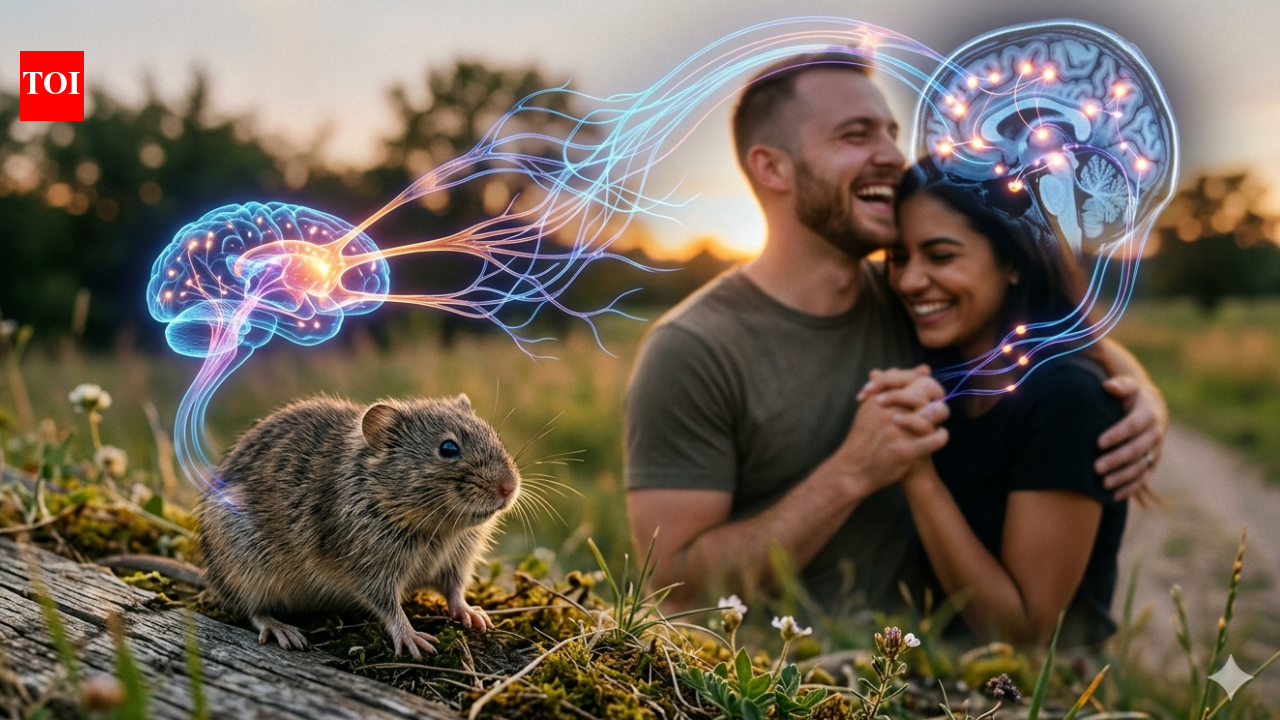
The rodent that changed the science of love A breakthrough hidden inside the brain Why human love feels so powerful An evolutionary solution to a difficult problem The ancient origins of attachment Why scientists are still studying love The mystery that remains Love has inspired poetry, fuelled wars, launched lifelong partnerships and broken countless hearts. It can feel overwhelming, irrational and impossible to explain. Yet some of the most important clues about why humans fall in love did not emerge from studies of couples, philosophers or poets. Instead, they came from a small brown rodent scurrying through the grasslands of the American Midwest. For decades, scientists have turned to prairie voles to investigate one of humanity's oldest mysteries. What they discovered transformed our understanding of romance, revealing that the roots of love may lie deep within the brain's chemistry and millions of years of evolution.At first glance, prairie voles seem unremarkable.These mouse-sized rodents live across parts of the central United States and spend much of their time foraging and building nests. What attracted scientific attention was their social behaviour. Unlike many mammals, prairie voles often form long-term pair bonds. Males and females share nests, raise offspring together and frequently remain with the same partner.Nearby lives a close relative, the meadow vole. The two species look remarkably similar, yet their behaviour is very different.Meadow voles generally do not form lasting pair bonds and tend to have multiple partners.For researchers, the contrast presented an intriguing puzzle.
Why would two nearly identical animals approach relationships in such different ways?The answer began to emerge in the late twentieth century when neuroscientists started examining the brains of prairie voles.They discovered that the animals possessed unusually high concentrations of receptors for oxytocin and vasopressin, hormones involved in social bonding. These receptors were concentrated in regions of the brain associated with reward and motivation.Experiments revealed something remarkable. When researchers blocked the action of these hormones, prairie voles often failed to form pair bonds. When the same systems were manipulated in other ways, attachment behaviours could be strengthened or weakened.The findings suggested that bonding was not simply a matter of instinct or behaviour. It was linked to specific neural circuits.Scientists had uncovered evidence that social attachment could be influenced by the architecture of the brain itself.Humans are far more complex than voles, but subsequent research has revealed striking parallels.Brain imaging studies have shown that people experiencing intense romantic love display heightened activity in regions rich in dopamine, a neurotransmitter associated with reward, motivation and pleasure. Some of the same neural pathways activated during romantic attraction are also involved in reinforcement learning and goal-directed behaviour.This helps explain why falling in love can feel so consuming.People often find themselves thinking constantly about a partner. They may experience bursts of excitement after receiving a message or hearing a familiar voice. Separation can feel surprisingly painful, while reunion brings relief and pleasure.From a neurological perspective, romantic attraction is far more than a simple emotion.
It engages systems that evolved to encourage behaviours important for survival and reproduction.Human infants present a unique challenge.Compared with many other mammals, babies are born highly dependent and require years of care before they can survive independently. Raising children demands enormous investments of time, energy and resources.Many evolutionary biologists believe this created conditions that favoured pair bonding and long-term social attachment.A strong emotional connection between caregivers may have improved the chances that children survived to adulthood. Over thousands of generations, natural selection could have reinforced biological systems that encouraged cooperation, commitment and parental investment.Love, in this view, is not simply a cultural invention. It may be an evolutionary strategy that helped humans raise offspring in an unusually demanding environment.The chemistry associated with bonding did not begin with humans.Oxytocin-like molecules and related social behaviours can be found across a wide range of vertebrate species. Birds form long-term partnerships. Some mammals cooperate to raise young. Even certain fish display social behaviours linked to ancient hormonal systems.The biological foundations of attachment are therefore much older than our species.Long before humans built cities or wrote love stories, evolution was already shaping the neural mechanisms that help animals recognise, trust and remain close to one another.The emotions people experience today may be built upon systems that originated hundreds of millions of years ago.Despite decades of research, many questions remain unanswered.Researchers continue to investigate how genetics, hormones, environment and personal experience interact to shape romantic relationships.
Not everyone experiences love in the same way, and cultural influences play an important role in how relationships develop.Scientists are also exploring how attachment changes over time. The intense excitement of early attraction often gives way to a different form of connection characterised by trust, companionship and long-term commitment.Understanding these processes could have implications far beyond romance. Insights into bonding may help researchers better understand loneliness, social isolation and certain mental health conditions.For all the advances in neuroscience and evolutionary biology, love has not lost its capacity to surprise us.Scientists can identify hormones, map brain activity and trace the evolutionary origins of attachment. They can explain why certain neural circuits become active and how bonding may have improved the survival of our ancestors.Yet knowing the biology does not diminish the experience itself.A prairie vole may have helped unlock some of the mechanisms behind human romance, but it has not solved every mystery. Love remains one of the most powerful forces shaping human lives, sitting at the intersection of chemistry, evolution, memory and personal experience. The deeper researchers look into the brain, the more they discover that understanding love requires examining both the molecules that drive it and the stories people build around it.
 The BriefWire