Why is Hezbollah still important for Iran?
Although weakened, Lebanon-based Hezbollah militant group remains a central piece of Iran's power projection in the Middle East. Tehran has insisted they be included in
Although weakened, Lebanon-based Hezbollah militant group remains a central piece of Iran's power projection in the Middle East. Tehran has insisted they be included in any peace deal with the US and Israel. The situation in the Middle East remains tense, with a fragile ceasefire in the Iran war looking more and more tenuous as all sides exchange threats and fire. On Monday, the US blamed the crash of an attack helicopter off Oman on Iran and carried out strikes on Iranian sites. Strikes have continued into Tuesday. Iran has responded with attacks of its own on US sites in Bahrain and Kuwait. But the conflict is not limited to the US and Iran. Despite an ostensible ceasefire between Israel and Iran-backed Hezbollah militia, the Israeli army struck targets in the suburbs of Beirut over the weekend following new Hezbollah rocket attacks. Shortly thereafter, Tehran responded with missile strikes on Israeli territory. Israel, in turn, responded with attacks on targets in Iran. The continued fighting between Hezbollah and Israel has disrupted attempts by US President Donald Trump to negotiate a deal with Tehran to end the conflict. Hezbollah, which is based in Lebanon, is an Iran-backed Shiite militant group, designated as a terrorist organization by Western states, Israel, Gulf Arab nations and the Arab League. Middle East fears Iran-Israel fighting could become new norm To view this video please enable JavaScript, and consider upgrading to a web browser that supports HTML5 video Iran's Middle East strategy under pressure "From Iran's perspective, a key priority at present is ensuring that Hezbollah is included in any potential political agreements and peace negotiations," said Middle East expert Arman Mahmoudian at the University of South Florida.
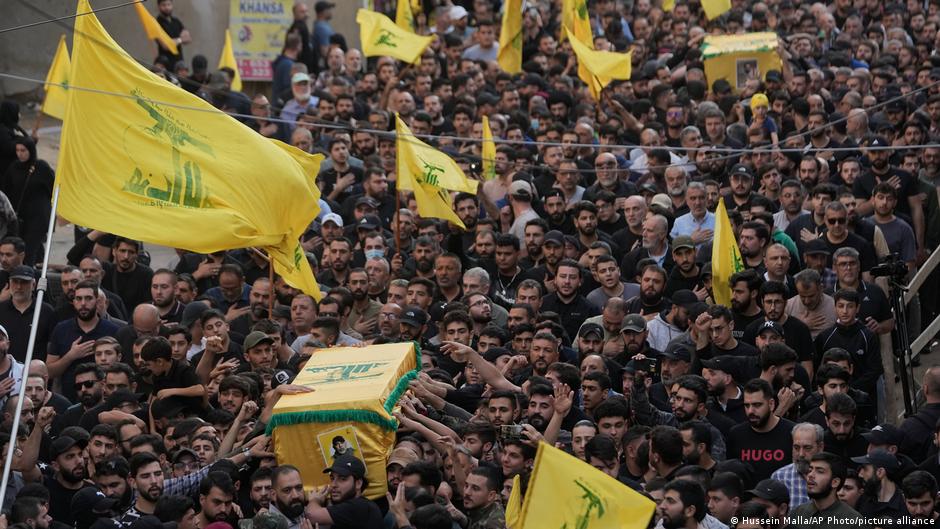
Any agreement would require mutual concessions. For Tehran, however, it is crucial that Hezbollah not become a bargaining chip. For Iran, the issue at stake is its regional influence. Mahmoudian said that if Hezbollah "continues to come under Israeli fire while at the same time giving the impression that Tehran is abandoning it, this could have significant consequences for Iran and undermine the confidence of other actors in the region allied with Iran — such as the Houthis in Yemen or Shiite militias in Iraq." "After all, Hezbollah became involved in this conflict primarily out of loyalty to Iran and attacked Israel following the killing of Khamenei," Mahmoudian said. Following the outbreak of the Iran War on February 28 and the killing of Iranian Supreme Leader Ayatollah Ali Khamenei in an Israeli airstrike on Tehran, the Lebanese Hezbollah militia fired rockets at Israel, thereby entering the war on Iran's side. Israel responded with airstrikes on southern suburbs of the capital Beirut and other parts of its northern neighbor, spreading the war to Lebanon. The Israeli military has also occupied a strip of land in southern Lebanon forming a "security zone" in an area from where it says Hezbollah launches attacks on Israeli towns. Some 3,600 Lebanese civilians have been killed since hostilities began more than 100 days ago, according to Lebanese health authorities. Slow ceasefire talks, Hezbollah drones shake Israel's north To view this video please enable JavaScript, and consider upgrading to a web browser that supports HTML5 video Hezbollah as a multifunctional organization The Shiite militia Hezbollah emerged in the early 1980s during the Lebanese Civil War and following the Israeli invasion of Lebanon.
In addition to Sunnis (approximately 32%),Lebanon is home to about 31% Shiites, as well as numerous Christian communities, Druze, and Alawites. Shiite Iran played a decisive role in Hezbollah's founding following the 1979 Islamic Revolution and supports the organization financially, militarily and ideologically. The movement has an armed wing, but is also represented as a political party in the Lebanese parliament and operates social institutions. Germany, the US and numerous other countries classify Hezbollah in whole or in part as a terrorist organization. Its activities have been banned in Germany since 2020. At the same time, Hezbollah is considered significantly weakened today. Israeli military strikes have impaired its military capabilities and killed many of its leaders since the October 7 terror attacks in 2023 at the hands of Hamas, another Iran-backed militant group. Nevertheless, the organization has been able to rebuild its structures, at least in part, despite heavy losses, similar to what happened after the 2006 Lebanon War. The rising cost of confrontation with Israel For decades, Hezbollah has been a central pillar of Iran's regional strategy. Iran expert Arash Azizi describes this approach as "forward defense." Under this strategy, he said, Iran seeks to deter potential threats as far away from its own territory as possible through allied actors. However, this strategy has partially reversed. Today, Iran finds itself increasingly compelled to actively protect its allies, even at the cost of direct attacks on Israel as well as counterattacks on its own territory and infrastructure.
According to Azizi, the new Iranian leadership is striving to justify its support for Hezbollah more based on national security interests than ideological arguments. "Nevertheless, the argument remains that Iran, as a state that sees itself in conflict with Israel, cannot simply abandon its regional allies," he told DW. At the same time, the costs of further confrontation with Israel are significant for Iran. The economic damage caused by the war is considerable as living conditions for many people have deteriorated and economic prospects remain difficult. "The new leadership will therefore not only have to address security and foreign policy challenges, but also answer the question of what vision for the future it can offer the Iranian people," added Azizi. Trump tells Netanyahu to reduce Israel's Lebanon strikes To view this video please enable JavaScript, and consider upgrading to a web browser that supports HTML5 video The report was originally written in German.
 The BriefWire