Germany: The surprising defeat of a neo-Nazi
A neo-Nazi candidate surprisingly lost by small margin in a local election in the eastern state of Saxony. Many are relieved, yet concern remains. The
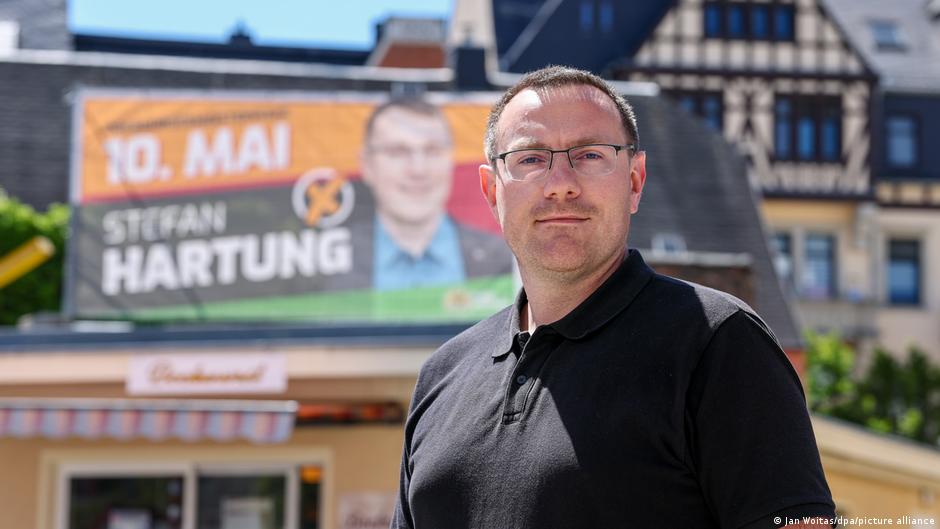
A neo-Nazi candidate surprisingly lost by small margin in a local election in the eastern state of Saxony. Many are relieved, yet concern remains. The small town of Aue-Bad Schlema rarely makes big headlines in Germany. Located in the Ore Mountains near the German-Czech border in southeastern Saxony, it is surrounded by picturesque forests and is far removed from the bustle of the big cities. In this old mining region, people are deeply connected to their roots and take pride in preserving traditions such as brass band music, nutcrackers, and the famous ornamental Christmas pyramids. However, the near-victory of a candidate from a party officially classified as far-right extremist has had lingering effects in Aue-Bad Schlema, in southeastern Saxony. "When you walk through the town today, you see cheerful people. But that can be misleading," Jürgen Freitag told DW in an interview the day after the election. Freitag is an editor with Freie Presse, a regional newspaper covering the Ore Mountains. "Appearances can be deceptive. I perceive the town's mood as divided." How much of a neo-Nazi party is the German AfD? To view this video please enable JavaScript, and consider upgrading to a web browser that supports HTML5 video A long tradition of Nazism in Saxony This is due to the fact that Stefan Hartung, a far-right politician from the Freie Sachsen party, came close to being elected as mayor of the town.
He received around 47% of the vote in the June 7 run-off election, losing by a small margin to Marcus Hoffmann of the center-right Christian Democratic Union (CDU), who secured 53%. Hartung hails from Bad Schlema and has been active in local politics for many years. He was previously a member of the neo-Nazi Democratic Party of Germany (NPD), which Germany's top court has described as being akin to Nazism in its ideology. Hartung serves as deputy chairman of the Freie Sachsen party, which in Germany is considered even more radical than the far-right Alternative for Germany (AfD), itself officially classified as extremist in Saxony. The state domestic intelligence service describes it as follows: "Freie Sachsen is a grouping of neo- Socialists organized as a political party." The party's campaigns againstimmigrants in Germany are especially radical. They incite hostility toward refugees and immigrants, broadly blame them for violence in the country, and call for mass deportations. So far, the party has not achieved any notable political successes. In Saxony's most recent state elections, it received just over 2% of the vote. In the 2024 local elections, it remained below 5% across the board. Erzgebirge: Germany's Ore Mountains To view this video please enable JavaScript, and consider upgrading to a web browser that supports HTML5 video State of Democracy remains a concern However, the party has now drawn national attention after reaching Aue-Bad Schlema's mayoral run-off — an achievement resulting from heavy investment.
"It was worse than during the federal election," Felix Sell told DW. He works locally for the Competence Center for Community Work, promoting social cohesion in Aue-Bad Schlema. "There was a massive campaign for Stefan Hartung," he said, adding that it clearly impressed many people. "That frightened us." Sell is relieved that Marcus Hoffmann — a CDU politician — won the election, partly because he is not a "typical career politician." Hopes are now pinned on him: "We need to pull together, and everyone has to do their part." However, thestate of democracy in Germany overall remains a concern. Sell said that people in Aue-Bad Schlema are becoming less concerned about whom they elect, even when the candidate is a far-right extremist. "Citizens are deeply disappointed with politics." Journalist Jürgen Freitag from Aue-Bad Schlema shares this view. For him, the election result reflects a nationwide trend: Far-right extremists are gaining support across Germany, not just in Aue-Bad Schlema. "Not all of Hartung's voters can be described as far-right extremists; however, this election must not be downplayed, either," he warns. Why Germany's anti-AfD firewall is crumbling To view this video please enable JavaScript, and consider upgrading to a web browser that supports HTML5 video The Freie Sachsen party may succeed in building on well-established far-right structures in this town and across the Ore Mountains.
Not only do nutcrackers and brass band music have a long tradition in this region — so do anti-democratic movements and far-right extremism. Shortly after German reunification, in the early 1990s, neo-Nazi groups formed in the region, and members of the anti-democratic Reichsbürger movement, which rejects the current German state as illegitimate in favor of the German Reich, began to settle there. The far-right " Socialist Underground" (NSU) group, which murdered ten people across Germany in a terrorist killing spree that long went uninvestigated, also found fertile ground there, with André Eminger becoming one of its closest associates. The NSU's motive: racism. However, the Ore Mountains are also characterized by a vibrant civil society. Aue-Bad Schlema boasts more than 300 associations, despite having a population of only around 19,000. Felix Sell from the local Competence Center observes that the election has triggered change: the town's associations are drawing closer together — for democracy and diversity. "In the past, the network was weak, it didn't really work. But now, something is starting to take shape." This article has been translated from German.
 The BriefWire