Kerala, Tamil Nadu & More: Why The South Has Emerged As Congress's Political Lifeline
Kerala, Tamil Nadu & More: Why The South Has Emerged As Congress's Political Lifeline Written By, Last Updated: May 21, 2026, 14:57 IST Southern India
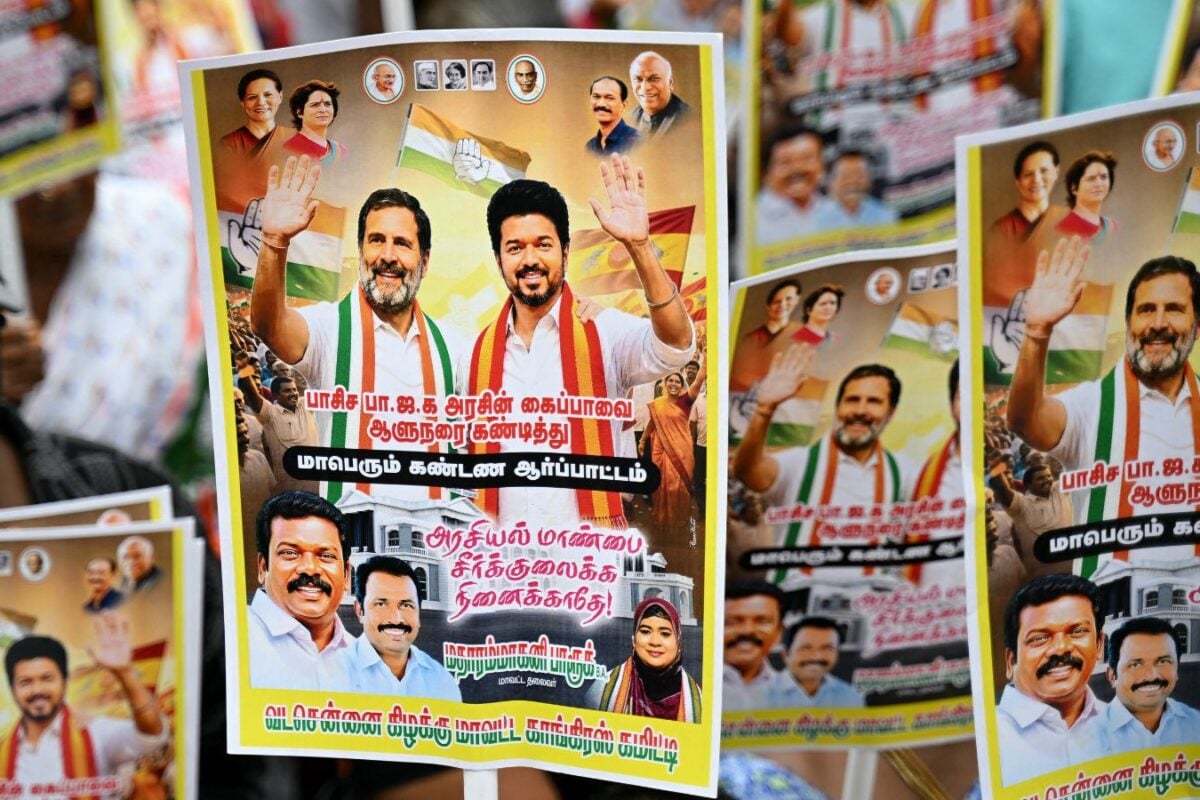
Kerala, Tamil Nadu & More: Why The South Has Emerged As Congress's Political Lifeline Written By, Last Updated: May 21, 2026, 14:57 IST Southern India has increasingly become the Congress’s political safety net and the reasons are both ideological and structural Rapid Read In Tamil Nadu, Congress has returned to government after nearly six decades through a coalition arrangement with Vijay’s TVK. (AFP) With two Congress legislators inducted into chief minister Vijay’s expanded Tamil Nadu cabinet, the Congress is now part of the ruling establishment across all four major southern political centres—Karnataka, Telangana, Kerala and Tamil Nadu—marking a significant consolidation for a party that continues to struggle against the BJP across much of north and west India. The moment is politically striking not because Congress dominates every southern state, but because it has managed to remain relevant in very different ways across them. In Karnataka, Telangana and Kerala, the party directly leads governments. In Tamil Nadu, it has returned to government after nearly six decades through a coalition arrangement with Vijay’s TVK. Together, these victories have turned southern India into the Congress party’s most important political anchor. Why The South Still Works For Congress Southern India has increasingly become the Congress’s political safety net.
The reasons are both ideological and structural. In states like Tamil Nadu and Kerala, politics has long been shaped by strong regional identities, linguistic pride, welfare politics and suspicion of excessive centralisation. That has often made the BJP’s Hindi-Hindutva-nationalism model harder to replicate at scale compared to the Hindi heartland. Tamil Nadu’s Dravidian political tradition earlier and now TVK’s rise, Kerala’s bipolar coalition system and Telangana-Karnataka’s regional caste coalitions have all created political ecosystems where Congress has remained competitive even during its national decline. The BJP has undoubtedly expanded in the South over the last decade, especially in Karnataka, Telangana and Kerala. Recent assembly results showed the BJP increasing its vote share and organisational presence even in states where it remains outside power. But unlike in many northern states, it has not yet fully displaced entrenched regional or Congress-led social coalitions. The Times of India also credits this to a growing “federal politics" dimension, which it says is helping Congress and regional parties converge in the South. Debates around fiscal devolution, language policy, NEET, governor-state confrontations and especially delimitation have sharpened fears in southern states that they may lose political influence despite stronger economic and demographic indicators.
That sentiment has helped anti-BJP alliances acquire a broader narrative: not just defeating the BJP electorally, but protecting southern political autonomy and representation within the Union. Congress’s Southern Strategy For Congress, the South is now not merely an electoral region; it is the backbone of the party’s remaining national relevance. Karnataka and Telangana are among the party’s most important standalone governments. Kerala remains one of the few states where Congress still possesses a deep cadre network and a realistic path to alternating power. In Tamil Nadu, the party has accepted a junior-partner role but continues to extract relevance through alliances. Analysts quoted by The Indian Express increasingly describe this as a pragmatic shift—instead of insisting on a ‘big brother’ role everywhere, Congress is learning to survive by adapting to the realities of coalition politics. Tamil Nadu reflects that transition perfectly. After spending decades as an alliance appendage to Dravidian parties, Congress has now re-entered the government itself after 59 years; not through independent revival, but through negotiated coalition politics with Vijay’s TVK. Are There Implications Beyond States? To some extent, yes. Southern India now contributes disproportionately to Congress’s parliamentary relevance. Even when the party performs poorly in large northern states, strong southern performances help it maintain Lok Sabha numbers, administrative credibility and organisational morale.
That is increasingly important in an era where the BJP remains the country’s dominant national force. The contrast between the two parties is also becoming geographically sharper. The BJP dominates much of northern, western and central India through a highly centralised national model. On the other hand, Congress and regional allies are building a counterweight rooted in coalition politics, welfare narratives and federalism, particularly in the South. This does not automatically translate into a national comeback for Congress. But it does ensure that the party retains a substantial governing footprint despite repeated setbacks elsewhere. News18 Newsletter Handpicked stories, in your inbox A newsletter with the best of our journalism submit First Published: May 21, 2026, 14:08 IST News explainers Kerala, Tamil Nadu & More: Why The South Has Emerged As Congress's Political Lifeline Disclaimer: Comments reflect users’ views, not News18’s. Please keep discussions respectful and constructive. Abusive, defamatory, or illegal comments will be removed. News18 may disable any comment at its discretion. By posting, you agree to our Terms of Use and Privacy Policy Loading comments...
 The BriefWire