World Cup 2026: Edin Dzeko still going strong for Bosnia
With all so much unpleasantness surrounding this World Cup it's easy to forget that there's anything about it that can generate a smile. Bosnia captain
With all so much unpleasantness surrounding this World Cup it's easy to forget that there's anything about it that can generate a smile. Bosnia captain Edin Dzeko's story can. If Edin Dzeko played for a bigger footballing nation, this wouldn't be just his second appearance at the tournament. But 12 years after Bosnia-Herzegovina failed to make it out of the group stage in Brazil, the now 40-year-old striker and his country are back on the game's biggest stage. Although Bosnia, which gained its independence in 1992, has only made it to the one previous World Cup and never qualified for a European Championship, Dzeko has played an incredible 148 times (scoring 73 goals) for his country. Growing up in a besieged capital That independence came at a heavy price, as it was engulfed in one of the wars that followed the breakup of the former Yugoslavia. The capital, Sarajevo, was particularly hard hit, enduring almost four years of siege by Yugoslav Army and the newly formed Bosnian-Serb army who held the mountains surrounding the city. Between 1992 and 1995 more than 10,000 people, mostly civilians, were killed through shelling and by snipers in Sarajevo alone. During the war Sarajevans would routinely sprint to avoid getting hit by snipers Image: picture-alliance/ dpa Dzeko was six years old when the war broke out and during the siege, kicking a ball around on the streets of the ever-more battered capital was a welcome distraction. "Our home was destroyed, so we had to move in with my grandparents. The whole family lived there under one roof, maybe 15 people crammed into an apartment of 35 square meters," Dzeko told British newspaper The Mail in 2011 of his experience of the war.
"It was constant stress and worry, in case something happened or news came through that someone we knew had been killed. I was only young, and I cried often, through fear. Every day, you could hear the guns firing, and we lost family, friends and even some relatives." From Sarajevo to Wolfsburg and beyond He would continue his development in the academy of one of the city's two big clubs, FK Zeljeznicar. That's where he made his debut as a professional in Bosnia's topflight in 2003, but this would be the beginning of the end of his career in his homeland. His first coach, who happened to be a Czech, convinced FK Teplice to sign him for a reported €25,000 two years later. There he attracted the attention of German coach Felix Magath, who brought Dzeko to Wolfsburg in the summer of 2007, the same year he made his debut for the senior Bosnian national team. It was in Wolfsburg where he flourished. Alongside Grafite, he was one half of the most prolific striking duo in Bundesliga history combining for a total of 54 goals (28 for Grafite, 26 for Dzeko) as the pair led the club to their only league title in 2009. It was under Felix Magath at Wolfsburg that Edin Dzeko developed into a superstar Image: Anke Fleig/Sven Simon/picture alliance By then, the Bosnian "diamond," as he had been dubbed by a local broadcaster, was coveted by top clubs all over Europe. He went on to win titles at Manchester City and Inter, while also enjoying successful spells at Roma and Fenerbahce before returning to Italy's Serie A with Fiorentina this past season.
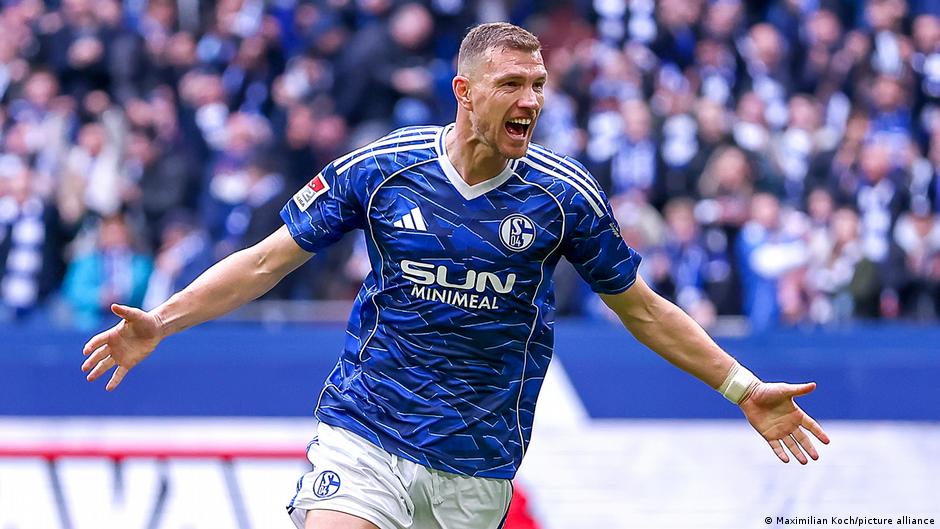
By then he had racked up 369 goals in 856 games in all competitions for his various clubs. Returning to Germany At 39, having managed just one goal in five Conference League matches for Fiorentina, and none in his 11 Serie A appearances, it seemed as if his long career was drawing to a close. In December, a frustrated Dzeko started looking for a new club – one where he would again get regular minutes. This came just as second-division German side Schalke were looking to boost their chances of winning promotion back to the topflight. Their Bosnian-born coach, Miron Muslic, who fled the war with his parents as a child, could hardly believe his luck when he learned that Dzeko was prepared to take a big pay cut to play in a lower league. In fact, Dzeko was so eager to play, that he turned down Schalke's offer to send a plane for him – having already booked a commercial flight to Germany. Just days after his arrival, Dzeko was back in his familiar blue and white, the traditional colors not only of Schalke, but also his first club, Zeljeznicar, and the Bosnian national team. Coming on as a sub, he scored his first of six goals in the second half of the season as he helped Schalke seal promotion just weeks after his 40th birthday. "I've won quite a few titles during my career. But I've never celebrated one like we did here at Schalke," Dzeko told the club's website afterwards. "I said from day one that Schalke belongs in the Bundesliga." Edin Dzeko (holding ball) could make his 150th appearance for Bosnia at this summer's World Cup Image: Georg Hochmuth/APA/picture alliance A 'perfect few months' All the while, Dzeko remained captain of the national team, determined to make it to one more World Cup – a proposition that seemed extremely unlikely when another Bosnian legend, Sergej Barbarez, took over as coach of "The Dragons" in April 2024.
Not much was expected of Barbarez, considering the fact that although he had completed his coaching badges years earlier, he had absolutely no experience in the role. But Barbarez, an impressive Bundesliga striker in his own right in the 1990s and 2000s, had a way of inspiring a mainly young Bosnian side to the kind of success they hadn't seen in over a decade – upsetting Italy in a playoff to qualify for North America. Dzeko was a big part of the campaign. "I wanted to help bring the club (Schalke) back to where it belongs," he said. "The fact that I also qualified for the World Cup with the Bosnia and Herzegovina national team has made the past few months perfect. I absolutely made the right decision." Edin Dzeko seems to have made a habit of making the right choices over his long career. Seeing him make it to one last World Cup stands out as a feel-good story going into a tournament largely making the headlines for the wrong reasons. Edited by: Jonathan Harding
 The BriefWire