BNS To Triple Talaq: How Modi Government Rewrote India's Legal Landscape In 12 Years
BNS To Triple Talaq: How Modi Government Rewrote India's Legal Landscape In 12 Years Reported By, Edited By Last Updated: June 10, 2026, 12:25 IST
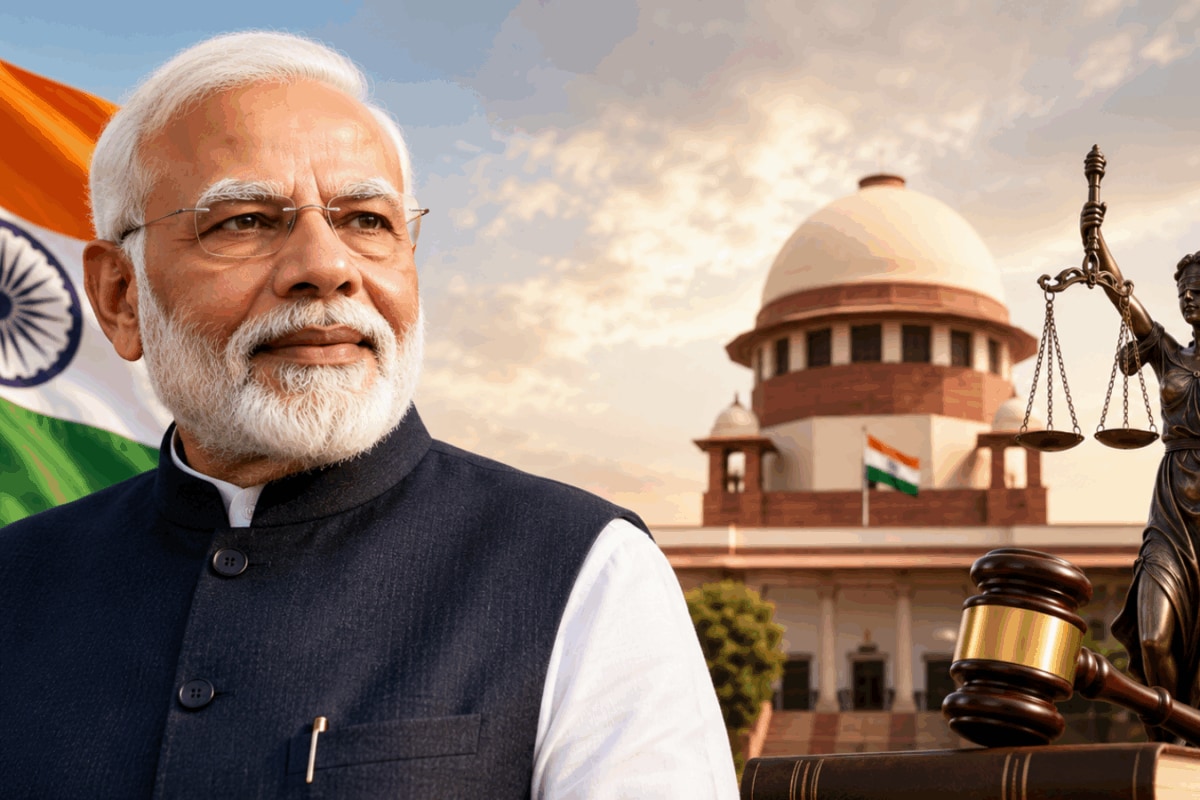
BNS To Triple Talaq: How Modi Government Rewrote India's Legal Landscape In 12 Years Reported By, Edited By Last Updated: June 10, 2026, 12:25 IST The most far-reaching legal reform undertaken during the Modi years has been the replacement of IPC - inherited from British rule - with Bharatiya Nyaya Sanhita (BNS). Rapid Read From replacing colonial-era criminal laws to digitising courts and repealing obsolete statutes, PM Modi's reform agenda has touched multiple layers of India's legal system. (AI generated image) Prime Minister Narendra Modi has completed 4,399 days in office, becoming India’s longest-serving democratically elected PM, breaking Jawaharlal Nehru’s record. One of the most significant – and often less publicly discussed – aspects of his government’s legacy lies in the domain of law, justice and governance. Over the past twelve years, the Modi government has pursued a series of legal, judicial and administrative reforms that are aimed at making justice delivery faster, governance more efficient and laws more aligned with contemporary India. From replacing colonial-era criminal laws to digitising courts and repealing obsolete statutes, PM Modi’s reform agenda has touched multiple layers of India’s legal system. Replacing Colonial-Era Criminal Laws The most far-reaching legal reform undertaken during the Modi years has been the replacement of three foundational criminal laws inherited from British rule. The Indian Penal Code (IPC) of 1860, the Code of Criminal Procedure (CrPC) of 1973 and the Indian Evidence Act of 1872 have been replaced by the Bharatiya Nyaya Sanhita (BNS), Bharatiya Nagarik Suraksha Sanhita (BNSS) and Bharatiya Sakshya Adhiniyam (BSA). The government has described this transition as a shift from a colonial framework designed to govern subjects to a citizen-centric justice system.
The new laws place greater emphasis on technology-enabled investigations, time-bound procedures, electronic evidence and offences such as organised crime and terrorism. Critics have raised concerns over some provisions, but there is little dispute that the reform marks the biggest overhaul of India’s criminal justice architecture since Independence. Article 370 and Constitutional Integration Another defining legal and constitutional move came in August 2019, when the government revoked the special status granted to Jammu and Kashmir under Article 370. The move effectively brought the former state under the same constitutional framework applicable to the rest of India. The government argued that it would improve governance, investment and integration. Supporters viewed it as the completion of national integration, while critics questioned both the process and its implications for federalism. Nevertheless, it remains one of the most consequential constitutional decisions in modern Indian history. Triple Talaq Law and Women’s Rights In 2019, Parliament enacted legislation criminalising instant triple talaq, a practice that allowed a Muslim man to divorce his wife by pronouncing “talaq" three times. The law came as a major step towards gender justice and protection of Muslim women. The legislation followed a Supreme Court judgment that had already declared the practice unconstitutional. For many women affected by unilateral divorce, the law came as an additional layer of legal protection. Digital Transformation of India’s Courts The Modi years have also witnessed a major push towards digitisation of the judiciary through the e-Courts Mission Mode Project. Virtual hearings, electronic filing of cases, online access to court records and digital case management systems have expanded significantly, especially after the Covid-19 pandemic accelerated the adoption of technology.
Today, litigants in many parts of the country can access court services without physically travelling long distances, helping improve access to justice. Repealing Obsolete Laws Successive governments had spoken about legal clutter, but the Modi government undertook a large-scale exercise to eliminate outdated laws. Hundreds of obsolete statutes – some dating back to the colonial period – were repealed. The objective was to simplify the legal framework, reduce compliance burdens and improve ease of doing business. The exercise was part of a broader governance reform agenda aimed at reducing bureaucratic complexity. Insolvency Reforms and Corporate Governance The Insolvency and Bankruptcy Code (IBC), introduced in 2016, fundamentally changed how corporate insolvency is handled in India. Before IBC, resolving bad loans often took years. The new framework established a time-bound process for insolvency resolution and strengthened creditor rights. While challenges remain, the code is widely regarded as one of the most significant economic and legal reforms of the past decade. Faster Justice Through Infrastructure Expansion Recognising the enormous backlog of pending cases, the government has also focused on expanding judicial infrastructure and supporting fast-track courts, particularly for cases involving women and children. Special courts dealing with sexual offences, improved court facilities and increased use of technology have been as measures to accelerate case disposal and improve judicial efficiency. Tribunal Reforms and Administrative Justice The government has also attempted to rationalise India’s tribunal system through structural reforms aimed at reducing overlap and improving efficiency. Tribunals play a crucial role in resolving disputes relating to taxation, company law, service matters and other specialised sectors. The reforms sought to streamline adjudication and reduce delays. Focus on Women’s and Children’s Protection Several legislative measures over the past decade have strengthened legal safeguards for women and children.
Amendments relating to sexual offences, child protection and trafficking have sought to enhance punishments and improve legal protections for vulnerable groups. The Emergence of ‘Ease of Justice’ Taken together, these reforms reflect a broader theme that the government frequently describes as “Ease of Justice" – the idea that citizens should be able to access legal remedies more quickly, transparently and efficiently. Whether through digital courts, modernised criminal laws, constitutional restructuring or governance simplification, the Modi government’s legal reform agenda has been among the most ambitious undertaken in independent India. While debates continue over the impact and implementation of several measures, there is little doubt that law and justice reforms have become a central pillar of governance during the past 4,399 days. News18 Newsletter Handpicked stories, in your inbox A newsletter with the best of our journalism submit About the Author Ananya Bhatnagar Principal Correspondent Ananya Bhatnagar, Principal Correspondent at CNN-News18, reports on various legal issues and cases in lower courts and the Delhi High Court. He has covered the hanging of the Nirbhaya gang-rape convic... Read More First Published: June 10, 2026, 12:25 IST News india BNS To Triple Talaq: How Modi Government Rewrote India's Legal Landscape In 12 Years Disclaimer: Comments reflect users’ views, not News18’s. Please keep discussions respectful and constructive. Abusive, defamatory, or illegal comments will be removed. News18 may disable any comment at its discretion. By posting, you agree to our Terms of Use and Privacy Policy Loading comments...
 The BriefWire