Air India 171 needs answers, not another year of speculation
Three seconds after Air India Flight 171 lifted off from Ahmedabad, two fuel switches in its cockpit moved to the cut-off position, starving both engines
Three seconds after Air India Flight 171 lifted off from Ahmedabad, two fuel switches in its cockpit moved to the cut-off position, starving both engines of fuel. Half a minute later, the London-bound Boeing 787 Dreamliner crashed into a medical hostel complex, killing 260 people. It was India's deadliest aviation disaster since the 1996 Charkhi Dadri mid-air collision, the world's deadliest air accident in a decade, and the first crash in which a Dreamliner was destroyed. Read Full Story Of the 230 passengers and 12 crew members, all but one (British national Vishwashkumar Ramesh, sitting on the now-famous seat 11A next to an emergency exit) died. Another 19 people, at the medical hostel complex into which Air India 171 crashed, were killed on the ground. The crash resulted in an inferno reaching temperatures of up to 1,000 degrees Celsius and left many bodies so badly mutilated that identification took weeks of painstaking DNA matching. In the year since, Air India 171 has existed in a space between two nightmare theories, both linked to those two fuel switches. One is human: Deliberate or inadvertent action in the cockpit moved the fuel switches and cut fuel to both engines seconds after take-off. The other is technical: A modern Boeing 787 Dreamliner, built with multiple backup systems, suffered a catastrophic mechanical or electrical failure or failures that starved both engines of fuel at the worst possible moment. An aerial shot of the Air India 171 crash site (Photo: AAIB) Neither theory has been established. But both have been intensely argued over in media reports and social media. One theory can destroy the reputation of a dead pilot who cannot defend himself and raise troubling questions for the aviator community at large. The other poses multibillion-dollar consequences for the US-based Boeing, Air India, and the wider aviation industry. That is the high-pressure backdrop against which the first anniversary of the crash arrives on June 12. AIR CRASH PROBES To understand why the anniversary matters, it helps to know how air crash investigations are supposed to work. Under protocols laid out by the International Civil Aviation Organization The country where the crash happens leads the investigation. Other countries may take part and comment on the final findings if the aircraft was designed, manufactured, registered or operated there, or if their citizens were killed or seriously injured. A preliminary report is expected within 30 days. A final report is expected as soon as possible and, ideally, within 12 months.
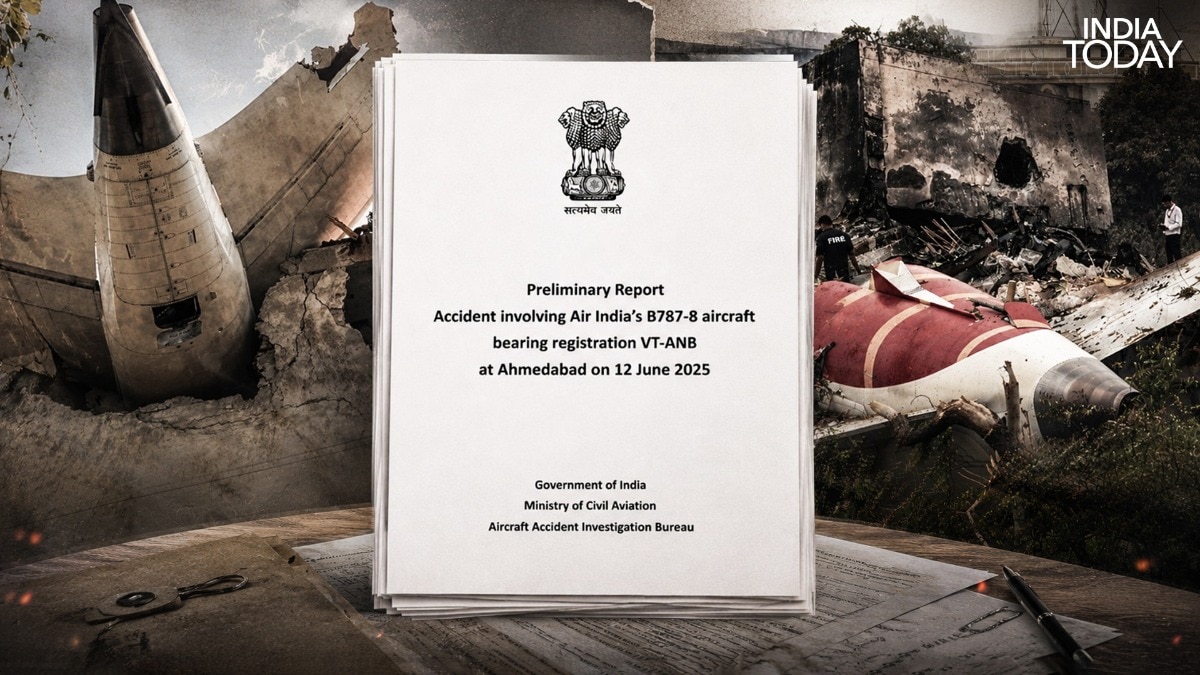
If the final report is not ready by then, the investigating country is expected to issue an interim statement on each anniversary, detailing the progress of the investigation and any safety issue uncovered. The purpose of an air crash investigation is not to apportion blame. It is to prevent future accidents. That means India's Aircraft Accident Investigation Bureau (AAIB) is expected to release either a final report or an interim update around the anniversary. What we have for now is last year's preliminary report, and the furore it generated. The report did not provide conclusive answers regarding the crash. It was not meant to; preliminary reports are generally meant to set out the factual matrix of an air crash. But it did raise troubling questions. According to the report, around three seconds after Air India 171 took off from the Ahmedabad airport, the Engine 1 and Engine 2 fuel cutoff switches "transitioned from RUN to CUTOFF" within a gap of one second. Thrust in both engines started reducing as the fuel supply was cut off. The report then says, "In the cockpit voice recording, one of the pilots is heard asking the other why did he cutoff. The other pilot responded that he did not do so." The switches were later recorded moving back to RUN, but by then the aircraft had lost too much power and altitude. Moments later, one of the pilots transmitted a "MAYDAY, MAYDAY, MAYDAY" call before the jet crashed and erupted into a fireball. THEORY VS THEORY The comparatively detailed preliminary report, released on July 12, 2025, sparked a firestorm of speculation and counter-speculation that has continued for the past year. One side focused on the cockpit. The movement of the fuel switches described in the preliminary report, and the pilot exchange that followed, became the basis for theories about deliberate or mistaken pilot action. The switches are guarded and are not routine in-flight controls. That was used to argue that the movement described in the report would be hard to explain without human involvement. Some media reports went further. News agency Reuters reported in July 2025 that an early informal assessment by US officials (the US was participating in the probe as the country where the aircraft was designed, manufactured, and certified), based on the cockpit recording, supported the view that the captain had cut off fuel flow and that the first officer had challenged him. In February 2026, after another report claimed investigators were preparing to call the crash an intentional act, the AAIB pushed back and called such reporting incorrect and speculative.
(L) The damaged fuel switch panel of Air India 171. (R) A representative photo of Dreamliner's fuel control panel; the fuel switches are located towards the bottom. The other side focused on the aircraft, manufactured by the aviation giant Boeing. The argument was that either a severe electrical failure, a mechanical switch-latching issue, or a logic problem with the aircraft's highly autonomous engine control systems (read a former Air India pilot's opinion on the matter here) had led to the fuel being cut off at the worst possible moment. Then, months after the crash of Air India 171, pilots of another Air India 787 on a London-Bengaluru route reported a temporary fuel-switch latch issue during engine start. This brought renewed attention to the possibility of a mechanical failure in the fuel switch column. Later Air India checks did not find a design-safety issue with the London-Bengaluru jet's fuel switches. But the unit in question is now being sent to Boeing headquarters for further tests in the presence of Indian aviation regulators. Critics of the pilot action theory also pointed to Boeing's conduct during the 737 MAX MCAS crisis (read a detailed report on Boeing's controversial in-flight control software here), arguing that the plane maker has a history of not being fully transparent about design defects. Apart from its February 2026 statement urging avoidance of "premature speculation", the AAIB has kept quiet on Air India 171. But, by now, it should be quite clear that the agency faces immense pressure. One question asks whether someone in the cockpit did the unthinkable, deliberately or by mistake. The other asks how a modern aircraft, built with multiple backup systems, could fail in a way aviation does not expect. But there must be an answer. A couple of other crashes explain why and show what happens when an air crash investigation fails to reach a logical conclusion. China Eastern Flight 5735 is the warning about silence. On March 21, 2022, a China Eastern Boeing 737-800 flying from Kunming to Guangzhou plunged into a hillside in Guangxi, killing all 132 people on board. China's aviation regulator issued a basic preliminary report saying there were no abnormalities with the crew, aircraft, maintenance, weather, air traffic control, cargo and loading. A year later it issued a terse interim statement that essentially said that the probe remained ongoing due to the "very complicated and extremely rare" nature of the crash. A second anniversary statement in 2024 said that no abnormalities had been found and the probe, still, remained ongoing.
Then the public updates stopped coming. Things took a turn this year when the US air crash investigation agency, the NTSB, released data that aviation experts said pointed to cockpit action (deliberate or otherwise) as central to the crash. China, the primary investigator, has yet to release a full investigation report. EgyptAir Flight 990 offers a different warning: competing truths. On October 31, 1999, an EgyptAir Boeing 767 crashed into the Atlantic Ocean, killing all 217 people on board. The US NTSB (which led the probe at Egypt's request) concluded that the aircraft crashed "as a result of the relief first officer's flight control inputs". The reason for the inputs was not determined. Egyptian officials completely rejected the conclusion and, after launching their own probe, said that a mechanical failure was the most likely cause of the crash. In both cases, the aviation industry was left poorer: in one, by the absence of a conclusion; in the other, by competing official explanations. That is the trap Air India 171 must avoid -- a probe that produces theories, arguments, and counter-narratives, but no usable and actionable findings. The rooftop of one of the buildings of the medical hostel complex where Air India 171 came down (Photo: AAIB) If the cause of the crash is indeed human action in the cockpit, it would be deeply uncomfortable. It would raise questions about pilots, cockpit procedures, stress, mental health, and the limits of what airlines can realistically do about the people flying their aircraft. These are frightening questions because they are not easily solved by a new part, a new checklist or a software update. If the cause is technical, the consequences could be just as severe. A finding that the fuel switches, their locking mechanism, the aircraft's electronics, hidden faults within the Dreamliner's systems, or some combination of these played a role could force checks, redesigns or replacements across dozens or even hundreds of aircraft. That would mean cost, disruption, and hard questions for Boeing, Air India, regulators and every airline operating the type. But air safety has always been built from ugly truths. The worst possible ending to Air India 171 would not be an ugly answer. It would be no answer at all. Ends
 The BriefWire