US strikes Iran after downed helicopter near Hormuz; Tehran vows retaliation: Top developments
US launches 'self-defence' strikes against Iran Apache helicopter downed near Strait of Hormuz Dramatic rescue of crew by unmanned Navy vessel Trump downplays incident, then
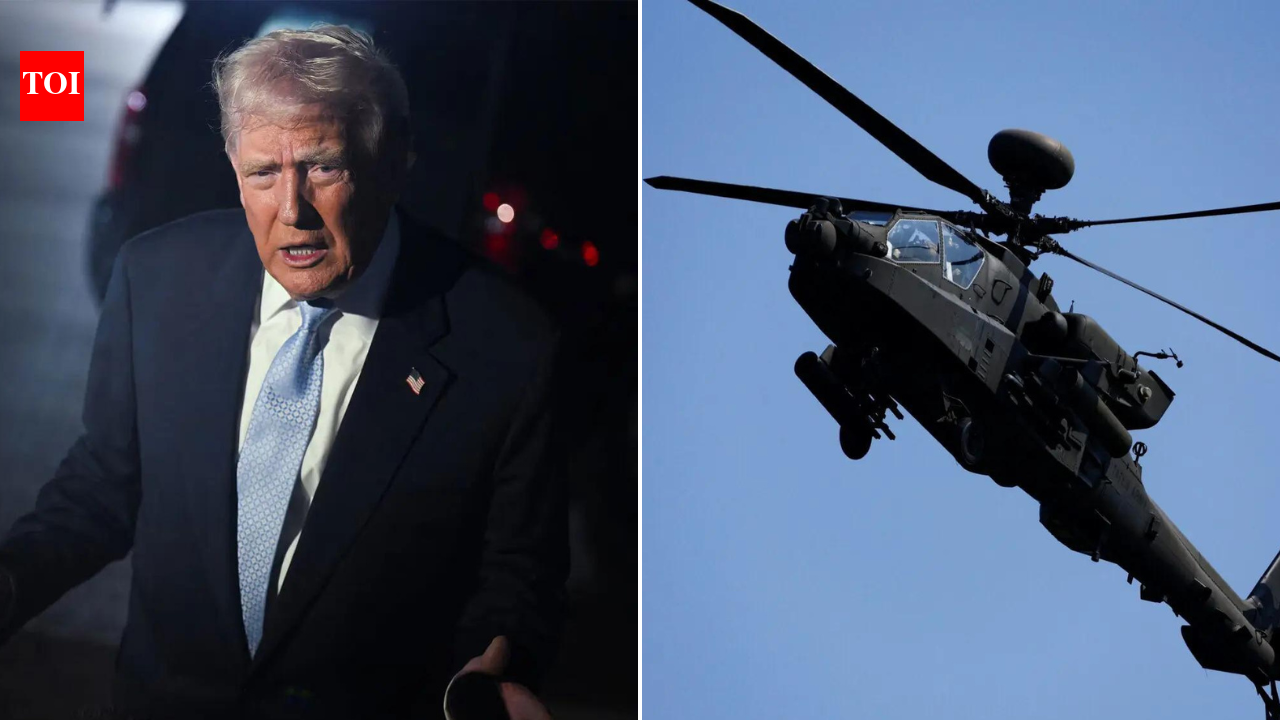
US launches 'self-defence' strikes against Iran Apache helicopter downed near Strait of Hormuz Dramatic rescue of crew by unmanned Navy vessel Trump downplays incident, then vows retaliation. Iran says helicopter was not deliberately targeted IRGC warns against using crash as pretext for attacks Explosions reported in Hormozgan province after US strikes US President Donald Trump launched strikes on Iran after hours after an American Apache attack helicopter was brought down near the Strait of Hormuz on Tuesday.US central command (CENTCOM) said the attack, which it described as "self defence" strike began at 5pm Washington time on Trump's order and were intended as a "proportional response" to what it called Iranian aggression. The move came after Trump accused Iran of shooting down the Apache overnight and vowed, "of necessity, respond to this attack."While Trump publicly promised retaliation, he had later sought to play down the helicopter incident, saying it was "not a big deal" because the pilots had survived. Meanwhile, Iran's state media, citing military sources, reported that IRGC also vowed "decisive response" against the "renewed hostilities by the enemy under the pretext of helicopter crash."Here are the top developments so far.The US central command announced that US forces had begun conducting strikes against Iran at President Trump's direction.In a statement posted on X, it wrote, "US Central Command (CENTCOM) forces began launching self-defence strikes against Iran at 5 pm ET today at the Commander in Chief’s direction, in response to yesterday’s downing of a US Army Apache helicopter.
The mission is a proportional response to unjustified Iranian aggression."The exact targets of the strikes were not immediately disclosed.The escalation began after a US Army Apache attack helicopter went down near the Strait of Hormuz. Initial reports from US officials did not establish the cause of the crash. Officials said it was unclear whether the helicopter had been shot down, suffered a mechanical failure or encountered another problem.However, a US official later said that a one-way Iranian attack drone had brought down the aircraft, Reuters reported citing an official who spoke on the condition of anonymity.The two crew members aboard the Apache survived and were rescued in what US military officials described as a first-of-its-kind operation.According to CENTCOM spokesman Captain Tim Hawkins, a 24-foot unmanned US navy surface vessel located the pilots after they had spent roughly two hours in the water off the coast of Oman.The drone boat recovered the aviators and transported them safely to shore. Military officials said both crew members were in stable condition and had not suffered serious injuries.Trump later confirmed the rescue, saying, "The pilots are fine. Nobody injured."Before publicly blaming Iran, Trump initially appeared to minimise the significance of the helicopter loss.Before departing New York after attending an NBA Finals game, speaking to the reporters Trump stressed that the crew members were safe and said a report on the incident would be issued later.According to a The Wall Street Journal report, Trump also described the crash as "not a big deal", adding that "the pilot is fine." He suggested that the circumstances were "much different than you think".Hours later, however, Trump took it to Truth Social to express his aggression against the helicopter downing.In the post he said that he had been informed by the US military that Iran had shot down the Apache while it was patrolling over the Strait of Hormuz."I have just been informed by our Great Military that last night the Iranians shot down one of our highly sophisticated Apache Helicopters while patrolling over the Strait of Hormuz.
There were two pilots involved, both are safe and uninjured. Nevertheless, the United States must, of necessity, respond to this attack."Iran's deputy foreign minister said that the Apache had not been deliberately targeted by Iranian forces, Al Jazeera reported.The official said Tehran was not responsible for intentionally attacking the helicopter, while acknowledging that incidents could occur in the highly volatile environment around the Strait of Hormuz.The remarks stopped short of directly accepting responsibility but suggested that any involvement by Iranian forces may have been accidental rather than part of a deliberate military operation.Iranian foreign minister Abbas Araghchi, without explicitly denying that Iranian forces had brought down the helicopter, argued that foreign military forces operating close to Iranian territory faced inherent risks."Foreign forces in proximity to our territory are at constant risk on account of their own human errors, plain accidents, or potentially being caught in crossfire," he wrote on X, "To reduce risk, best solution is for them to leave."In a statement attached to his post he had also stressed upon the terretory of Hormuz stating that, "The Strait of Hormuz is NOT international waters but shared between Iran and Oman."Even as Iranian officials suggested the incident may not have been intentional, Tehran issued a warning against any US military response.Iranian state media quoted military sources as saying that if Washington used the helicopter incident as justification for renewed military action, Iran would respond forcefully.According to the report, in the event of renewed "hostility by the enemy" under the pretext of the Apache crash, Iran would deliver a "decisive response".Iranian media reported explosions in several locations within Hormozgan province, which lies along the northern side of the Strait of Hormuz.
Fars News Agency said explosions were heard in eastern parts of the province, including the areas of Kuhestak, Sirik and Minab.The agency also reported air defence activity in some locations, suggesting Iranian forces may have been responding to incoming attacks.Iranian authorities had not immediately provided details on possible casualties or damage.
 The BriefWire