The 24x7 Prime Minister: How Social Media Changed The Nature Of Leadership In The Modi Era
The 24x7 Prime Minister: How Social Media Changed The Nature Of Leadership In The Modi Era Published By, Last Updated: June 09, 2026, 15:14 IST
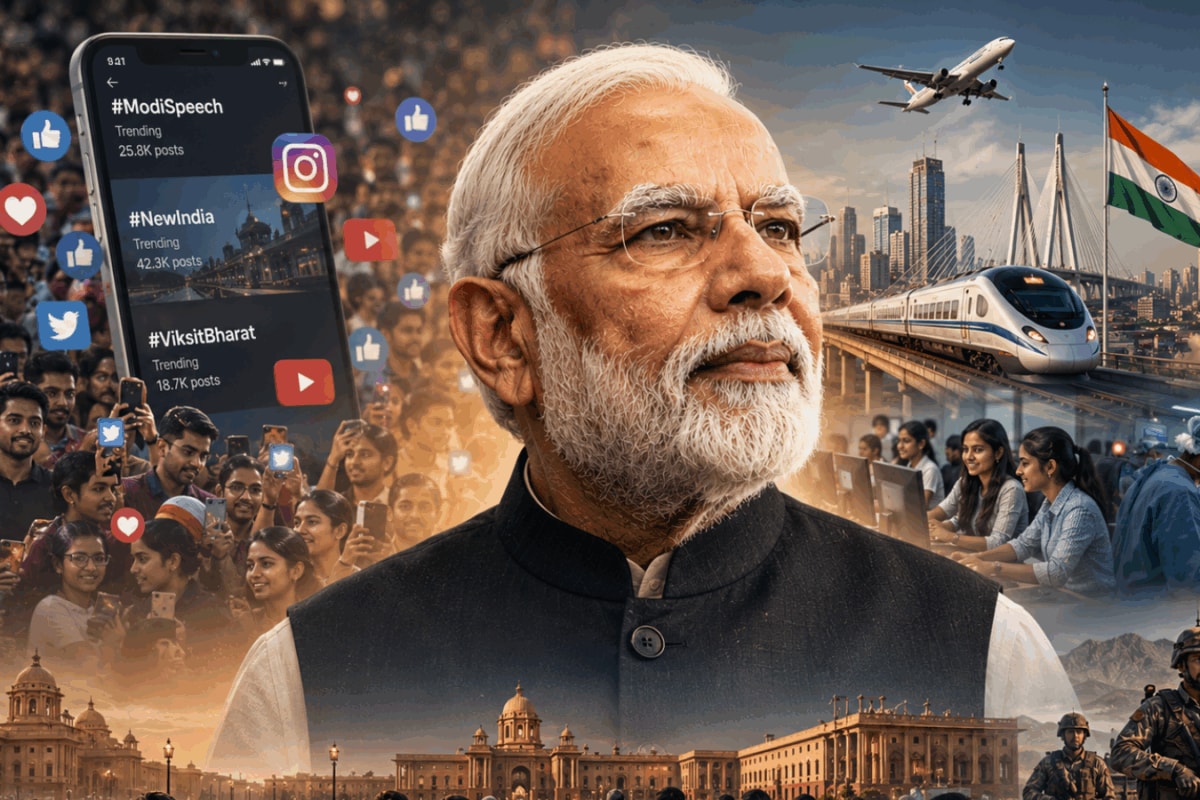
The 24x7 Prime Minister: How Social Media Changed The Nature Of Leadership In The Modi Era Published By, Last Updated: June 09, 2026, 15:14 IST PM Modi governs in an age where every speech, decision, foreign visit, policy announcement and political statement is analysed in real time Rapid Read PM Modi operates under a level of visibility that earlier generations of politicians did not experience. (AI generated image) As Prime Minister Narendra Modi prepares to surpass Jawaharlal Nehru’s record as India’s longest continuously serving democratically elected Prime Minister, one of the biggest differences between the two eras lies not in politics but in technology. Nehru governed through newspaper headlines, radio broadcasts and occasional public rallies. PM Modi governs in an age where every speech, decision, foreign visit, policy announcement and political statement is analysed in real time by millions of people across social media platforms. The office of Prime Minister has remained the same. The environment in which it operates has been transformed. From Weekly Headlines To Minute-by-Minute Judgement When Nehru was Prime Minister, information moved relatively slowly. Newspapers often shaped public opinion over days and weeks. Radio was the primary medium of mass communication. Television was virtually absent for most of his tenure. Political debates largely took place through Parliament, public meetings and traditional media. Today’s reality is dramatically different. India now has more than 950 million active internet users, according to the Internet in India Report 2025, while social media platforms reach hundreds of millions of people across the country. Every government decision can generate instant reactions, criticism, support, memes, fact-checks and debates within minutes.
Political communication is no longer confined to election campaigns. It is continuous. A Prime Minister Under Constant Public Observation The rise of digital media has fundamentally altered the relationship between political leaders and citizens. A foreign policy decision, a government scheme, an infrastructure project or a parliamentary speech is no longer assessed solely by journalists and political commentators. Citizens themselves participate directly in the conversation through social media platforms. This means PM Modi operates under a level of visibility that earlier generations of politicians did not experience. Supporters and critics alike can instantly respond to government actions, while news cycles that once lasted days can now change within hours. In such an environment, political leadership increasingly involves not only governance but also communication, public engagement and rapid response. The Age of Higher Expectations The nature of public expectations has also evolved significantly. In the decades immediately after Independence, the government’s primary responsibilities centred on nation-building, food security, institution creation and economic development. Today’s citizens expect much more from the state. They demand modern highways and airports, reliable digital services, efficient welfare delivery, quality healthcare, employment opportunities, strong national security, effective diplomacy and globally competitive infrastructure. In many ways, the growth of expectations reflects India’s own transformation. Rising incomes, expanding education, greater connectivity and exposure to global standards have increased what citizens expect from public institutions. Digital Governance Becomes a Public Benchmark One area where changing expectations are especially visible is digital governance. Government services that once required physical visits and paperwork are increasingly expected to be available online.
Citizens now judge governments not only by policy outcomes but also by convenience, speed and accessibility. India’s digital ecosystem has expanded rapidly in recent years under PM Modi. UPI has become one of the world’s largest real-time payment systems, accounting for a majority of India’s payment transaction volume. Smartphone ownership has also expanded significantly, with government data showing that more than 85 per cent of Indian households possess at least one smartphone. As digital adoption grows, citizens increasingly expect governments to deliver services with the same ease and responsiveness they experience on private digital platforms. Infrastructure, Diplomacy and Global Visibility The scrutiny is not limited to domestic issues. PM Modi is also judged on international diplomacy, economic performance, infrastructure creation and crisis management. Large infrastructure projects, global summits, international partnerships and economic indicators are discussed extensively across television channels, online platforms and social media networks. Every achievement, setback or controversy becomes part of a continuous national conversation. This creates a governing environment where public evaluation is no longer periodic. It is constant. The Social Media Difference Perhaps the defining characteristic of PM Modi’s tenure has been that it coincided with the rise of social media as a dominant force in public life. India had only a fraction of its current internet penetration when Modi first became Prime Minister in 2014. Today, the country has hundreds of millions of social media users and one of the largest digital populations in the world. As a result, leadership is assessed differently than it was during the eras of Nehru, Indira Gandhi, Rajiv Gandhi or even Atal Bihari Vajpayee.
The public now receives information instantly, reacts instantly and expects responses instantly. A New Era of Leadership Comparisons between Nehru and Modi often focus on ideology, policy or politics. But the communication environments in which they governed were fundamentally different. Nehru led a newly independent nation through the age of print and radio. PM Modi has led a digitally connected India where nearly every action is subject to immediate public examination and debate. Whether on infrastructure, welfare, diplomacy, security or economic policy, modern political leadership operates under an intensity of public scrutiny that previous generations of leaders never experienced. As PM Modi approaches a historic longevity record in office, his tenure also reflects a broader transformation in Indian democracy itself – from periodic political engagement to a system where citizens participate in public discourse every day, every hour and often every minute. News18 Newsletter Handpicked stories, in your inbox A newsletter with the best of our journalism submit First Published: June 09, 2026, 15:14 IST News india The 24x7 Prime Minister: How Social Media Changed The Nature Of Leadership In The Modi Era Disclaimer: Comments reflect users’ views, not News18’s. Please keep discussions respectful and constructive. Abusive, defamatory, or illegal comments will be removed. News18 may disable any comment at its discretion. By posting, you agree to our Terms of Use and Privacy Policy Loading comments...
 The BriefWire