Strong Solar Storm Heads Towards Earth; Here's Why Scientists Have Issued An Alert
Strong Solar Storm Heads Towards Earth; Here's Why Scientists Have Issued An Alert Reported By, Last Updated: June 08, 2026, 15:20 IST The storm is
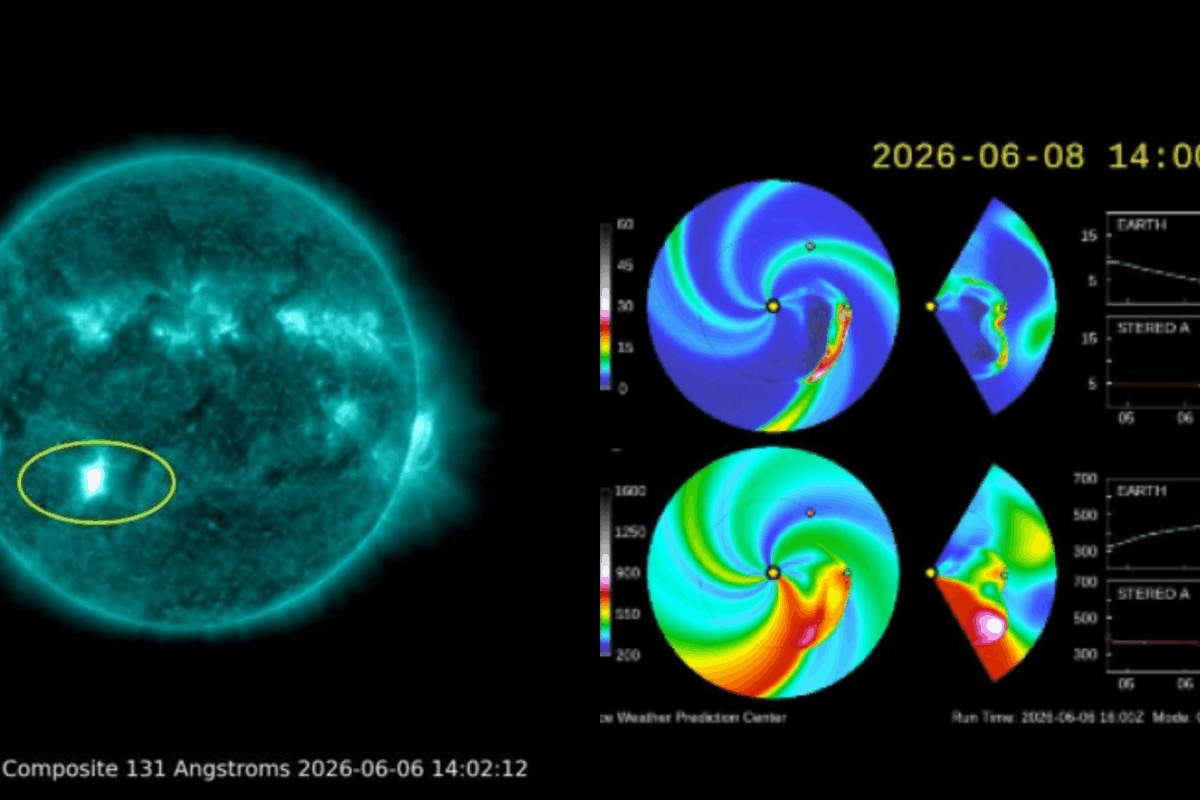
Strong Solar Storm Heads Towards Earth; Here's Why Scientists Have Issued An Alert Reported By, Last Updated: June 08, 2026, 15:20 IST The storm is moving at very high speed and is expected to reach Earth by Monday evening, and has potential to cause minor technological impacts. Rapid Read While a ‘G3 geomagnetic storm watch’ has been issued for 8 June, it is expected to reduce in intensity, with a ‘G2 geomagnetic storm watch’ for 9 June. Scientists have warned that a strong geomagnetic storm is expected to hit Earth on 8-9th June following intense solar eruptions that left the Sun on 6th June. The storm could potentially cause minor satellite disruptions, prompting space agencies to remain on alert. The Space Weather Prediction Center of US-based Oceanic and Atmospheric Administration (NOAA) has issued a geomagnetic storm watch for June 8-9. While a ‘G3 geomagnetic storm watch’ has been issued for 8 June, it is expected to reduce in intensity, with a ‘G2 geomagnetic storm watch’ for 9 June. A G3 is categorised as a ‘strong’ storm on the NOAA scale, which can cause intermittent problems in satellite navigation especially low earth orbiting satellites.
While a G2 storm is ‘moderate’, which can cause voltage alarms at high-latitude power systems, and potential transformer damage. Speaking with CNN-News18, solar astrophysicist Wageesh Mishra from Indian Institute of Astrophysics, Bengaluru, explained that the activity is linked to a Coronal Mass Ejection (CME) which emerged from the Sun on June 6, and was also associated with a solar flare of moderate, but quite significant strength. A Coronal Mass Ejection (CME) is an eruption of solar material and magnetic fields, which can result in a geomagnetic storm when they reach Earth. Such activity, though infrequent, is ‘not uncommon.’ “The CME had a very high speed of about 1500 km/second near the Sun, which is extremely fast. But, it can slow down as it moves through space, so its arrival time and final impact may vary. But we expect it to reach Earth by Monday evening, and last for several hours. When it’s a G3 level, then the space agencies also remain on alert, because it is considered strong enough to disrupt low-Earth satellites providing navigation services. There can be minor disruptions in power grids at higher latitudes too," added Mishra.
WHAT CAN IT DO? Such solar eruptions can cause increased geomagnetic activity once they reach Earth. Depending on the directions of its magnetic field, they could lead to strong geomagnetic storm levels. According to the latest update, NOAA said the upcoming storm could cause limited, minor impacts to some technological infrastructure, which should be manageable. The aurora may become visible in some higher latitude regions. “For sky gazers at mid-to lower latitudes like India, nothing noticeable may happen. Strong effects are mostly seen near the polar regions, where auroras may be visible, but we will definitely keep a watch at our Himalayan observatory in Ladakh. Additionally, satellites passing over polar regions are more vulnerable as they are exposed to solar radiation, so space agencies take mitigation measures accordingly," said senior astrophysicist Professor SP Rajaguru from Indian Institute of Astrophysics, Bengaluru. Scientists tracking space weather, monitor these events regularly, but the effects are more pronounced near the polar regions, where satellite and communication systems may be affected. As a precaution, space agencies sometimes try to place their satellite into safe or parking modes to protect sensitive components, or conduct orbit-raising maneuvers.
According to Professor Dibyendu Nandi from IISER, Kolkata, some minor technological impacts like brief GPS navigation errors, and orbital decay of low Earth orbiting satellites is likely, but no major societal impacts anywhere, including India. News18 Newsletter Handpicked stories, in your inbox A newsletter with the best of our journalism submit About the Author Srishti Choudhary Srishti Choudhary, Senior Assistant Editor at CNN-News18 specializes in science, environment, and climate change reporting. With over a decade of extensive field experience, she has brought incisive g... Read More First Published: June 08, 2026, 15:20 IST News world Strong Solar Storm Heads Towards Earth; Here's Why Scientists Have Issued An Alert Disclaimer: Comments reflect users’ views, not News18’s. Please keep discussions respectful and constructive. Abusive, defamatory, or illegal comments will be removed. News18 may disable any comment at its discretion. By posting, you agree to our Terms of Use and Privacy Policy Loading comments...
 The BriefWire