Alcohol sales allowed in Muslim-majority Lakshadweep. Explained why rules changed
For the first time in 47 years, the Muslim-majority Union Territory of Lakshadweep is set to permit the regulated sale of alcohol through licenced outlets
For the first time in 47 years, the Muslim-majority Union Territory of Lakshadweep is set to permit the regulated sale of alcohol through licenced outlets after the Union government repealed the Lakshadweep Prohibition Regulation, 1979. The law had largely kept the archipelago dry since its enactment, with limited exceptions for government-run bars and tourist resorts on Kavaratti and Bangaram Islands. The prohibition law was repealed, and the new rules were brought in on June 5. Read Full Story The new Lakshadweep Excise Regulation, 2026 replaces the prohibition regime with a licencing framework governing the manufacture, possession, import, export, transport, purchase, sale and consumption of liquor. It also allows government-owned corporations and agencies to obtain licences for importing and retailing alcoholic beverages. However, taxes related to alcohol have been kept high. Excise duties have been fixed at 400% on Indian Made Foreign Liquor (IMFL) and foreign liquor, 200% on beer and 80% on wine. For context, a 25% VAT is charged on IMFL, beer, wine and imported foreign liquor in Delhi. The law does not create an unrestricted alcohol market. The administrator retains the power to regulate drinking, impose limits on purchases and possession, and even enforce prohibition on the whole or any part of Lakshadweep. The sale of liquor to persons below 21 years of age is prohibited.
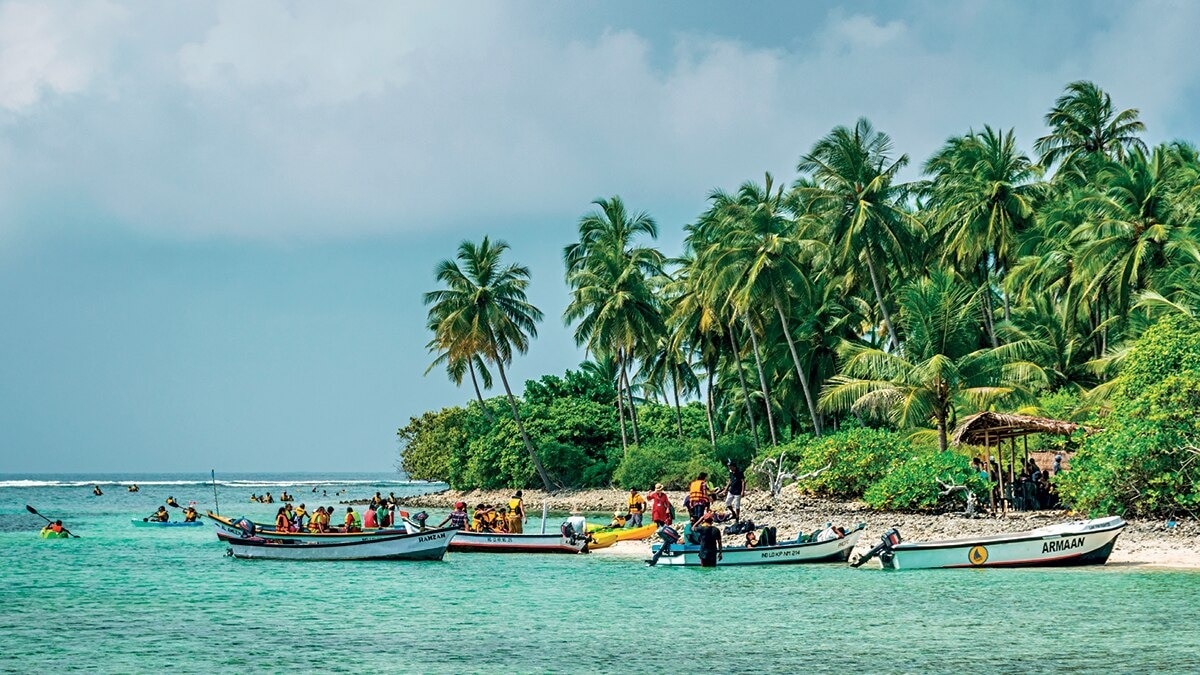
The Lakshadweep archipelago consists of 36 islands, of which 10 are inhabited, including Agatti, Amini, Andrott, Bitra, Chetlat, Kadmat, Kalpeni, Kavaratti, Kiltan, and Minicoy. Foreigners and Indian tourists are allowed to visit the archipelago only after acquiring a special permit, with foreign tourists restricted to the islands of Agatti, Bangaram and Kadmat. The Lakshadweep archipelago consists of 36 islands, which includes 10 inhabited islands, 17 uninhabited islands and islets, 4 newly formed islets, and 5 submerged reefs. (Image: File) WHY WAS ALCOHOL BANNED IN LAKSHADWEEP? Muslims make up 97% of the population in Lakshadweep, representing the highest proportion of Muslims of any state or union territory in India. That being said, a majority of them are also classified as Scheduled Tribes (ST). According to the Census of India, 2011, 61,120 of the UT's 64,473 inhabitants (or about 95%) fall under the ST category. Alcohol prohibition in Lakshadweep dates back to 1979 and was introduced against the backdrop of the islands' predominantly Muslim population, with alcohol consumption prohibited in Islam. This made the UT one of the few regions in India to ban the sale of alcohol, alongside the states of Gujarat, Bihar, and some Northeast states. Successive administrations retained the ban for decades, arguing that it reflected local preferences and social conditions.
Political parties and community organisations frequently opposed proposals to expand alcohol availability, maintaining that prohibition was consistent with prevailing cultural and religious practices in the islands. The ban, however, was never absolute. Alcohol remained available for tourists and government officials under limited exemptions, most notably at resorts on Kavaratti and Bangaram Island, allowing the administration to accommodate visitors while preserving the broader prohibition framework. WHY WERE ALCOHOL RULES CHANGED IN LAKSHADWEEP? The biggest factor behind the shift appears to be the Union government's effort to develop Lakshadweep as a tourism destination. Officials have long argued that restrictions on alcohol availability put the islands at a disadvantage compared with competing Indian Ocean destinations, particularly the Maldives, where liquor is available at tourist resorts. In January 2024, Prime Minister Narendra Modi shared pictures from his Lakshadweep visit where he interacted with locals, enjoyed magnificent views of the pristine coastline and went snorkelling. It was a definitive push at pitching Lakshadweep as an alternative to destinations abroad. Data accessed by the India Today Group shows that tourist arrivals in Lakshadweep surged by 47% from just 3,875 in 2020 to 68,328 in 2024. The sharpest jump came after PM Modi's January 2024 visit. The Centre had already begun its efforts to boost tourism in Lakshadweep.
Efforts to relax prohibition gained momentum after the appointment of Administrator Praful Khoda Patel in 2020. In 2021, the administration proposed extending alcohol service beyond Bangaram Island to tourism establishments on inhabited islands. The proposal drew opposition from local political parties, community organisations and residents, who argued that wider access to liquor could lead to addiction, social problems and law-and-order concerns. The administration nevertheless continued moving towards a regulated alcohol regime. In 2023, it published a draft excise regulation proposing a licencing framework for the sale and consumption of liquor. In February this year, government-run bungalows on Chetlat and Bitra islands were notified as licenced premises where liquor could be served to permit holders under the then existing prohibition law. The debate around prohibition has often been framed through the prism of religion, as Islam explicitly bans the consumption of alcohol. However, alcohol has long been legally available in Jammu and Kashmir, a Muslim-majority union territory, while several Muslim-majority countries, including the Maldives, permit its sale in designated zones. With the repeal of the 1979 law, the Centre appears to have concluded that a tightly regulated liquor regime is more compatible with its plans to expand tourism and hospitality infrastructure in the archipelago. Ends
 The BriefWire