Nehru's Parliament Had 22 Women. PM Modi's Has 74 And A Promise Of More
Nehru's Parliament Had 22 Women. PM Modi's Has 74 And A Promise Of More Published By, Last Updated: June 08, 2026, 14:53 IST For BJP
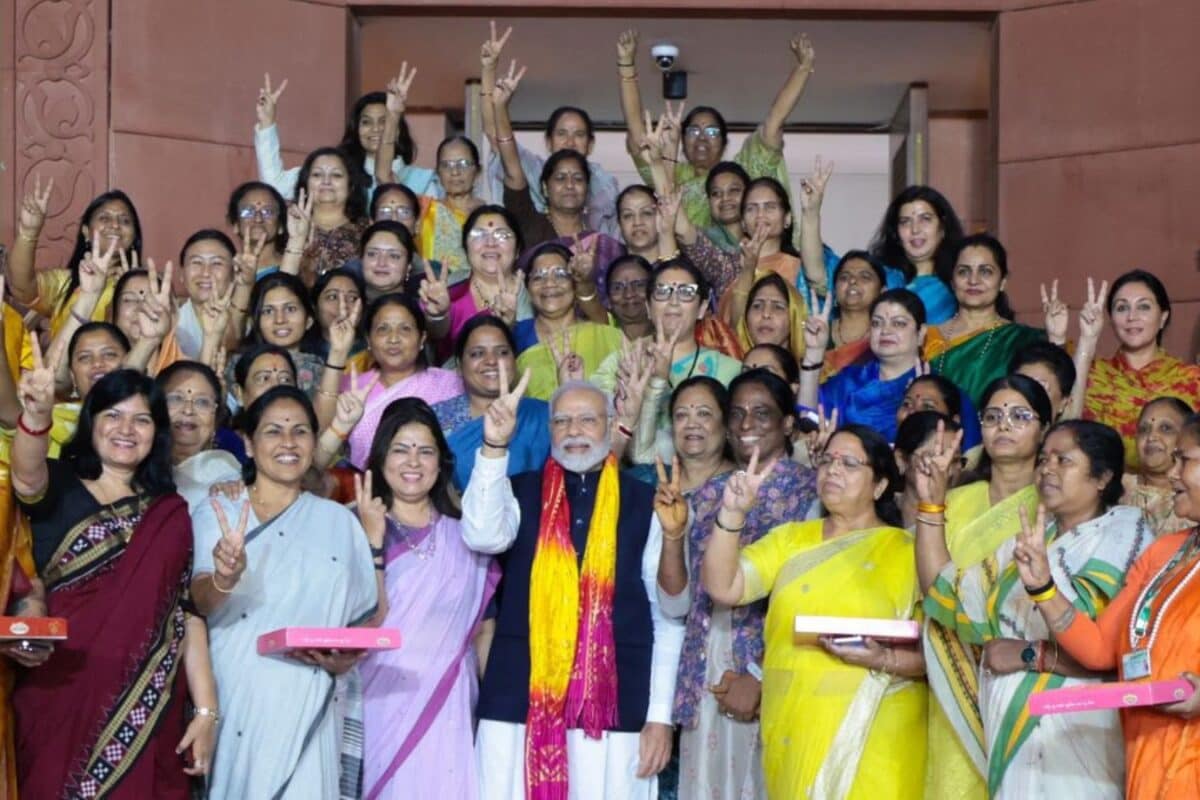
Nehru's Parliament Had 22 Women. PM Modi's Has 74 And A Promise Of More Published By, Last Updated: June 08, 2026, 14:53 IST For BJP, Nari Shakti Vandan Adhiniyam represents the moment when India moved beyond slow progress & committed itself to a structural expansion of women's political participation Rapid Read The Nari Shakti Vandan Adhiniyam, passed in September 2023, provides for 33 per cent reservation for women in the Lok Sabha and state legislative assemblies. As Prime Minister Narendra Modi prepares to surpass Jawaharlal Nehru as India’s longest-serving democratically elected prime minister, another comparison is increasingly finding political resonance: the representation of women in Parliament. When India held its first general election in 1952 under Prime Minister Jawaharlal Nehru, only 22 women were elected to the Lok Sabha, accounting for just 4.4 per cent of the House. More than seven decades later, the 2024 Lok Sabha has 74 women MPs, the highest-ever representation in absolute numbers, constituting 13.63 per cent of the Lower House. The numbers tell a story of gradual progress, but also of how slowly that progress came. Now, with the passage of the Nari Shakti Vandan Adhiniyam in 2023, the Modi government argues that India is on the cusp of a far more dramatic transformation—one that could eventually guarantee women one-third of the seats in Parliament and state assemblies. The Long Road From 1952 The first Lok Sabha had 499 members, of whom only 22 were women.
Despite the constitutional promise of equality, women’s representation in Parliament remained stubbornly low for decades. A decade after Independence, the proportion of women MPs rose only marginally. By 1971, it had actually fallen below 4 per cent. Through much of the 1980s and 1990s, women occupied fewer than one in ten seats in the Lok Sabha. Even as India’s economy expanded and more women entered education and the workforce, political representation lagged behind. The gains became more visible only in the last two decades. Women MPs increased from 49 in 1999 to 59 in 2009, 65 in 2014 and a record 78 in 2019. The 2024 election saw a slight decline to 74 women MPs, but the figure still remains more than three times the number elected in Nehru’s first Lok Sabha. Yet the bigger picture remains sobering. Even with 74 women MPs, women account for only 13.63 per cent of the Lok Sabha, far below the global average and significantly short of the proposed 33 per cent reservation. India continues to rank relatively low internationally in terms of women’s parliamentary representation. Why The Modi Government Says 2023 Was A Watershed The BJP argues that while successive governments discussed women’s reservation for nearly three decades, it was the Modi government that finally enacted it. The Nari Shakti Vandan Adhiniyam, passed in September 2023, provides for 33 per cent reservation for women in the Lok Sabha and state legislative assemblies, including seats reserved for Scheduled Castes and Scheduled Tribes.
The legislation was passed after multiple failed attempts dating back to 1996. For supporters of the government, the law marks the shift from incremental gains to structural change. Under the proposed framework, roughly one out of every three MPs in the Lok Sabha would be women once the law is implemented. In numerical terms, that would represent a leap far greater than anything seen since Independence. The BJP has increasingly framed the legislation as part of a broader transition from “women’s development" to “women-led development", a phrase frequently used by Prime Minister Modi in speeches and policy initiatives. Although the legislation has been enacted, its implementation remains linked to a future Census and delimitation exercise. As a result, the reservation is not expected to apply immediately and may only come into force from a future general election after those processes are completed. The debate over women’s representation also extends beyond Parliament. India’s experience with reservation in local bodies is often cited as evidence that quotas can significantly alter political participation. More than 14 lakh women currently serve as elected representatives in Panchayati Raj institutions, with several states providing 50 per cent reservation for women at the grassroots level. Supporters of the women’s reservation law argue that Parliament is now catching up with a transformation that has already taken place in villages and municipalities across the country. A Tale Of Two Eras Viewed through the lens of parliamentary representation, the journey from Nehru’s India to Modi’s India is unmistakable.
The first Lok Sabha had 22 women MPs. The current Lok Sabha has 74. Yet despite seven decades of democratic evolution, women still occupy barely one in seven seats in Parliament. For the BJP, the Nari Shakti Vandan Adhiniyam represents the moment when India finally moved beyond decades of slow progress and committed itself to a structural expansion of women’s political participation. Whether that promise translates into a historic jump from 13.63 per cent representation today to 33 per cent in the years ahead may ultimately determine how this chapter of India’s democratic journey is remembered. News18 Newsletter Handpicked stories, in your inbox A newsletter with the best of our journalism submit First Published: June 08, 2026, 14:49 IST News india Nehru's Parliament Had 22 Women. PM Modi's Has 74 And A Promise Of More Disclaimer: Comments reflect users’ views, not News18’s. Please keep discussions respectful and constructive. Abusive, defamatory, or illegal comments will be removed. News18 may disable any comment at its discretion. By posting, you agree to our Terms of Use and Privacy Policy Loading comments...
 The BriefWire