Two skeletons found inside a Pompeii bakery may be the key to an unsolved eruption mystery hidden beneath for nearly 2,000 years
PC: Pompeii E-Journal How animal skeletons may reshape the Pompeii timeline How the absence of volcanic debris refines the moment of death What the animals
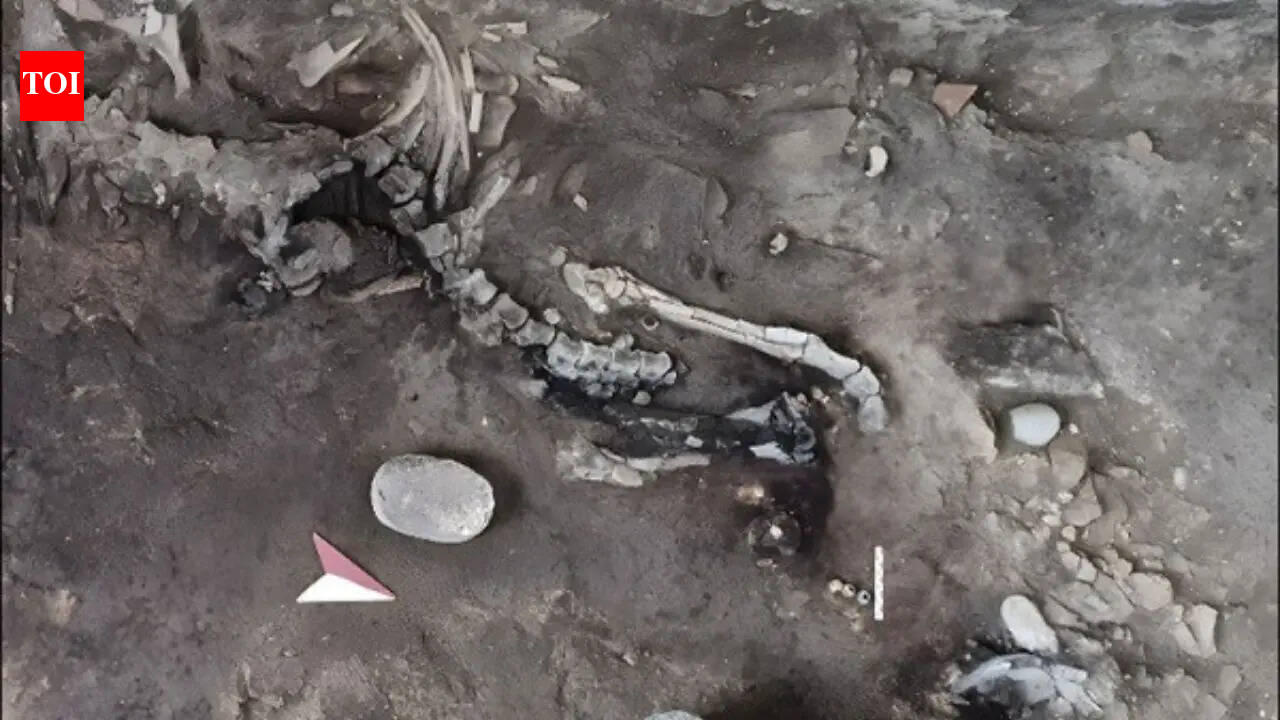
PC: Pompeii E-Journal How animal skeletons may reshape the Pompeii timeline How the absence of volcanic debris refines the moment of death What the animals themselves reveal about labour in Pompeii How collapsing buildings change the story of eruption dynamics Why animal archaeology changes how we read ancient infrastructure Inside a bakery complex in ancient Pompeii, bread production did not just stop; it froze. Archaeologists working in the House of the Chaste Lovers recently uncovered something that complicates the familiar image of panic and ash-filled silence: two animals trapped beneath a collapsed room, still positioned as if the day might continue. The Archaeological Park of Pompeii E-Journal reports the Pompeii bakery equids discovery comes from a space that had already been repurposed from food production into temporary animal housing during repairs, likely after earthquake damage weakened parts of the structure.Ongoing work on the remains will likely focus on biomolecular and isotopic analysis to refine species identification and health profiles. That could clarify whether these were horses, donkeys, or hybrids, and whether they were bred locally or brought in from outside trade networks. If genetic sampling succeeds, it may also help map broader breeding practices in Roman Campania’s urban economies, an area still poorly resolved compared to human demographic studies of Pompeii.The House of the Chaste Lovers was not a static domestic site. It functioned as an industrial node in Pompeii’s bread supply chain, complete with ovens, milling spaces, and storage rooms.Previous excavations at the site have already identified stables and working equids used to grind grain and move materials through the bakery system.By the time of the eruption, that system was under stress.
Archaeological evidence suggests renovation work was underway, likely tied to earthquake damage that affected multiple structures in Pompeii in the years leading up to CE 79. As reported by The Archaeology News Magazine, the room where the animals were found, roughly 6.3 by 3.45 meters, had stopped functioning as a bakery workspace. A large stone-supported table had been removed, leaving an open area that appears to have been temporarily converted into a holding space.That detail matters. It shifts the interpretation of the Pompeii bakery equids discovery from a snapshot of routine labour to something closer to emergency logistics. These animals were not simply working when disaster hit. They were inside a compromised building already in flux.Reportedly, The Archaeology News Magazine reveals one of the most technically important observations is what archaeologists did not find around the skeletons: lapilli. These small pumice fragments are typically among the first solid materials deposited during the initial phases of the Vesuvius eruption.Their absence beneath and around both equids suggests a narrower time window for death. Rather than being buried gradually by falling volcanic material, the animals appear to have died before significant ash or pumice accumulation reached the room.Stratigraphy, the layering of soils and materials, functions like a timestamp system. If lapilli are absent below a body but present elsewhere in a structure, researchers can infer that collapse or structural failure occurred first.In this case, a large maple beam was found above the skeletons, burned and later buried under ash. That sequence points to a structural collapse event early in the eruption process, potentially triggered by seismic activity or initial explosive phases that destabilised upper floors.As reported by The Archaeological Park of Pompeii E-Journal, two animals were identified in the room, labeled RP1 and RP2.
The older individual, RP1, was estimated at 10 to 12 years based on dental and skeletal analysis. The younger, RP2, was between roughly 3.5 and 6 years. Researchers have not yet confirmed whether they were horses, donkeys, or hybrids, but their morphology places them firmly within the working equid category used widely across Roman urban economies for transport and milling.The Pompeii bakery equid discovery becomes especially revealing when you look at the artefacts associated with RP1. Iron rings consistent with harness attachments were recovered near the neck area, along with three glass-paste beads, two white and one blue. These likely formed part of a decorative element on a collar or strap.That detail complicates a purely utilitarian reading of animal labour. Decorative elements on working equipment suggest a degree of investment in the animal beyond basic functionality. In Roman urban settings, working animals were infrastructure, comparable in economic importance to carts or milling stones, but they were still occasionally individualised, especially if they belonged to a stable or workshop with ongoing ownership and maintenance.RP2, by contrast, had no such ornamentation, which could indicate different ownership, role, or usage within the bakery system.The structural failure above the animals is not just background detail. It is central to how researchers reconstruct the eruption sequence. A wooden beam made of maple was found above both skeletons. Evidence suggests it burned after the collapse and was later buried under ash. This indicates a sequence where structural failure occurred first, followed by fire activity and then volcanic burial.This order matters because it challenges simplified timelines that place ashfall as the primary immediate killer.
Instead, buildings already weakened by earlier seismic activity may have failed under the combined stress of tremors and early eruption shockwaves.A common misconception is that Pompeii was uniformly engulfed in ash in a single, rapid event. What sites like this show is a patchwork collapse scenario. Some structures failed early due to design vulnerabilities or pre-existing damage. Others held longer and were buried in later phases.Animal remains are often treated as secondary evidence in urban archaeology, but in industrial contexts like Pompeii bakeries, they function as primary data for understanding economic systems.Working equids were essential to Roman bread production. They powered mills, transported grain, and moved finished goods. Their presence inside a bakery is not incidental. It reflects a tightly integrated production chain where animals and architecture operated as a single system.What makes the Pompeii bakery equids discovery especially informative is the intersection of zooarchaeology and building collapse analysis. The animals are not just remains, they are positional markers inside a failing structure. Their orientation, associated artefacts, and surrounding debris help reconstruct how the building behaved mechanically during stress.Modern archaeological practice increasingly overlaps with engineering analysis. Researchers effectively reverse-engineer failure sequences using physical traces such as beam placement, burn patterns, sediment layering, and skeletal articulation.
 The BriefWire