Pitch Perfect At 2026 FIFA World Cup? Grass Engineered Across 16 Venues In 3 Countries
Pitch Perfect At 2026 FIFA World Cup? Grass Engineered Across 16 Venues In 3 Countries Published By, Last Updated: June 06, 2026, 18:52 IST Researchers
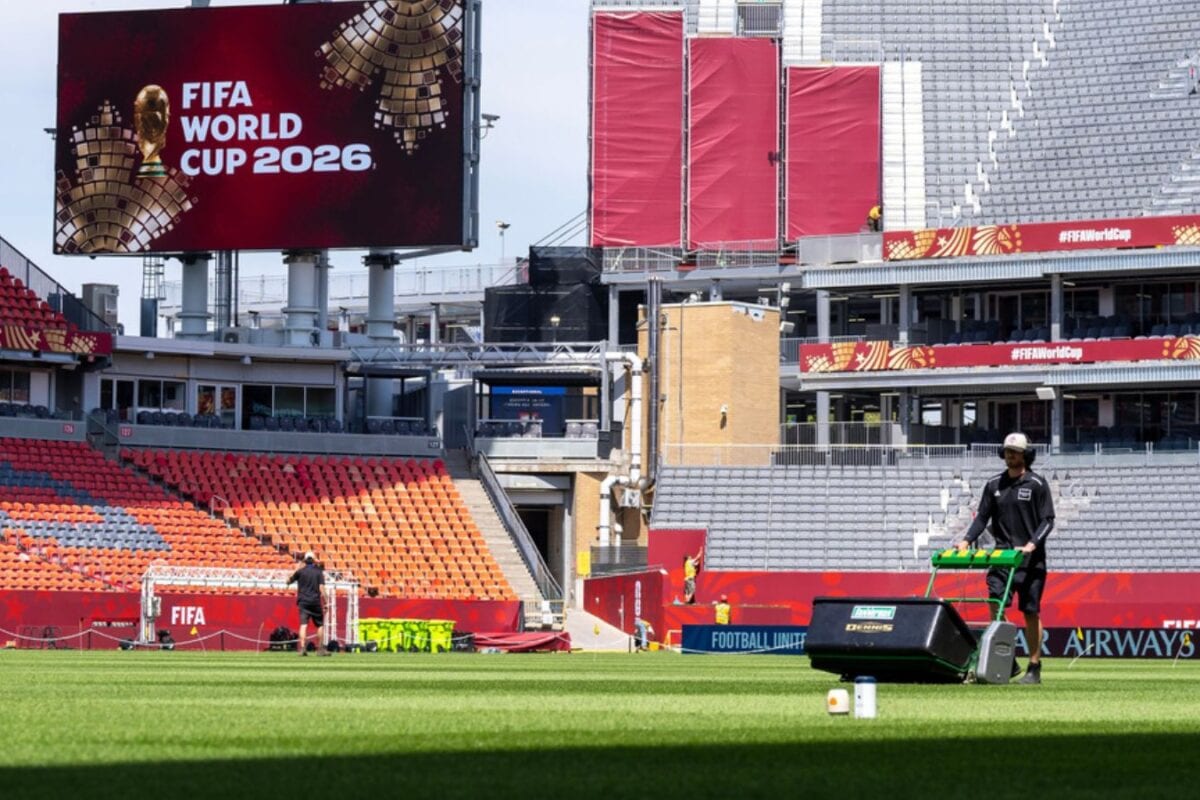
Pitch Perfect At 2026 FIFA World Cup? Grass Engineered Across 16 Venues In 3 Countries Published By, Last Updated: June 06, 2026, 18:52 IST Researchers developed hybrid grass for 2026 FIFA World Cup, adapting to diverse climates and roofed NFL venues with new lighting and drainage systems. Engineer grass for the different stadiums at FIFA World Cup (AP) The playing surfaces at the 2026 FIFA World Cup may span three countries and 16 venues, but the people responsible for creating them hope they remain almost invisible to spectators. Years of research, planning and engineering have gone into producing world-class pitches, yet the ideal outcome is that attention stays on the football rather than the grass beneath it. A flawless playing surface is critical to the quality of the game. Uneven ground, worn patches or loose turf can affect movement, balance and performance, making pitch preparation one of the most important behind-the-scenes aspects of the tournament. Growing Grass In A Lab “We want to give credit to the pitch managers who do an amazing job to get these canvases presentable, to be beautiful, but also play perfect, and people see it and admire it. But then they go on and say, ‘Oh, what a great goal that was, and what a great header that was,'" said John Sorochan, professor of turfgrass science in the Department of Plant Sciences at the University of Tennessee. For nearly eight years, researchers from the University of Tennessee and Michigan State University have collaborated on developing hybrid grass systems suitable for World Cup venues across the United States, Canada and Mexico.
FIFA requires pitches to be predominantly natural grass and to provide a consistent playing experience at every stadium, a challenge made even greater by the FIFA World Cup’s expansion to 48 teams and 104 matches. The task is particularly complex because eight host venues normally use artificial turf. Seven of those stadiums are in the United States and one is in Canada, with most serving as NFL venues. Several are enclosed or partially enclosed by roofs, creating additional hurdles for maintaining healthy grass. Seattle’s Lumen Field was among the first stadiums to undergo the transformation. Engineers installed a drainage and ventilation layer above the existing surface, added a substantial sand base, laid fresh sod and reinforced it with synthetic fibres. The venue, which will stage six World Cup matches, completed the work in time for the U.S. women’s national team to test the surface in April. “I didn’t notice it at all, so that means it was a good thing," Heaps said. Different Condition Across The Continent The diverse climates across North America required different solutions. Hotter locations such as Monterrey needed Bermuda grass, while cooler cities and indoor venues received a blend of perennial ryegrass and Kentucky bluegrass. Turf for both stadiums and training facilities was cultivated at 10 farms spread across the three host nations. Dallas Stadium, formerly known as AT&T Stadium, presents one of the most unique cases. Set to host a tournament-high nine matches, the venue uses a retractable roof that blocks natural sunlight from reaching the pitch.
To overcome that issue, engineers suspended pink grow lights from the stadium ceiling to keep the grass healthy. “They’ve never been hung from the ceiling before, so basically, what’s fantastic out of that is that typically these systems have a set of wheels that they’re wheeled on in and out of the facility, and so these are able to be lifted up, and it means that we’ve just got one less thing on the field," said Ewen Hodge, the World Cup’s head of pitch infrastructure. For Sorochan, the project is the culmination of decades of learning since working on the 1994 World Cup as a student. “We moved it in, it was inside for 30 days, and we didn’t have the grow lights, we didn’t have all the technologies that we have today with the hybrid reinforcement, so those 30 days with no sunlight, it just kind of deteriorated and went down," Sorochan said. “It held up for those four games they had and practice sessions, but you could definitely see the wear and tear on the field, and I thought, How do we make that better?" The innovations developed for this World Cup could have applications far beyond elite sport, helping communities create more sustainable and efficient grass systems in the future. “We can now develop hydroponic systems where we grow grass and recycle water below, and instead of watering from above, we can use the same water back and forth, and we can have a pitch that’s going to be more sustainable, and really a benefit to the community," Sorochan said.
“So that’s kind of some of the cool stuff coming out of this research that’s just starting to explode over the next five, 10 years. It’s gonna be an unintended game changer." (With inputs from Agencies) News18 Newsletter Handpicked stories, in your inbox A newsletter with the best of our journalism submit About the Author Ritayan Basu Ritayan Basu, Senior Sub-Editor, Sports at News18.com. Has been covering domestic and and international football for over a decade. Has played and covered badminton. Ocassionally writes cricket conten... Read More Location: United States of America (USA) First Published: June 06, 2026, 18:52 IST News sports football Pitch Perfect At 2026 FIFA World Cup? Grass Engineered Across 16 Venues In 3 Countries Disclaimer: Comments reflect users’ views, not News18’s. Please keep discussions respectful and constructive. Abusive, defamatory, or illegal comments will be removed. News18 may disable any comment at its discretion. By posting, you agree to our Terms of Use and Privacy Policy Loading comments...
 The BriefWire