Asteroid 2026 JH2 — no need to worry about it hitting Earth
This big asteroid was discovered shortly before it was expected to hurtle past Earth. Any time you see a headline about asteroids approaching the planet
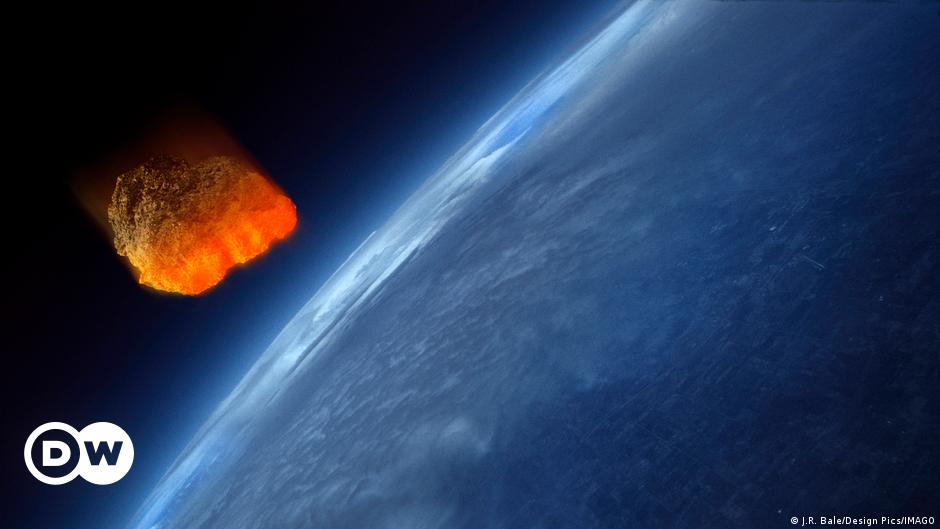
This big asteroid was discovered shortly before it was expected to hurtle past Earth. Any time you see a headline about asteroids approaching the planet, you can relax. Big and small asteroids fly by all the time. Picture the scene: An asteroid is hurtling towards Earth. It's the size of the Eiffel Tower, shaped like a peanut and potentially hazardous — sounds scary, right? Take asteroid 2026 JH2. It was first detected on May 10, 2026. And was due to fly by Earth eight days later — at a distance of less than a quarter of the distance between Earth and our moon. It's still very unlikely to hit Earth. But media coverage was everywhere. Such scare stories crop up all the time. In 2024, it was because of Asteroid 2024 ON — it didn't miss us, because it was never going to hit. "Publications need to have these 'cliffhangers' to have visits," said Juan Luis Cano of the European Space Agency's Planetary Defense Office. "But on a daily basis we are visited by many objects." In fact, around 100 tons of space material hits Earth every day. Fortunately, the mass is spread across many tiny rocks, rather than one, large destructor. Large destructors: near-Earth objects in a nutshell The United Nations Office for Outer Space Affairs defines near-Earth objects (NEOs) simply as any asteroid or comet which passes close to Earth's orbit. In more technical terms, NEOs are objects with a perihelion — their closest orbital distance to the sun — of under 195 million kilometers (121 million miles).
Given that Earth orbits the sun at a distance of about 150 million kilometers, NEOs are well within our solar neighborhood. Scientists like Cano know of about 34,000 NEOs, but none of the larger ones are currently on course to hit Earth. How likely is an asteroid impact on Earth? While tiny NEOs smack Earth every day, the larger ones hit far less often. Asteroids the size of 2024 ON might strike Earth once every 10,000 years. Those bigger than a kilometer in diameter, such as the Chicxulub asteroid that sent the dinosaurs into extinction 66 million years ago, might hit within the next 260 million years. "We estimate there are around one thousand objects larger than a kilometer and we have discovered 95% of them," said Cano. "These are the ones that could cause a global disaster." But smaller ones also have destructive potential. Depending on the speed and angle of entry into Earth's atmosphere, a 40-meter-wide (131-feet) rock could level an entire city. Hundreds of thousands of such smaller NEOs are yet to be catalogued. "We discover around 3,000 near-Earth asteroids [NEAs] every year," said Cano. "[But] we need [...] to find them quicker." Finding near-Earth objects is a 'tricky' business There is a handful of space-based telescopes tasked with finding NEOs. First, there was NEOWISE, which documented more than 158,000 NEOs. NEOWISE was launched in 2009 and retired in 2024 after a more than 10-year mission. Second, there's a successor mission called the Near-Earth Object Surveyor. And Canada's NEOSSat also tracks asteroids and comets, as well as space debris and exoplanets.
The NEO Surveyor is due to start operation in 2027. It will aim to find the rest of the potentially hazardous asteroids (PHAs) within 50 million kilometers of Earth's orbit. But finding hazardous objects in space is tricky. "One of the trickiest things to do in astronomy is to tell how far away something is," said Amy Mainzer, a planetary scientist at UCLA who headed the NEOWISE mission and will lead the NEO Surveyor. "You would think, 'Well, we see objects at the edge of space, why don't we know what's right next to us here by Earth? Don't we just know everything?' and the answer is, 'No, it's actually really hard.'" It's important to keep track of the objects we have seen and communicate those findings, said Mainzer. To do that, astronomers also use ground and space-based telescopes to monitor NEOs and PHAs. One of the newest is the Vera Rubin Observatory, currently under construction in Chile, which will spend a decade creating a time-lapse map of the universe. "This is going to revolutionize the number of asteroids we discover," said Cano. ESA is also crafting four small "Flyeye" multi-lens telescopes to make wide-field observations of the night sky. How can we defend Earth against asteroids? To view this video please enable JavaScript, and consider upgrading to a web browser that supports HTML5 video How NEO tracking helps our planetary defense No known asteroids are set to strike Earth for at least the next century. We know that thanks to our planetary defense systems.
Tracking NEOs is a part of that. Once an object is identified, researchers like Mainzer and Cano make repeat observations to quickly but accurately plot a NEO's trajectory. This can help deescalate concerns about a NEO and forms part of what scientists call planetary defense. Take Apophis, for instance. When it was first identified in 2004, the 340m-wide Apophis was considered one of the most potentially hazardous objects ever discovered. It was thought it could hit Earth in 2029, 2036 or 2068. Subsequent calculations ruled that out. It will come within 30,000km of the planet, which is closer than the moon and in the range of geostationary satellites, at the end of this decade. But it won't hit Earth on current projections. But what would happen if a new, rogue NEO was spotted on a collision course with Earth? Given enough warning, engineers might try to nudge it off target. In 2022, NASA's Double Asteroid Redirection Test (DART) mission successfully crashed a spacecraft into an asteroid called Dimorphos. It demonstrated that a collision-based mission could change the direction of a celestial body and defend our planet. Edited by: Zulfikar Abbany This article was originally published in October 4, 2024, at the time of the Asteroid 2024 ON's flight past Earth. It was updated on May 15, 2026, ahead of Asteroid 2026 JH2's expected flyby.
 The BriefWire