The wind boom Trump couldn't stop
Even with fierce opposition, offshore wind projects are multiplying along US coasts — signaling a massive shift in energy. The US president makes no bones
Even with fierce opposition, offshore wind projects are multiplying along US coasts — signaling a massive shift in energy. The US president makes no bones about his disdain for wind power, which over the years he's falsely blamed for cancer and whale deaths in the Atlantic Ocean. But his anti-wind sentiment has assumed new proportions since he took office. During that time, he has thrown up roadblocks to stop wind expansion at every turn: from pulling permits, issuing stop-work orders and paying energy companies to halt offshore projects in favor of oil and gas drilling. Nonetheless, Donald Trump will likely oversee the biggest expansion in wind in the nation's history. By 2027, the country is expected to have nearly 35 times the offshore wind capacity it had when he took office. "It's a tale of two cities," Jeremy Firestone, a professor emeritus at the University of Delaware's School of Marine Science and Policy, told DW. How Iran war energy crisis strengthens case for renewables To view this video please enable JavaScript, and consider upgrading to a web browser that supports HTML5 video At a time when fuel prices are high, electricity demand is rising thanks in part to power-hungry AI data centers, and planetary heating is worsening, clean energy advocates say removing wind from that story will have consequences for consumers. "With the real focus on data centers and the price of electricity and the price of oil and the price of fuel," says Ted Kelly, director of clean energy at the nonprofit Environmental Defense Fund (EDF), "it would be even more ridiculous to continue to block clean energy projects and drive electric prices even higher." The war on wind — and the fightback Yet blocking is exactly what Trump is set on doing.
On the first day of his second term, he issued an executive memorandum freezing leasing on new wind projects — dubbed "the wind ban" by campaigners. He then went on to issue stop-work orders on all five endorsed offshore initiatives under construction, citing classified national security concerns, and to pull permits from other approved projects. The intervention has not stopped there. One of his most recent moves involves paying energy companies to walk away from wind. In March, the administration handed nearly $1 billion (€854 million) to French energy giant TotalEnergies, which had bought leases to develop offshore wind projects near North Carolina and New York. Catching wind at sea is not something the current US administration cares to endorse Image: Getty Images via AFP A month later, he offered payouts to two other companies totaling $885 million. A move that Secretary of the Interior Doug Burgum said would help "lower everyday energy costs" for Americans who will "no longer be footing the bill for expensive, unreliable, intermittent energy projects." Despite the forces pushing back against wind power, it is having a moment in the legal spotlight. "When offshore wind goes to court, it has been winning," said Pasha Feinberg, an offshore wind strategist at the US nonprofit Natural Resources Defense Council. Last December, a judge struck down Trump's wind ban, ruling it exceeded his authority. And while the administration is appealing, other courts have also ruled construction could restart on all five offshore projects issued with a stop-work order. Meanwhile, the administration's tax cut legislation, the One Big Beautiful Act bill — which eliminated clean energy tax credits created under former president Joe Biden — has produced a sprint for developers to break ground on renewables projects before they expire in July.
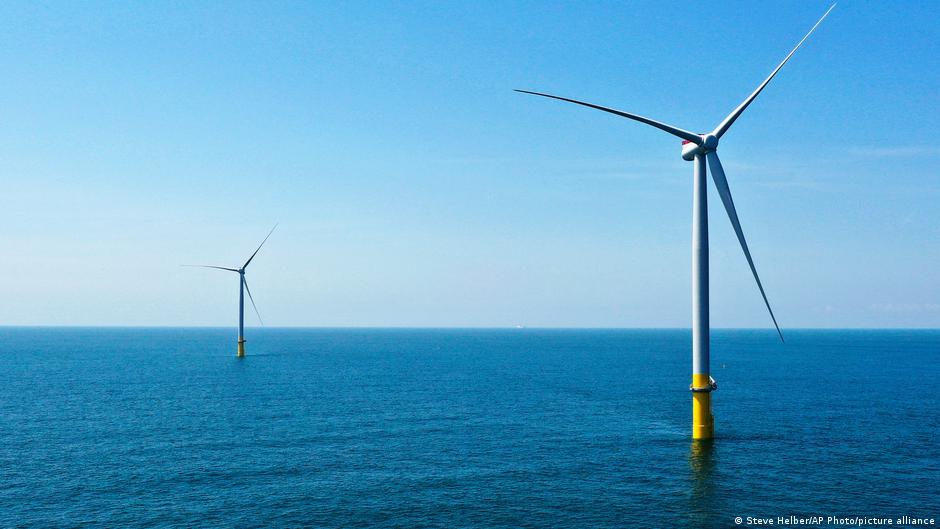
New offshore wind farms are expected to add around six gigawatts to the grid by 2027 — enough to power some 2.5 million homes. One is Norwegian energy company Equinor's Empire Wind project, located south of Long Island. Previously hit by a now overturned stop-work order, it will use turbines so powerful that a single blade rotation is set to offer a day and half of energy for one home. What wind does for Americans' electricity bills In 2025, wind generated around 10% of US electricity, behind natural gas at 40% and nuclear at roughly 17%. Even without subsidies, utility-scale onshore wind and solar remain some of the cheapest new power sources in the US, according to financial advisory firm Lazard. Offshore is pricier, but still broadly competitive with new gas plants and far cheaper than nuclear. Speaking at the World Economic Forum in Davos this year, Donald Trump said China makes wind turbines to sell to "stupid people" Image: Fabrice Coffrini/AFP Once a turbine is built, the wind costs nothing, so wind farms can sell wholesale electricity far more cheaply than gas or coal plants, tending to pull down prices for everyone. "Ratepayers are going to save a lot of money, because it's going to tamp down these hourly prices," Firestone said. The effect is already visible: A cold snap in New England last December should have sent energy prices soaring, but Vineyard Wind — an almost complete offshore project off Massachusetts — was churning with strong winter ocean winds, displacing price-volatile natural gas. The EDF estimated it saved ratepayers $2 million a day across the region. Wind projects also generate an estimated $2 billion annually in state and local tax and land-lease payments.
The industry employs 133,000 people, compared to roughly 115,900 working in oil and gas exploration and extraction in 2024. Wind turbine service technicians are among the two fastest-growing occupations in the US this decade, according to the Bureau of Labor Statistics. The wind story of the future Still, the political volatility is damaging investor confidence even where Trump has lost in court, say analysts. Before the US president returned to power, BloombergNEF had projected 39 gigawatts of US offshore wind capacity by 2035. The firm expects six to be the ceiling for now. "We don't see any new offshore wind projects coming online without significant policy changes," said Harrison Sholler, a wind analyst at BloombergNEF. Amid ever-growing demand for electricity and anxiety about energy bills, advocates argue that wind's economic logic will eventually win out. The top three onshore producer states — Texas, Iowa and Oklahoma — are all largely red. And more than eight in 10 American voters support more renewable energy, including 77% of Republicans, according to polling from offshore wind advocacy group Turn Forward. "We have no choice but to use it if we're going to meet our energy demands," Feinberg said. "It will carry the day." Edited by: Jennifer Collins
 The BriefWire