UK re-chalks Dorset's famed and feisty Cerne Abbas Giant
Britain's Trust is working on replacing the chalk outline of the Cerne Abbas Giant in Dorset. The Saxon-era carving depicts a club-wielding man "still standing
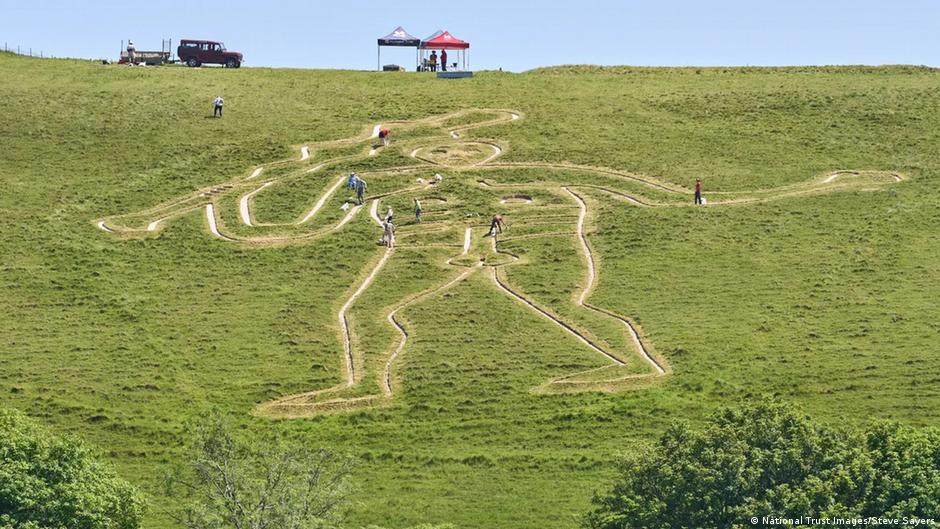
Britain's Trust is working on replacing the chalk outline of the Cerne Abbas Giant in Dorset. The Saxon-era carving depicts a club-wielding man "still standing tall," as the charity puts it. The Trust, Britain's heritage and nature conservation charity, said on Thursday that specialists had started work re-chalking the UK's "largest and most iconic chalk hill figure," the Cerne Abbas Giant. The roughly 55-meter (180-feet) tall chalk giant carved into a hillside overlooking Cerne Abbas in Dorset in southwest England is a standout figure of the landscape and renowned landmark, not least because it's such an anatomically faithful rendering of a naked and clearly excited club-wielding man. The outline is prone to the elements, though, and requires regular renewal to prevent it from fading. The famous erect penis was accidentally extended by almost a third during maintenance in 1908, when what used to be the belly button was mistakenly incorporated into the tip — but as author Peter Alan Ross put it, 'there have been no complaints' Image: Ben Birchall/empics/picture alliance What is being done to make the Cerne Abbas Giant stand out again? Trust staff, volunteers and members of the public whose donations recently helped secure the purchase of a swath of land near the site, with a view to better protect the landmark and its environs, are using around 17 metric tons of fresh chalk for the task.
It's painstaking and highly skilled work, carried out roughly once a decade. The steep slope is vulnerable to erosion and the rock must be packed in tightly to keep water out and weeds at bay. "Re‑chalking the Giant relies on techniques that haven't changed for generations — carefully digging out older material and packing in fresh chalk by hand on a very steep slope. It's how we've kept him visible for centuries," Luke Dawson, Lead Ranger for the Trust at West Dorset and Cranborne Chase said. Dawson said that in recent years, his rangers had noticed algae growth starting to dull the bright white outline. "We can't say for certain what's driving that, but warmer, wetter conditions may be a factor and it's something we're continuing to investigate," he said. "We're also seeing more intense rainfall, which can increase water run-off and gradually wear away the chalk, so we're planning further monitoring to understand the impacts and how we might need to adapt — potentially by re-chalking more often." The last re-chalking operation took place in 2019. Rangers are also planning to explore other ways of encouraging the surrounding landscape to retain water, for instance by allowing areas of scrub to develop and establishing permanent grassland. Keeping the chalk watertight and limiting weed growth is crucial to maintaining the outline's clarity over time Image: Ben Birchall/empics/picture alliance Why is the Trust purchasing surrounding land to better conserve the Giant?
The Trust general manager for the region, Hannah Jefferson, said this year's work to re-chalk the giant "feels especially meaningful." It follows a few months after the conservation organization purchased roughly 130 hectares (roughly 320 acres) of land around the Giant — a mix of "species-rich chalk grassland, a Site of Special Scientific Interest, and important archaeological landscape." This was achieved with a combination of major gifts, grants, legacies, and a public appeal championed by Sir Stephen Fry to fundraise around 300,000 pounds (roughly €350,000 or $400,000), that hit its target within a week. "For centuries, people have cared for the Giant by renewing him in chalk. Now, thanks to thousands of people coming together through the appeal, we can care not just for the figure itself, but for the extraordinary landscape that surrounds him," Jefferson said. "The Giant was never meant to exist in isolation. By protecting the surrounding land, we now have the chance to explore how people moved through, used and understood this landscape over thousands of years," Trust archaeologist Steve Timms said. What is known about the Cerne Abbas Giant's origins? Precisely who carved the giant into the Dorset countryside and why remains a mystery. For centuries, historians did not even know when it was made. Theories ranged from Roman-era depictions of Hercules all the way to a satirical rural portrayal of Civil War military leader and Lord Protector Oliver Cromwell in the 1600s, when the figure was first mentioned in written sources.
But in 2021, a study commissioned by the Trust dated the first carving of the figure to the late Saxon period, between 700 and 1100 AD. Dorset was a major cultural and religious center in Saxon England, at the heart of the Kingdom of Wessex in southwest England from which the first Saxon kings of a relatively unified England like Alfred the Great and Æthelstan hailed. The south of England is also famous for a series of chalk white horses, the oldest of which in Uffington near Oxford was created centuries before the Cerne Abbas Giant. Most, however, were carved into the landscape in the later Middle Ages from the 17th century onwards, as is the case for the England's other large chalk giant, the Long Man of Wilmington in East Sussex. That rather more PG-13 carving was previously thought to hail from the Iron Age, until its provenance was better clarified in 2003. Don't let the algorithm hide the news. If you rely on our team for trusted reporting, please take a moment to select us as your Preferred Source on Google by clicking here and hitting the "star" or "preferred" button, so you'll always see our verified news first. Edited by: Zac Crellin
 The BriefWire