France moves to symbolically repeal slavery legislation
Members of the lower house of the French parliament unanimously voted to abolish a series of royal edicts known as the "Code noir" or Black
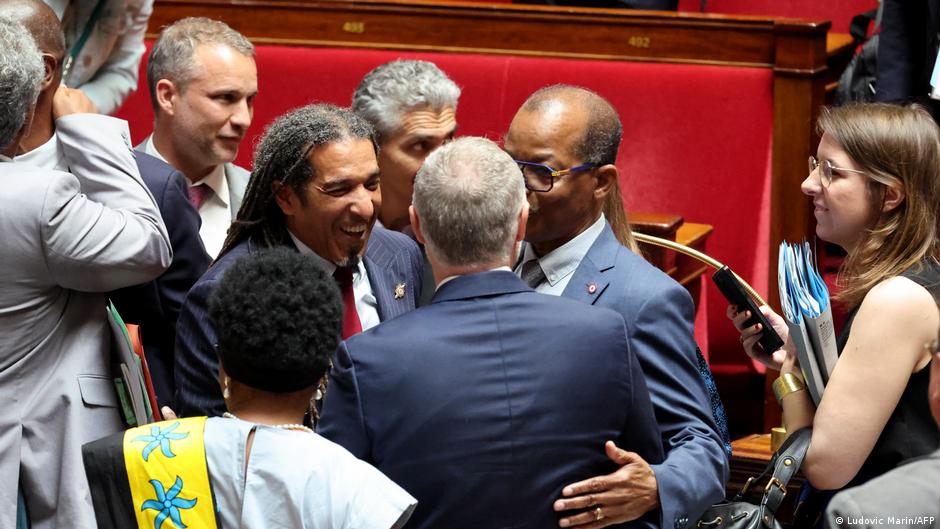
Members of the lower house of the French parliament unanimously voted to abolish a series of royal edicts known as the "Code noir" or Black Code. The bill stops short of some lawmakers' demands like possible reparations. French lawmakers on Thursday voted to formally repeal slavery-era laws that defined the legal status of enslaved people as "movable property" and justified abuse and corporal punishment. While slavery was outlawed more than 170 years ago in France, making Thursday's motion a symoblic move to formally repeal an old royal decree that was superseded not overturned, the vote comes as the country continues to grapple with its colonial legacy. France was the third-most prolific European trader of enslaved people in the colonial era, after Britain and Portugal. Expert estimates suggest ships departing French ports trafficked more than a million men, women and children from Africa, often to toil in Caribbean colonies. Max Mathiasin, a lawmaker from Guadeloupe, presented the bill to parliament Image: Thomas Padilla/AP Photo/picture alliance What does the bill aim to do? All 254 parliamentarians present in the lower house voted in favor. The bill still must clear debate in the upper house, the Senate, which is seen as a formality. If adopted, the bill would require the government to report to parliament on the consequences of colonial law and the lasting effects of slavery on racism and discrimination in French society, as well as how the history of slavery is taught in schools.
The legislation to be repealed — a series of royal edicts issued between 1685 and 1724 known as the "Code noir" or Black Code — was never formally abrogated when France abolished slavery a second and final time in 1848, or when it recognized slavery and the slave trade as crimes against humanity in 2001. "This proposal does not claim to erase history, nor to single-handedly heal the wounds of history," said Max Mathiasin, a centrist member of parliament from the French Caribbean island of Guadeloupe as he presented the law. "It aims to take a new step, to make a powerful act of remembrance, justice and recognition, by formally repealing the Code noir and all the texts that stem from it." Speaking to parliament on Thursday, Greens lawmaker Steevy Gustave — whose father was born in the French former colony turned overseas territory of Martinique — said the vote was personal. "I'm thinking of my great-grandmother, Mama Bebelle," he said, barely holding back tears. "She was the grand-daughter of Ambroise Zerambe, born in Africa, then reduced to slavery under the number 336." Paris holds ceremonies and commissions artworks honoring the abolition of slavery late in May each year Image: Thomas Padilla/AP Photo/picture alliance Push for reparations not included in current bill French President Emmanuel Macron lent his support to the motion this month, even raising the subject of reparations but without making concrete proposals.
The question of some form of reparations is a longstanding one, with suggestions ranging from formal apologies to financial compensation. Opponents however argue that it's problematic to hold modern-day states or institutions responsible for historical crimes. Mathiasin said that he did not want this more contentious issue to "weigh down" the much less disputed notion of striking the Code noir from the record, but others demurred. Paris' ceremonials in honor of the victims of slavery took place on Saturday Image: Karim Ait Adjedjou/ABACA/picture alliance "In my opinion, we must fight on the issue of reparations, which is the essential question," said Marcellin Nadeau, a left-wing member of parliament from the French Caribbean island of Martinique — one of more than half of the Assemblee Nationale members who, for one reason or another, did not vote. The former president of Martinique, Serge Letchimy, earlier this month wrote an open letter to Macron calling for "a law that clearly establishes the principle that the crimes of trafficking and slavery have caused lasting historical, cultural, social, economic and psychological harm." He referred to a 10-point plan that Caribbean nations have suggested, including international debt cancellation, as well as support for healthcare and illiteracy eradication. Should Europe pay for slavery? To view this video please enable JavaScript, and consider upgrading to a web browser that supports HTML5 video What was the Code noir?
The first of the series of royal edicts known as the Code noir was signed by King Louis XIV at Versailles Palace in 1685. It set the rules for slavery across France's colonial empire. Article 44 designated the people being trafficked across the Atlantic, often to work in Caribbean colonies, as "movable property." Masters were able to buy, sell, mortgage them, and leave them to their children. Article 28 stipulated that enslaved people could "own nothing that does not belong to their master." It allowed them no name in law, only a number and registration code. Articles 2 and 3 also required that all slaves be baptized and raised as Catholic. The various edicts that followed until 1724 all became moot in 1848 with France's second and definitive abolition of slavery, but the defunct royal edicts remained on the republic's books. Don't let the algorithm hide the news. If you rely on our team for trusted reporting, please take a moment to select us as your Preferred Source on Google by clicking here and hitting the "star" or "preferred" button, so you'll always see our verified news first. Edited by: Zac Crellin
 The BriefWire