What makes a vanity project? A history of building for power
As Donald Trump proposes costly redesigns for Washington, DC, the question arises: When do grand projects serve the public — and when do they serve
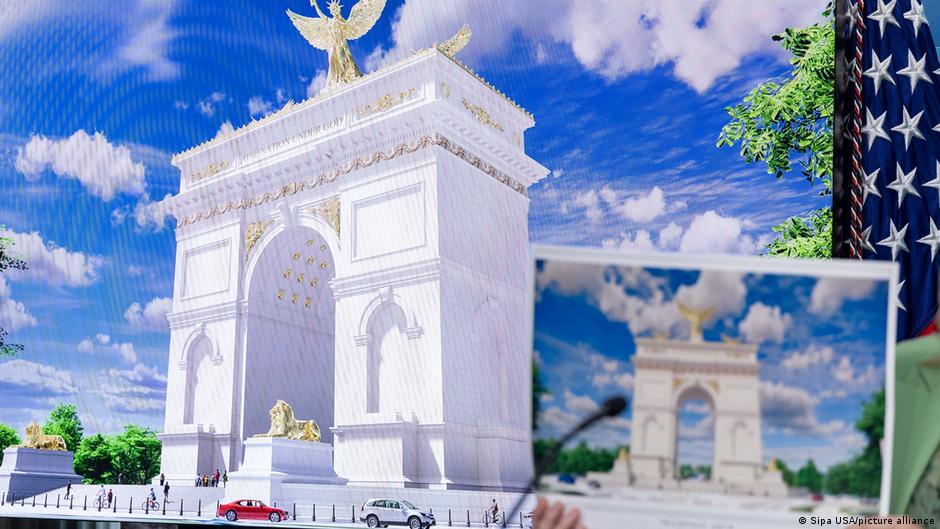
As Donald Trump proposes costly redesigns for Washington, DC, the question arises: When do grand projects serve the public — and when do they serve the leader? The term "vanity project" is having a moment. It tends to surface whenever US President Donald Trump floats another plan to give Washington, DC, a costly architectural facelift. Whether it's a $100 million (€86 million) triumphal arch, a billion‑dollar White House ballroom or a $13 million redesign of the Lincoln Memorial Reflecting Pool, each proposal revives the questions: What counts as a political vanity project? And why do leaders pursue them? Trump's latest DC project: repainting the floor of the Lincoln Memorial Reflecting Pool "American flag blue" Image: Olivier Douliery/abaca/picture alliance Distinctive features of vanity projects First, not every expansive or expensive endeavor — across eras or countries — counts as a vanity project. Esra Akcan, professor of architecture at Cornell University, says that while architecture often fulfills multiple and sometimes competing practical, social, governmental and symbolic needs — making definitions of the concept of "vanity project" inherently blurry — it is ultimately intent that distinguishes public purpose from political vanity. "While it is hard to respect any vanity project, a political vanity project should raise more opposition, because it would involve a situation when a leader uses his position and tax money to build a monument that fulfills his own ego, rather than a public service," Akcan tells DW. For her, the clearest warning sign is when scale becomes the point rather than the outcome, "when grandeur and bigness become the main driving force of design rather than an answer for a need." Put another way, one needs to look at who ultimately benefits — and who is left out of that vision. State‑funded projects that provide citizens with equitable social housing, public squares and parks or schools and universities "are very different programs from oversized and gated governmental palaces which are built for a ruler's family and friends and which extract a country's resources for a limited ruling elite." The construction of the Turkish Presidential Palace has been found to have flouted local zoning laws Image: Baris Kaykusuz/Depo Photos/abaca/picture alliance Cementing authority Historically, rulers over different eras have used monumental architecture to project authority, legitimacy or national identity.
Akcan notes how 20th‑century totalitarian regimes in Germany, Italy and the former Soviet Union embraced overtly monumental forms to signal power at home and abroad. For instance, Adolf Hitler's Chancellery in Berlin, the Zeppelinfeld rally grounds in Nuremberg and the unbuilt People's Hall — a dome meant to fit 180,000 people — were conceived to overwhelm through sheer scale. The Zeppelinfield, the grandstand where Hitler held his infamous Nuremburg rallies, was directly inspired by the ancient Pergamon Altar Image: Scherl/SZ Photo/picture alliance Hitler's architect, Albert Speer, recalled in his 1969 memoir "Inside the Third Reich" that "He wanted the biggest of everything to glorify his works and magnify his pride." Thus, Speer drew on the ancient, stepped Pergamon Altar — excavated in now modern‑day Turkey and reconstructed in Berlin — and scaled it up for the vast Zeppelinfeld used during Nazi rallies. In 17th‑century France, Louis XIV expanded a former hunting lodge at Versailles into one of Europe's largest palace complexes. Its layout put the king literally at the center of the palace, and life at court revolved around him — from daily rituals to political decisions. Versailles made his central role impossible to miss. The Palace of Versailles was designed to put King Louis XIV front and center in politics and court life Image: Stefano Bianchetti/Bridgeman Images/picture alliance Some modern leaders have also invoked ancient precedents like the pyramids to justify ambitious projects. But Akcan cautions against flattening history. "Putting modern state‑funded projects and ancient monuments such as pyramids in the same category is a false equivalency," she says, noting that pyramids belonged to entirely different belief systems and politico‑economic structures. She rather argues that modern leaders often instrumentalize architecture from earlier eras to lend legitimacy to projects driven by personal or political ambition. The grandeur of Ancient Rome and Greece has often inspired authoritarians' designs to project power.
Shown here, the ancient Pergamon Altar Image: Art Media/Heritage Images/picture alliance Not limited to monuments or memorials Today, architecture has become a tool through which leaders shape political identity and legacy — not only through individual monuments, but sometimes through entire urban visions. "Many leaders are driven by ego and the desire to leave a tangible legacy on the largest possible scale. They are not content to leave monuments or architecture behind — creating an entire city is the ultimate display of power and is a physical manifestation of ideology," says Sarah Moser, professor of geography at McGill University and a leading scholar of new capitals. Masdar City in Abu Dhabi was criticized by some as an oil-state 'vanity project,' but it also serves as a testing ground for energy-efficient technologies Image: James Talalay/Visually/picture alliance City‑building is "always inherently political," adds Moser, because cities are highly visible public projects. States outside the West, she notes, have used new cities to brand themselves or signal a new political era. She points to Masdar City in Abu Dhabi, as the world's first zero-carbon and zero-waste city, which drew global attention and helped rebrand the capital of the United Arab Emirates as "hypermodern and technologically sophisticated," even after some original plans were scaled back. In Myanmar, the master‑planned capital, Naypyidaw, uses Buddhist imagery on government buildings. Moser says this visual language presents the state as rooted in a singular religious identity, noting that such design choices can signal inclusion for some groups while implicitly excluding others, including the Muslim Rohingya minority. Moser adds that leaders have long used entire cities to express political vision or personal legacy. Peter the Great founded St. Petersburg in 1703 to serve as Russia's "window to Europe"; Brasília signaled a modern, post‑colonial identity; and Astana reflects Nursultan Nazarbayev's vision for Kazakhstan through a blend of monumental scale, ethnic symbolism and futuristic architecture.
The question of due diligence Meanwhile, Akcan warns that democracies are increasingly adopting tactics once associated with more centralized systems of power. "Recently, countries habitually associated with democracy are using architectural tactics from the authoritarian playbook," she says, pointing to the erosion of due process. High‑budget, highly visible projects have been pushed through without open competitions, broad participation or institutional consensus. "Another worrisome fact is that many of these projects breach the laws and violate the zoning codes and regulations of their own legal systems," Akcan adds, citing Recep Tayyip Erdogan's governmental palace, Ak Saray, as an example. Trump's plans for D.C including a monumental arch has been met with opposition from some Image: Andrew Leyden/ZUMA/picture alliance Trump's own plans for Washington, D.C. have also faced pushback from preservationists, planners and cultural institutions. For Moser, any changes to Washington D.C. will be inevitably scrutinized, given how symbolically important it is for American national identity. "The intentions behind the 'face lift' and the money spent on it are a sort of bellwether for the values and modes of governing for the rest of the country," she says. Trump's proposals, she argues, are "a power play intended to test his allies, show his political strength, and leave a lasting legacy." Edited by: Elizabeth Grenier
 The BriefWire