Hunger in Oleshky: Ukraine asks for evacuation
The Ukrainian city of Oleshky has been occupied by Russian troops since 2022. Many residents are cut off from the outside world and living in
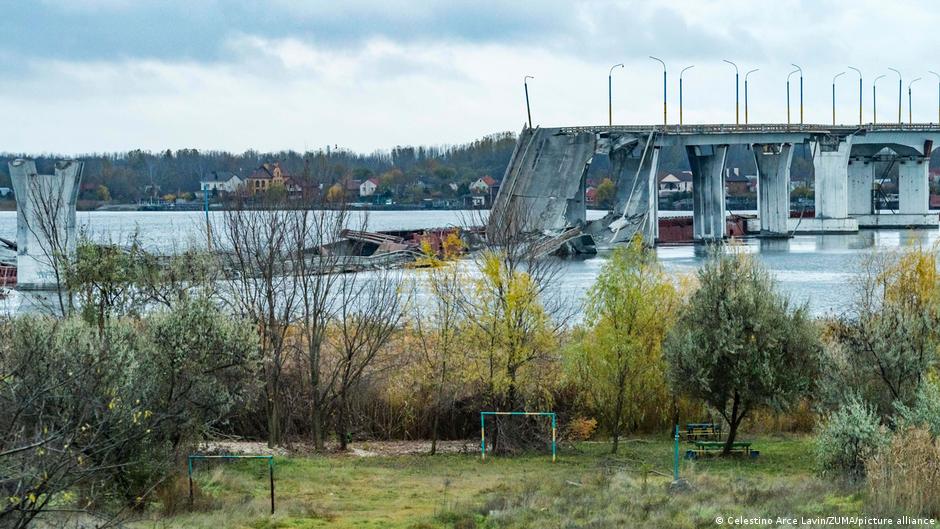
The Ukrainian city of Oleshky has been occupied by Russian troops since 2022. Many residents are cut off from the outside world and living in dire conditions. Now, Kyiv wants to rescue them. The situation is critical in Oleshky, a city in southern Ukraine. When the nearby Kakhovka dam was destroyed in 2023, Oleshky was first flooded and then bombed. Today, it is practically cut off from the outside world. But up to 2,000 people still live there, according to the Oleshky Military Administration, They are mostly pensioners and persons with limited mobility — but there are also almost 50 children reportedly. Prior to Russia's full-scale invasion of Ukraine in 2022, Oleshky had 24,000 residents and was situated in a popular vacation area. Of the 13 localities in the district, five have been completely destroyed according to officials. But people continue to live in the surrounding area. How Oleshky became a trap It has become almost impossible to leave Oleshky. The city itself and all access roads have been mined by the Russian army. Previously, the Antonivka Road Bridge over the Dnipro River connected Oleshky with the regional capital Kherson, which remains controlled by Ukraine. But the bridge no longer exists. It was blown up by the Russians in November 2022, after they retreated from the right bank of the river and deployed to the left bank. "In Oleshky, people are dying because of landmines, direct strikes on their homes or shrapnel," Ksenia Archipova, a former resident of Oleshky, who is currently helping people to evacuate on a regular basis, told DW. "The hospital is powered by generators, but there's practically no fuel. Complex operations, such as amputations after mine explosions, are impossible," she said. This was also confirmed by Natalia, who lived under Russian occupation for almost 18 months before leaving after the demolition of the Kakhovka dam. "People can barely survive, they don't have access to electricity or water.
There are virtually no medicine supplies, there is a shortage of groceries, and if there is anything, everyone stands in long queues to buy something, though they have very little money. Roadsides are littered with landmines that can explode when cyclists or pedestrians pass by. This is how many people are dying," Natalia told DW. She said that she still has relatives and acquaintances in the city with whom she stays in touch — due to its proximity to Kherson, Oleshky is within range of Ukraine's mobile phone network. She said that it was very dangerous for people in Oleshky to talk with her and others in non-occupied Ukraine, as Ukrainian SIM cards are banned in the Russian-occupied territories and all contact with Ukrainians. But people continued to take the risk, using solar panels from partially destroyed buildings to charge their old mobile phones. Kyiv calls for humanitarian corridors Already isolated, the situation became even worse for people in Oleshky last winter. The number of landmines on roads reached such a level that many of those transporting food supplies from other occupied territories to the city stopped doing so for fear of their lives. This almost led to the total collapse of food provisions in February, Tetyana Hasanenko, the head of the Oleshky Military Administration in the Kherson Region, told DW. "From March, there was effectively a famine in Oleshky, because almost no food was available from mid-January until February. On May 4, a truck carrying supplies arrived in Oleshky, but there were no more deliveries after that. People have no electricity, they have to cook with open fires, fridges are not working," Hasanenko added. Oleshky residents have endured terible hardship and hunger Image: Ksenia Archipowa She said that now Kyiv wanted to help save the remaining residents of Oleshky. Various authorities are involved in evacuation efforts, including the Ukrainian Foreign Ministry, Ukraine's human rights commissioner and also international aid organizations.
She said that humanitarian corridors were being discussed, but their establishment did not only dependent on Ukraine and Russia was currently using Oleshky's civilians as human shields. "We are dealing with Russian war criminals. A humanitarian corridor would only be possible under supervision of international missions — the United Nations, the Red Cross or other organizations," she said. Moscow will not accept a ceasefire Ukraine's Commissioner for Human Rights Dmytro Lubinets described the situation as a "humanitarian disaster." "There isn't enough food, medicine and drinking water," he told DW. At the beginning of March, he said, he had received calls for help from residents of the occupied city, after which he had turned to the International Committee of the Red Cross (ICRC). Simultaneously, he held talks with his Russian counterpart at the time Tatyana Moskalkova. According to Lubinets, the ICRC announced at the end of April that it was ready to supply as many buses as were needed to evacuate the people of Oleshky. Ukrainian media outlets quoted Lubinets as saying that Ukrainian officials had then coordinated the technical details of a possible evacuation from Oleshky and other localities on the left bank of the Dnipro. In total, there are some 6,000 civilians, including 200 children, who are waiting to leave the area. Currently, Kyiv is awaiting Moscow's confirmation of a date for a truce, so as to start the evacuation. Ukraine asks for international help In the meantime, Lubinets has been trying to attract the attention of the international community to the situation in Oleshky. Ukraine's Foreign Ministry has also announced that Kyiv intends to raise the precarious humanitarian situation with the United Nations and the Organization for Security and Cooperation in Europe (OSCE). "We urge the international community to take immediate, concrete action to save our citizens in the occupied Kherson region," an the ministry said in a statement. Human Rights Commissioner Dmytro Lubinets has warned about the dire humanitarian situation in Oleshky Image: Hanna Sokolova-Stekh/DW Searching for evacuation routes Some people have taken matters into their own hands and are trying to leave on their own.
Archipova is helping: "To get to them, we go ahead 100 meters (109 yards) at a time, checking the area for mines, before giving the all-clear to a vehicle, and that's how we move forward step by step. Every week, we evacuate seven to 12 people," she said, adding that there was financial support from the Ukrainian aid organization Save Ukraine. Archipova explained that people were initially taken to the Russian-occupied city of Skadovsk and then via Russia to the Ukrainian-Belarusian border. This was currently the safest way to leave Russian-occupied territories and reach Kyiv-controlled territory. "However, only people with IDs can leave Oleshky on that route," stressed Archipova. Those who do not have any or have lost them have to wait for the occupiers to issue a replacement, she added. "People without documents, whose entire belongings were burned during attacks, are unable to pass the checkpoints. That's why I advise them to obtain Russian passports, just to enable them to flee. For this, however, the Russians demand that three neighbors verify their identity. How are they going to find those?" In the meantime, therefore, many are remaining in Skadovsk. For example, families with children, who are waiting for a Russian passport too. And for those who only have Ukrainian papers, it has almost become impossible to leave Russian-controlled areas. "Those who try endure terrible checks that last six to seven hours" Archipova said. The Russian occupation authorities have systematically raised the hurdles for people without Russian citizenship, so that holders of Ukrainian documents only are largely stuck. This article was originally published in Ukrainian.
 The BriefWire