US-Iran tensions escalate as CENTCOM says military hit radar installations in Goruk, Qeshm Island - Moneycontrol.com
According to a statement from US Central Command, American forces shot down the drones before targeting coastal surveillance radar installations in the city of Goruk
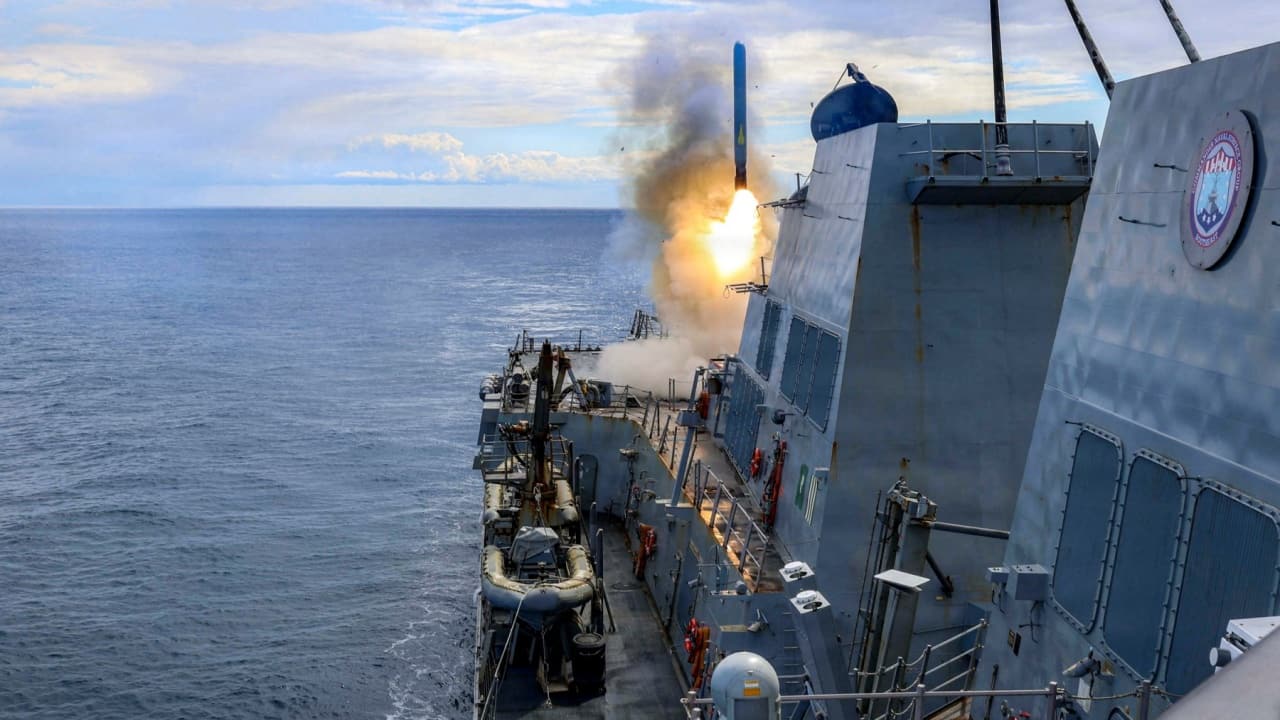
According to a statement from US Central Command, American forces shot down the drones before targeting coastal surveillance radar installations in the city of Goruk and on Qeshm Island. Representative image US strikes Iranian radar sites after intercepting attack drones Ceasefire remains fragile amid ongoing US-Iran tensions Lebanon urges Hezbollah to negotiate, not use arms as leverage Did our AI summary help? The United States military said it carried out strikes on Iranian radar facilities along the country’s southern coastline on Friday after intercepting four Iranian one-way attack drones headed toward the Strait of Hormuz, marking the latest escalation threatening an already fragile ceasefire. According to a statement from US Central Command, American forces shot down the drones before targeting coastal surveillance radar installations in the city of Goruk and on Qeshm Island. The military said the drones represented “an immediate threat to regional maritime traffic,” while the radar strikes were conducted to “defend against further attacks.” A ceasefire between Washington and Tehran has technically remained in effect since April 8, but efforts to secure a lasting settlement have failed to produce a breakthrough. The conflict has rattled global markets and created political challenges for US President Donald Trump as midterm elections approach.
Speaking to NBC News’ Meet the Press, Trump acknowledged that Iran still retains military capabilities but argued they have been significantly diminished. “I would say, percentage-wise, maybe 21, 22 percent of their missiles,” Trump said. “It’s a lot of missiles, but it’s not what it was when we first attacked.” He also maintained that the United States had “totally destroyed” Iran’s military. Trump’s estimate differs sharply from intelligence reportedly shared with Congress. The New York Times reported that lawmakers were told Iran had regained operational access to 30 of its 33 missile sites along the Strait of Hormuz and still possessed about 70 percent of its prewar missile stockpile. Iran’s military, meanwhile, claimed it launched “warning missiles” toward two US destroyers in the Gulf of Oman, an assertion immediately rejected by the US military. Earlier, Kuwait announced it had intercepted 30 ballistic missiles fired during what it described as “heinous Iranian aggression.” Asked about tanker traffic through the Strait of Hormuz, Trump said, “A lot. I don’t want say how many, but a lot.” Predicting a quick end to the disruption, he added, “It shouldn’t take long. One way or the other, it’s going to get done. And when it’s all straightened out, you’re going to have oil prices drop down to maybe even lower than they were.” On Iran’s nuclear programme, Trump said, “We’re having great success.
They’re not going to have a nuclear weapon. They’re in no position to have a nuclear weapon.” Tehran has repeatedly denied seeking nuclear weapons. In Lebanon, President Joseph Aoun delivered a strong message to Tehran and Hezbollah. Addressing Iran’s Revolutionary Guards, he said, “It’s not your country, it’s our country... It’s not your job to interfere into our country.” Aoun also accused Iran of treating Lebanon as leverage in talks with Washington, saying, “They are using Lebanon as a bargaining chip in their negotiation with the United States. It’s unacceptable.” His comments came after Hezbollah launched rockets into Israel on March 2, saying the attack was retaliation for the killing of Iran’s supreme leader in joint US-Israeli strikes. Israel responded with extensive airstrikes and a ground operation in Lebanon. Aoun urged negotiations, stating, “Hezbollah must understand that (there is) no other way but to sit and talk, no other way to solve this problem and to save what’s left except through negotiation and diplomacy.” Referring to Hezbollah leader Naim Qassem, he added, “It’s the Lebanese people, they are not Naim Qassem(‘s) people,” and said, “The majority of the Lebanese people are fed up with war.” His remarks followed a ceasefire understanding reached in Washington on Wednesday between Lebanese and Israeli representatives.
The arrangement hinges on a “complete cessation” of Hezbollah attacks but does not explicitly require Israel to stop military action. A previous truce that began on April 17 collapsed after violations by both sides. Calling the moment “a great opportunity to end the state of hostility between Lebanon and Israel,” Aoun said the issue of Hezbollah’s weapons should be handled by state institutions. “It’s the job of the state... but, on one condition -- that we remove the root causes of the existence of its weapons,” he said, citing an Israeli withdrawal and an end to hostilities. Addressing Israel directly, he said, “You need to show some willingness and commitment to end this war... We are willing, we are committed. Are you?” He also argued that military action alone would not achieve Israeli objectives, saying, “Israel can flatten the whole country, but they will never be able to achieve their objective,” adding, “They’ve tried it in Gaza. Hamas still exists.”
 The BriefWire