The egg-nomy of protest: Why people are targeting TMC leaders with this kitchen staple - Moneycontrol.com
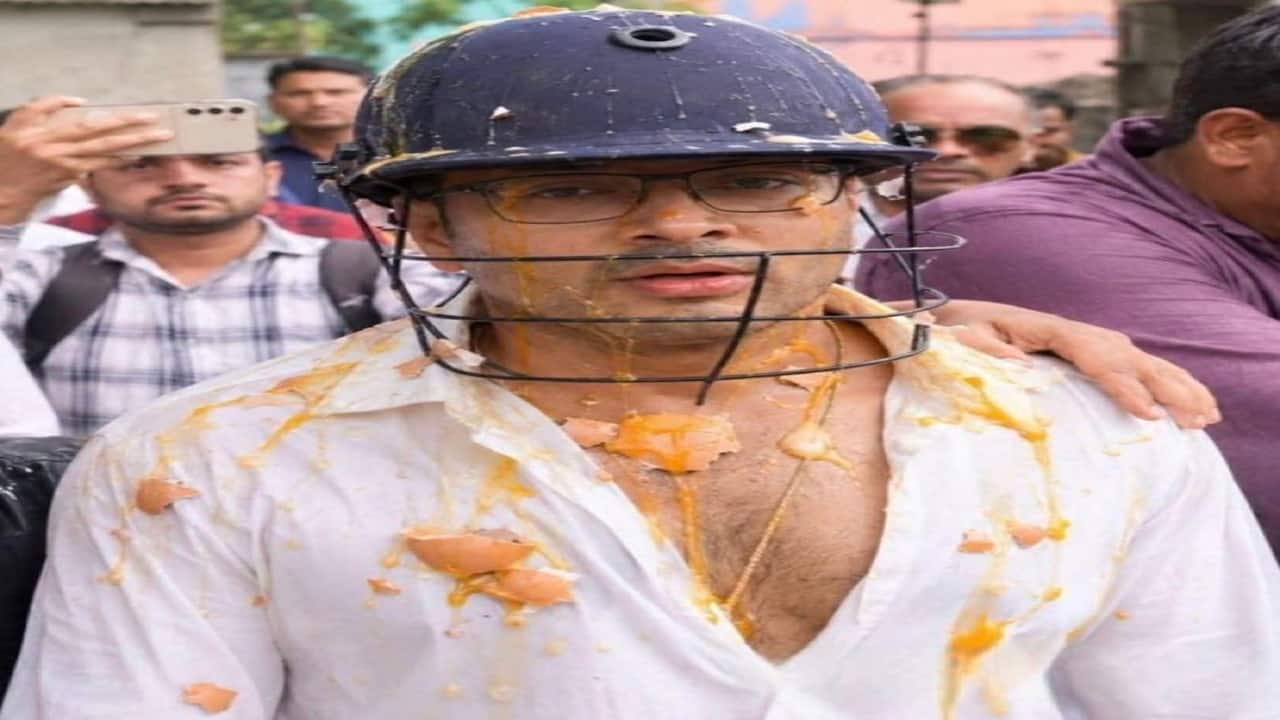
Eggs carry a unique symbolism. They are inexpensive, widely available and visually dramatic without being inherently dangerous. Protesters targeted TMC's national general secretary with eggs
Eggs carry a unique symbolism. They are inexpensive, widely available and visually dramatic without being inherently dangerous. Protesters targeted TMC's national general secretary with eggs when he visited Sonapur on May 30. Eggs used as protest tools against TMC leaders in West Bengal Egg attacks show post-election anger and political dissent Eggs, once a nutrition symbol, now signal anti-TMC sentiment Did our AI summary help? In West Bengal's increasingly charged political landscape, the humble egg has emerged as an unlikely symbol of public protest. Once associated with nutrition programmes and affordability, eggs are now being hurled at leaders of the Trinamool Congress (TMC), turning into a potent expression of public anger and political dissent. The latest and most high-profile incident involved TMC national general secretary and Lok Sabha MP Abhishek Banerjee, who was pelted with eggs and stones during a visit to Sonarpur in South 24 Parganas on May 30. Banerjee had travelled to the area to meet families allegedly affected by post-poll violence when protesters surrounded him, shouted slogans and pelted eggs. He later alleged that the attack was politically motivated and blamed the BJP. Following the Sonarpur protest, Rohit Mishra, a comedian from West Bengal, joked, "Before the elections, we were told that we would not get to have non-veg if there is a change in government. People were right. I went to some 12-15 shops today and not a single one of them could provide me with eggs. People are telling me all the eggs went for the Sonarpur protest." The Sonarpur incident was not isolated.
Days earlier, veteran TMC MP Sougata Roy faced a similar reception outside a police station in North 24 Parganas. Protesters shouted "thief" and hurled eggs at his vehicle as he exited the premises. Roy too described the demonstration as politically orchestrated. People of WB have found a new object to burst their anger- EGGs. Today EGGs are thrown aiming at TMC leader Jayprakash Majumder. When BJP workers were getting raped,killed- he quit BJP and joined TMC for own benefits. Today he is facing this. Absolute KARMA. pic.twitter.com/NRoGm17unT — Subham. (@subhsays) June 5, 2026 Perhaps, the most recent use of eggs in a protest are being undertaken by supporters of Indian Secular Front (ISF) who are planning to aim the non-lethal weapon at former TMC MLA Soukat Mollah, who has been arrested by the Investigation Agency (NIA) for his alleged involvement in a bomb blast case in Bhangar ahead of the West Bengal Assembly elections. Political symbolism is hardly new in India. Black flags, shoes and ink have long been used to register dissent. However, eggs carry a unique symbolism. They are inexpensive, widely available and visually dramatic without being inherently dangerous. For a country like India, where optics increasingly dominates public discourse, the acts of protest with eggs has evolved into a powerful tool of political messaging. A single egg flying toward a politician often attracts more attention than lengthy debates on governance, policy or public welfare. The rise of "egg politics" comes amid a broader backlash against the TMC following its loss of power in the 2026 Assembly elections after 15 years in office.
Corruption allegations, including the school recruitment scam and other investigations involving former party leaders, had become central themes in the opposition's campaign. Questions surrounding governance, accountability and political violence also dominated public discourse during the election season. Opposition leaders argue that the egg attacks reflect accumulated public frustration. Congress leader Adhir Ranjan Chowdhury recently said that the hostility faced by senior TMC leaders stems from years of public resentment over what he described as misgovernance and high-handedness. For the TMC, however, the incidents are being projected as politically engineered attempts to humiliate its leaders. The party has accused BJP supporters of orchestrating the demonstrations and has organised protests against what it calls targeted attacks on its functionaries. The egg attacks have also coincided with a period of extraordinary turmoil within the TMC. The party has been grappling with arrests of leaders, internal dissent and allegations of post-poll violence. These developments have intensified scrutiny of the organisation and fuelled a perception among sections of the public that the once-dominant party is vulnerable. The egg-nomy of West Bengal The egg’s journey into politics began from a very different place. According to a report in News18, in the decades following Independence, policymakers confronted the twin challenges of poverty and chronic malnutrition. Rich in protein, vitamins and essential nutrients, eggs were widely as an affordable dietary supplement. Their inclusion in school feeding programmes, particularly through the mid-day meal scheme, was seen as a practical intervention to improve child nutrition and educational outcomes. West Bengal is one of India's largest school meal providers after Uttar Pradesh and Bihar.
Under the PM POSHAN (formerly mid-day meal) scheme, the state serves meals to roughly 85–90 lakh children in primary and upper-primary government and government-aided schools. Ahead of the Assembly elections, the West Bengal government directed district administrations to provide additional eggs to school students under the midday meal scheme, aiming to enhance nutritional support for children. In February this year, it approved an additional allocation of Rs 8 per student per day for providing one extra egg (or a seasonal fruit) under the midday meal scheme. A food item capable of improving the health of millions of children is simultaneously being deployed as a tool of political spectacle. As told to the Statesman, Dr Amitav Sengupta, a political sociologist, said, “India’s egg politics reveals a profound contradiction. We are a country where millions of children still need eggs for nutrition, yet the same egg is increasingly used to express political outrage. This shift from nourishment to spectacle reflects how public discourse often prioritises symbolic confrontation over developmental concerns." Whether the egg becomes a lasting symbol of anti-TMC sentiment remains to be seen. What is clear is that a cheap commodity that is costing between Rs 6 and 6.25 in West Bengal has acquired political significance far beyond its market value. In a state known for its vibrant political culture, the egg has become more than food—it is now a projectile of protest, a symbol of ridicule and, increasingly a barometer of public anger wrapped in a fragile shell.
 The BriefWire