From 34 Crore To 1.4 Billion People: The India Nehru Governed And The Bharat PM Modi Leads
From 34 Crore To 1.4 Billion People: The India Nehru Governed And The Bharat PM Modi Leads Published By, Edited By Last Updated: June 05
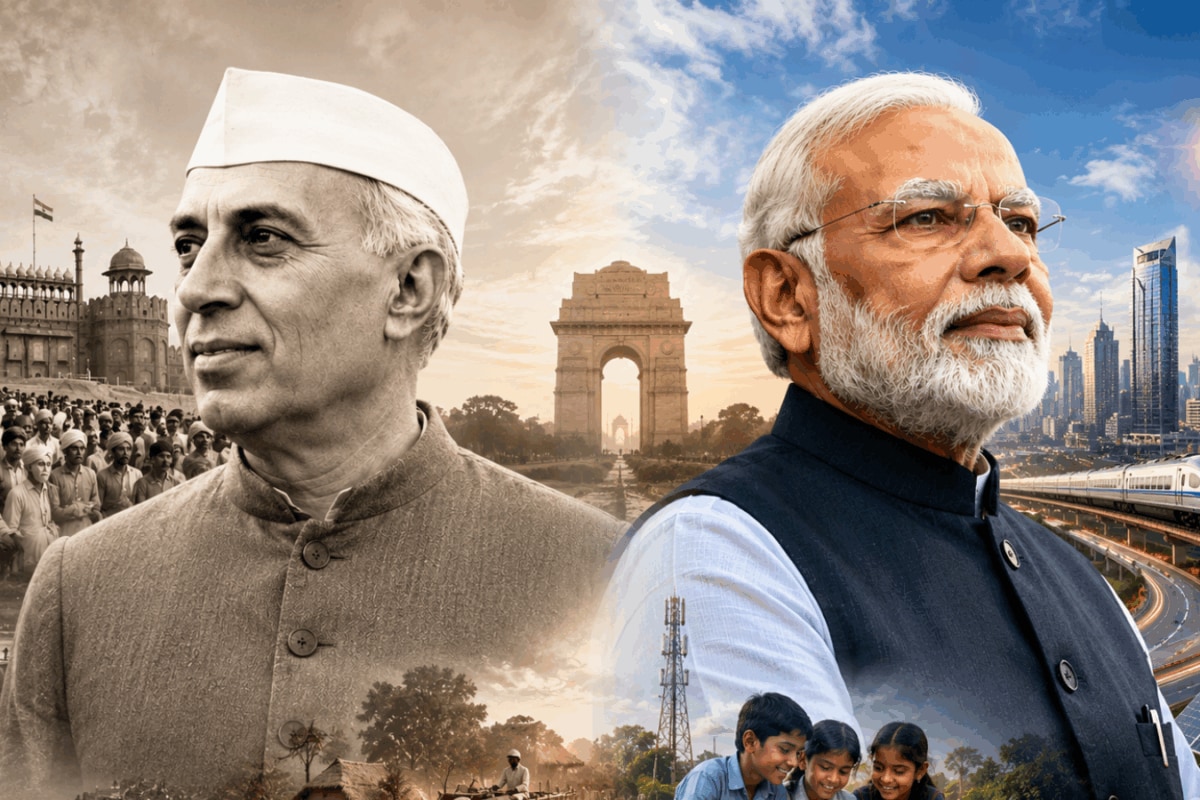
From 34 Crore To 1.4 Billion People: The India Nehru Governed And The Bharat PM Modi Leads Published By, Edited By Last Updated: June 05, 2026, 14:38 IST Today, India is home to more than 140 crore people, is the world's most populous country, one of the largest economies. Rapid Read The most important difference between the Nehru era and the Modi era is not ideological or political. It is the sheer scale of the country they governed. (AI generated image) On June 10, Prime Minister Narendra Modi is set to surpass Jawaharlal Nehru’s record as India’s longest continuously serving democratically elected Prime Minister. The milestone naturally invites comparisons between two leaders who governed India during vastly different periods of its history. Yet perhaps the most important difference between the Nehru era and the Modi era is not ideological or political. It is the sheer scale of the country they governed. When India became independent in 1947, it was a young nation of roughly 34 crore people struggling with poverty, illiteracy, food shortages and the immense task of nation-building. Today, India is home to more than 140 crore people, is the world’s most populous country, one of the largest economies on the planet and a major geopolitical player. Read More: Pandemics, Wars And 24×7 Scrutiny: How PM Modi’s Challenges Differed From Nehru’s The office of Prime Minister remains the same. The India being governed is not. From A New Nation To A Continental-Scale Democracy When Jawaharlal Nehru assumed office, India was conducting a democratic experiment that many around the world believed would fail. The first general election of 1951-52 involved around 17 crore voters, many of whom were voting for the first time in their lives.
Today, India’s electorate exceeds 95 crore voters, making it the largest democratic exercise anywhere in the world. The numbers tell only part of the story. Modern elections involve digital campaigning, social media outreach, electronic voting infrastructure, real-time data analysis and an electorate that is more aware, connected and politically engaged than ever before. The challenges of governing a democracy of this scale are fundamentally different from those faced in the early years of the Republic. The Rise of Political Competition The political landscape has also transformed dramatically. In India’s first general election, just over 50 political parties participated. The Congress party dominated national politics and remained the central force in public life for decades after Independence. Today’s India presents a very different picture. Hundreds of political parties contest elections, while regional parties exercise significant influence in many states. elections are fought in a highly competitive environment shaped by regional aspirations, coalition dynamics, identity politics and a constantly evolving media landscape. For any Prime Minister, governance now requires balancing a far more complex political ecosystem than existed in the early decades after Independence. An Economy of A Different Scale Economic governance has undergone an equally dramatic transformation. When Nehru was laying the foundations of independent India’s economy, the country’s economic output was a fraction of what it is today. India’s priorities revolved around industrialisation, infrastructure creation and achieving self-sufficiency in critical sectors. Today’s India is among the world’s largest economies and is deeply integrated into global markets. Decisions taken in Washington, Beijing, Moscow or Brussels can influence inflation, trade flows, energy prices and investment patterns within India. PM Modi, therefore, navigate both domestic priorities and international economic developments simultaneously.
The task is no longer limited to managing growth. It involves responding to supply-chain disruptions, energy shocks, financial volatility, technological competition and global market fluctuations. The Age of Instant Communication Perhaps no change has been more dramatic than the communication revolution. Nehru governed in an era of newspapers, radio broadcasts and limited television access. Information moved relatively slowly, and government decisions often took days or weeks to reach the wider population. PM Modi operates in a world where every speech, policy announcement and diplomatic engagement is instantly transmitted across television channels, digital platforms and social media networks. Public opinion is shaped in real time. Political debates unfold every hour. Government performance is continuously evaluated, questioned and analysed. The expectations from PM Modi have expanded accordingly. Citizens today expect governments to deliver quality infrastructure, digital services, welfare benefits, employment opportunities, national security, healthcare, education and global influence – often simultaneously. India’s Expanding Global Role India’s place in the world has also changed significantly. The India that Nehru represented was a newly independent nation seeking its place in the post-colonial international order. It was respected for its moral voice and leadership among newly decolonised nations. The India under PM Modi participates in global summits, plays a larger role in international institutions, engages major powers across continents and contributes to discussions on trade, technology, climate change, energy security and global governance. As India’s economic and strategic importance has grown, so too have the responsibilities of the Prime Minister. More Citizens, More Aspirations Perhaps the biggest transformation is not statistical but social. The India of the 1950s was a country focused on survival and stability.
For millions of Indians, access to food, education and basic public services was the primary concern. The India of the 2020s is increasingly aspirational. Citizens seek better opportunities, higher incomes, world-class infrastructure, quality education, digital connectivity and a stronger global presence for the country. This shift has fundamentally changed the nature of governance. Governments are no longer judged solely on maintaining stability. They are expected to deliver growth, efficiency and opportunity at an unprecedented scale. Both periods brought their own challenges and opportunities. But the scale of governance has expanded dramatically, from managing a country of 34 crore people finding its footing after Independence to leading a nation of more than 140 crore citizens in an increasingly interconnected world. As Narendra Modi prepares to cross a historic milestone in office, the comparison with Nehru serves as a reminder of how India itself has changed over the past seven decades. News18 Newsletter Handpicked stories, in your inbox A newsletter with the best of our journalism submit First Published: June 05, 2026, 14:38 IST News india From 34 Crore To 1.4 Billion People: The India Nehru Governed And The Bharat PM Modi Leads Disclaimer: Comments reflect users’ views, not News18’s. Please keep discussions respectful and constructive. Abusive, defamatory, or illegal comments will be removed. News18 may disable any comment at its discretion. By posting, you agree to our Terms of Use and Privacy Policy Loading comments...
 The BriefWire