The India Our Grandparents Explained Vs The India We Experience: A Nehru-To-Modi Story
The India Our Grandparents Explained Vs The India We Experience: A Nehru-To-Modi Story Published By, Last Updated: June 05, 2026, 15:22 IST If Nehru’s era
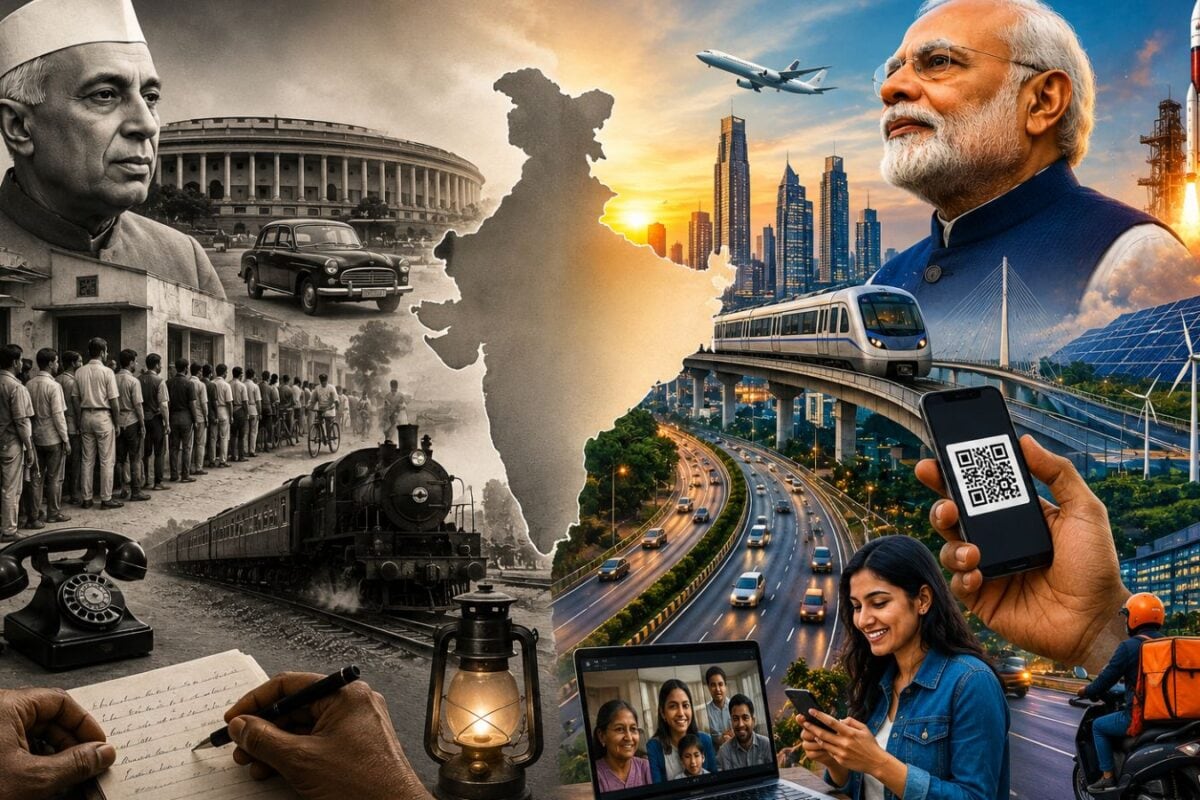
The India Our Grandparents Explained Vs The India We Experience: A Nehru-To-Modi Story Published By, Last Updated: June 05, 2026, 15:22 IST If Nehru’s era was about building institutions, PM Modi’s era has largely been about scaling systems Rapid Read For today’s India, progress is measured in app updates, expressways, digital payments and start-up valuations. (AI-Generated Image) Prime Minister Narendra Modi is on course to overtake Jawaharlal Nehru as India’s longest-serving, democratically elected prime minister in a milestone that is significant not just politically, but also because it invites a comparison between two vastly different Indias. If Nehru’s era was about building institutions, PM Modi’s era has largely been about scaling systems. The comparison becomes even clearer when viewed through everyday life. For generations of Indians, progress was measured in decades. For today’s India, it is often measured in app updates, expressways, digital payments and start-up valuations. Ask your grandparents about India, and you are likely to hear stories of waiting lists, shortages, power cuts, landline telephones and journeys that took days. Ask Gen Z or young millennials about India, and the conversation quickly shifts to UPI transactions, online deliveries, metro networks, digital identities and a country aspiring to become the world’s third-largest economy. Then: Waiting Was A Way Of Life For much of post-Independence India, scarcity defined everyday life. A telephone connection could take years to obtain. Owning a scooter often meant joining a waiting list. Foreign travel was rare, imported goods were limited and air travel was largely reserved for the affluent. Many grandparents still recall waiting months or years for an LPG connection, standing in queues to pay utility bills, booking railway tickets at counters, writing letters that took days to arrive, and travelling on roads that were often single-lane highways.
Today, many of those experiences sound almost unimaginable to younger Indians. Now: India Runs On Instant Access A train ticket can be booked in seconds. Bills are paid through smartphones. Food, medicines and groceries arrive at doorsteps within minutes in many cities. Video calls connect families across continents instantly. India’s digital public infrastructure has fundamentally changed how citizens interact with services. The biggest example is the Unified Payments Interface (UPI), which has transformed the way Indians transact. From roadside vendors to large retailers, QR codes have become ubiquitous. What once required cash, cheques or bank visits now takes a few seconds on a smartphone. Then: Dependency On The World Older generations grew up in an India that often depended heavily on imports for technology, defence equipment and energy. Foreign exchange shortages were a recurring concern. Economic growth remained modest for decades and India’s global influence was limited compared to major powers. Now: India Wants To Shape Global Conversations Today’s India is increasingly positioning itself as a global player. Whether it is hosting the G20 Summit, leading conversations on climate change, participating in semiconductor manufacturing plans or emerging as a major voice of the Global South, India’s ambitions have expanded dramatically. Then: Infrastructure Was A Bottleneck Grandparents often describe journeys that took an entire day to cover distances that now take a few hours. Back then, airports were limited. Metro rail networks barely existed. Expressways were rare. Logistics costs were high and connectivity remained uneven. Now: The Infrastructure Build-Out Is Visible Everywhere The transformation is perhaps most visible on the ground. Examples include the rapid expansion of metro systems across multiple cities, expressways connecting major economic corridors, modern airports in tier-2 and tier-3 cities, dedicated freight corridors aimed at improving logistics, and high-speed internet reaching previously underserved regions.
A traveller returning after two decades would struggle to recognise parts of urban India today. Then: Government Offices Meant Files And Queues Interacting with the government often meant paperwork, physical visits, and lengthy procedures. Obtaining certificates, licences or records could involve multiple trips and considerable delays. Now: Governance Is Increasingly Digital Services ranging from tax filing to passport applications, vaccination certificates and welfare transfers have increasingly moved online. Digital identity systems and direct benefit transfers have changed how citizens access public services. For younger Indians, standing in line for hours to submit a form is no longer the norm. Then: A Job Was The Dream For many in previous generations, the ideal career path was relatively straightforward: Secure a government job, join a public-sector undertaking, and build a stable career. Entrepreneurship was often viewed as risky. Now: Building A Startup Is A Career Option India has emerged as one of the world’s largest start-up ecosystems. Young Indians increasingly aspire to launch businesses, build technology companies, and become content creators. They also work remotely for global firms and pursue careers that did not even exist two decades ago. The shift reflects a broader change from a scarcity mindset to an aspiration-driven economy. Then: Information Was Scarce News arrived through newspapers, radio broadcasts and limited television channels. Access to information was often controlled by geography and resources. Now: Information Is Everywhere A smartphone offers access to global news, online education, government services, financial markets, and Artificial Intelligence tools. The challenge is no longer finding information. It is filtering it. The Energy Story Mirrors The Transformation Few sectors illustrate India’s evolution better than energy.
A generation ago, energy security largely meant ensuring enough fuel for a growing nation. Today, India is simultaneously buying discounted Russian crude, exploring long-term energy partnerships with Venezuela, investing in renewable energy, expanding electric mobility, and competing for critical minerals needed for future technologies. The shift reflects a country thinking not just about today’s needs but about its place in tomorrow’s global economy. News18 Newsletter Handpicked stories, in your inbox A newsletter with the best of our journalism submit About the Author News Desk The News Desk is a team of passionate editors and writers who break and analyse the most important events unfolding in India and abroad. From live updates to exclusive reports to in-depth explainers,... Read More First Published: June 05, 2026, 15:22 IST News india The India Our Grandparents Explained Vs The India We Experience: A Nehru-To-Modi Story Disclaimer: Comments reflect users’ views, not News18’s. Please keep discussions respectful and constructive. Abusive, defamatory, or illegal comments will be removed. News18 may disable any comment at its discretion. By posting, you agree to our Terms of Use and Privacy Policy Loading comments...
 The BriefWire