Scientists Precisely Edit Human Embryo DNA. Are ‘Engineered Babies’ Next?
Scientists Precisely Edit Human Embryo DNA. Are ‘Engineered Babies’ Next? Published By, Last Updated: June 05, 2026, 10:13 IST Scientists used base editing to alter
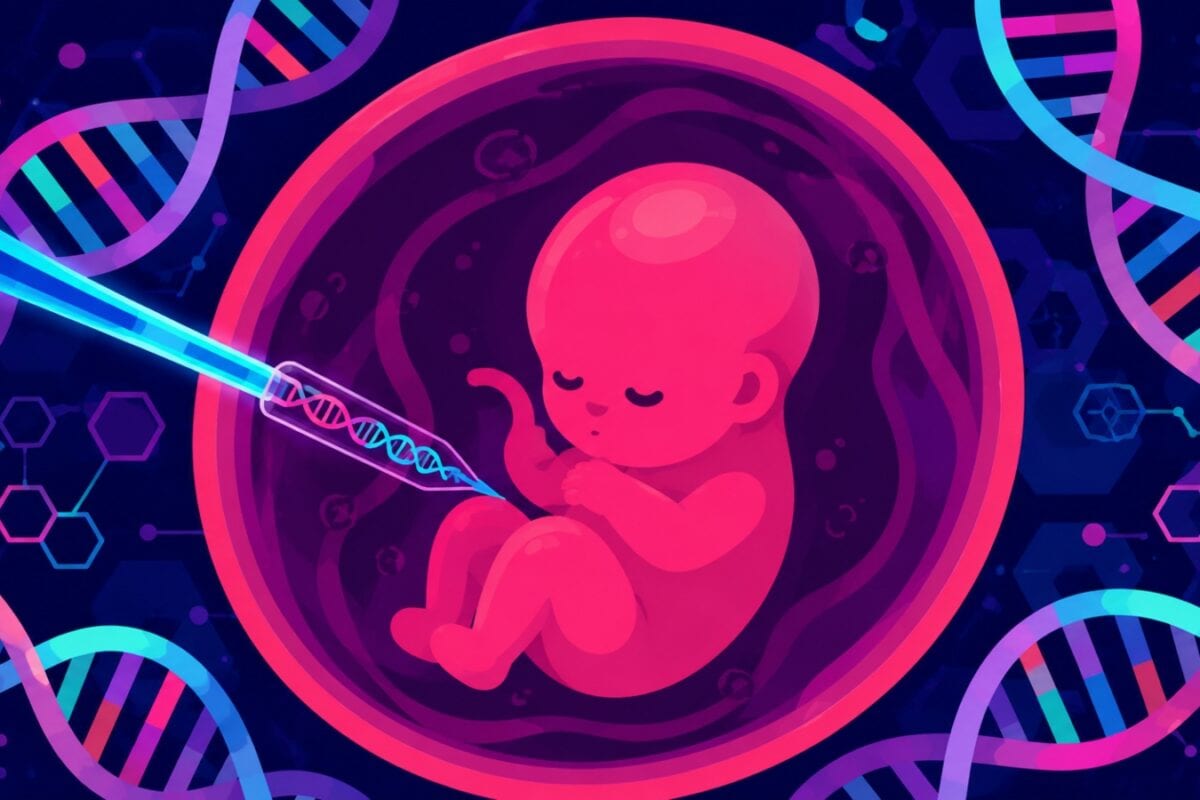
Scientists Precisely Edit Human Embryo DNA. Are ‘Engineered Babies’ Next? Published By, Last Updated: June 05, 2026, 10:13 IST Scientists used base editing to alter DNA in human embryos with unusual accuracy, raising hopes of fixing disease-causing mutations but also reviving fears over designer babies. Rapid Read The concern is that a technology meant to repair disease-causing mutations could also be used to select desired traits. (AI-generated image) Scientists at Columbia University have edited the DNA of early human embryos with unprecedented accuracy, a development that could one day help repair disease-causing mutations before birth but has also revived the long-running fear of babies engineered for selected traits. The research was led by geneticist Dieter Egli and used a newer technology called base editing. Unlike the earlier CRISPR method, which cuts DNA, base editing allows scientists to replace individual genetic letters more carefully. In simple terms, it works less like cutting a page out of a book and more like correcting a typo. Egli told The New York Times that the findings should trigger a wider public discussion on the pros and cons of altering embryo DNA. “As a scientist, you can provide the data for discussion, but then essentially there you stop and let others take over," he said. The study has been posted online and is under review for publication in a scientific journal. What Did The Columbia Team Do? The researchers used base editing on fertilised eggs and two-cell embryos donated by parents. They targeted two genes — PCSK9, which can carry mutations linked to higher LDL levels and heart disease risk, and HBG, which directs haemoglobin production in foetuses. The team was able to successfully change both genes. In some experiments, both genes were changed in the same embryo. The important difference from earlier CRISPR experiments was that the researchers did not find the extensive damage previously seen when embryo DNA was cut.
Why Is This Different From CRISPR? CRISPR became a major scientific tool after 2012 because it allowed scientists to snip out targeted segments of DNA. It later led to medical advances, including a US-approved treatment for sickle cell anaemia in 2023. But CRISPR is not perfect. Sometimes it misses the target or cuts the wrong genetic material. In embryos, that risk is especially serious. Egli’s own earlier work showed why. In 2020, his team used CRISPR on embryos carrying a mutation in the EYS gene, which causes hereditary blindness. The hope was that the embryo would repair the faulty gene using the healthy copy as a guide. That happened only in some embryos. In about half, the repair failed. Some embryos lost long stretches of DNA, while some destroyed the entire chromosome carrying the EYS gene. Egli described the result as having “absolutely catastrophic consequences." Base editing was created in 2016 by Harvard geneticist David Liu and colleagues. Instead of cutting out a DNA segment, base editors make a tiny nick in one strand and guide the cell to fix the mutation. Was The New Method Perfect? No. The new method avoided the large damage seen with CRISPR, but it did not work perfectly. Sometimes the base-editing molecules failed to find their target DNA. This meant some cells in the embryos were edited while others were not. Such embryos are called mosaics. It basically means the embryo became a genetic mix rather than carrying one clean change across all cells. If such embryos developed into babies, this could cause medical problems. Egli cautioned against assuming the technology is ready for clinical use. “We’re not saying this is going to be used tomorrow in the clinics," he said. Why Are Experts Still Cautious? Dr Paula Amato, a fertility expert at Oregon Health & Science University who was not involved in the study, called the method “promising", but said the final results must be examined when published in a journal.
Ana Iltis, a bioethicist at Wake Forest University, warned that safety checks would need to go beyond looking for damaged chromosomes. “It is possible that some of the potentially harmful effects would not be evident until after birth," she said. That concern is central to the embryo-editing debate: a genetic change made at the embryo stage could affect a future child in ways scientists may not immediately detect. Why Could This Matter For IVF? Nathan Treff, chief clinical officer of Nucleus Genomics, a company that screens IVF embryos for genetic disorders, and a co-author of the study, said fixing disease-causing mutations in embryos could help people using IVF. It could allow them to implant embryos that might otherwise be discarded. “There’s still work to do before getting to that point, but this research gets us closer," he told NYT. Nucleus Genomics will support the next stage of Egli’s research. Upcoming studies will look for ways to avoid mosaic embryos and will test base editing on embryos containing about 100 cells, the stage at which fertility clinics usually freeze and test embryos. Why Is There A Designer Baby Debate? The concern is that a technology meant to repair disease-causing mutations could also be used to select desired traits. Nucleus Genomics screens IVF embryos for thousands of genetic disorders and also makes predictions about risks for conditions such as heart disease and diabetes. It also looks at genes linked to traits such as height and intelligence. The company drew controversy in November with New York City subway telling commuters to “have your best baby". Geneticists have criticised its predictions for traits such as IQ as having low accuracy. Critics have accused the company of promoting a biotech version of eugenics, a charge the company rejects. Fyodor Urnov, a geneticist at the University of California, Berkeley, who was not involved in the study, said regular IVF screening made more sense than using a new technique with so many open questions.
“Do we do what we’ve done safely and effectively 15 million times since 1978, or do we instead try something that we can never truly de-risk, and where the risks are clear?" he asked. Urnov also warned that the method could appeal to people who want to enhance traits, not just address inherited diseases. He said it risked giving “baby improvers" a “how-to manual for forays beyond the ethical pale". So, Are Engineered Babies Next? Not immediately. The research shows that scientists can edit embryo DNA more precisely than before, but it also shows that the method is not yet reliable enough for clinical use. For now, the Columbia experiment is a scientific advance. Though it has brought the world closer to a question that science alone cannot answer: if embryo DNA can be changed, who decides how far that power should go? News18 Newsletter Handpicked stories, in your inbox A newsletter with the best of our journalism submit About the Author Karishma Jain Karishma Jain, Chief Sub Editor at News18.com, writes and edits opinion pieces on a variety of subjects, including Indian politics and policy, culture and the arts, technology and social change. Follo... Read More First Published: June 05, 2026, 10:13 IST News world Scientists Precisely Edit Human Embryo DNA. Are ‘Engineered Babies’ Next? Disclaimer: Comments reflect users’ views, not News18’s. Please keep discussions respectful and constructive. Abusive, defamatory, or illegal comments will be removed. News18 may disable any comment at its discretion. By posting, you agree to our Terms of Use and Privacy Policy Loading comments...
 The BriefWire