In 1854, a tiny mirror helped solve the Atlantic telegraph problem
PC: AI Generated How a 2,000-mile cable became the biggest test of the telegraph How Thomson turned a tiny movement into a visible signal The
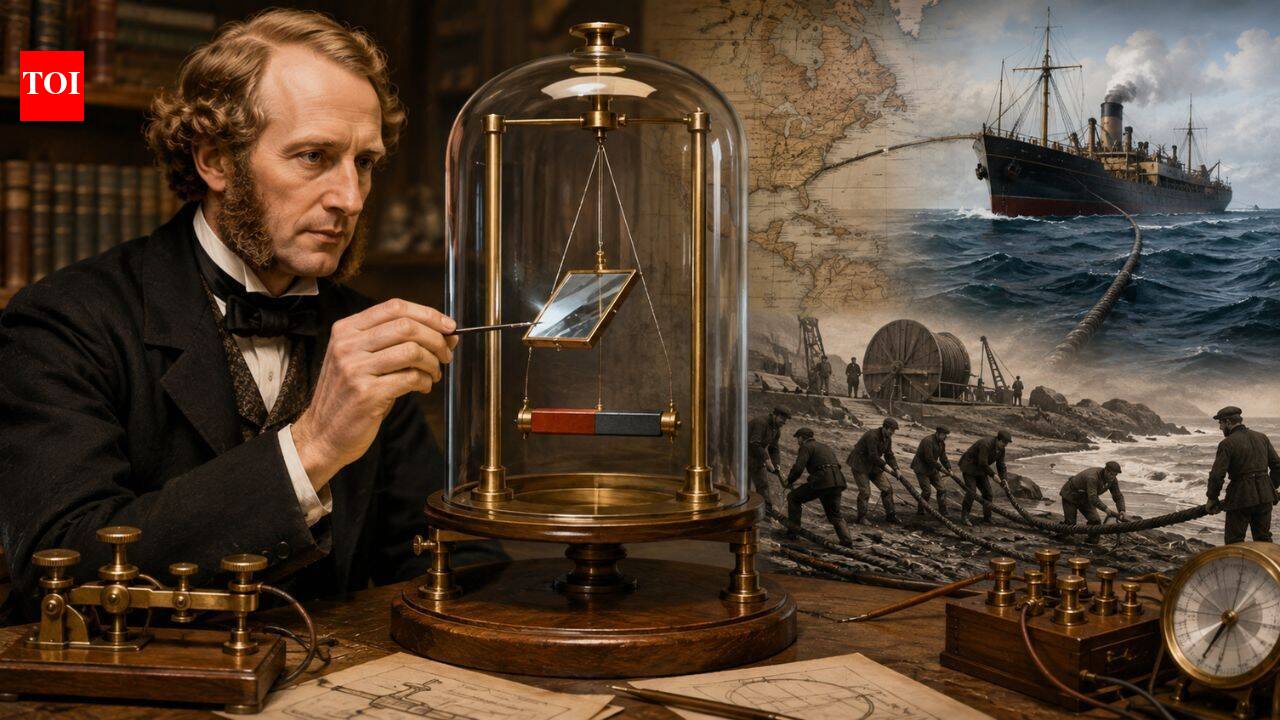
PC: AI Generated How a 2,000-mile cable became the biggest test of the telegraph How Thomson turned a tiny movement into a visible signal The weak signal that changed the way the cable was read Thomson's little mirror outlasted the first cable William Thomson: The mathematician behind the mirror In the middle of the 19th century, sending a message across the Atlantic was still a distant ambition. Telegraph lines had already begun shrinking distances on land, but an ocean presented a different problem. A signal travelling through thousands of miles of cable could arrive so weak that ordinary instruments struggled to detect it. William Thomson, the Irish-born Scottish mathematician and physicist who would later become Lord Kelvin, approached the problem from another direction. Rather than forcing more electrical power through the cable, he devised an extraordinarily sensitive instrument that could reveal movements far too small for a conventional needle to show. Its key feature was almost absurdly simple: a tiny mirror attached to a small magnet, suspended so delicately that a faint electrical signal could move it.The transatlantic telegraph changed communication even though messages still had to be encoded, decoded and written down. Europe and North America no longer depended entirely on ships to exchange urgent information.According to the History of the Atlantic Cable & Undersea Communications, the first serious transatlantic cable attempt in 1858 connected Newfoundland with Ireland, but weak signals made communication unreliable.Thomson’s sensitive mirror galvanometer offered a solution, while Edward Orange Wildman Whitehouse favoured powerful electrical equipment.By the 1850s, the telegraph was changing communication on land.
Messages could be converted into electrical signals and sent along wires far faster than a letter could travel by ship, train or horse. Extending that system across the Atlantic seemed like the next obvious step.The proposed route between Ireland and Newfoundland stretched for more than 2,000 nautical miles beneath the sea as reported. That meant engineers had to solve two separate problems: getting a cable safely across the ocean and making sure a signal sent into one end could still be recognised at the other.A long submarine cable behaved differently from a short telegraph wire. Electrical signals became spread out and weakened as they travelled, making conventional receiving equipment increasingly unreliable. The farther the message went, the less useful it became to think simply in terms of sending a stronger electrical impulse.Thomson was interested in precisely this problem. His mathematical work had already made him attentive to the way electricity behaved in long conductors, and his involvement with the Atlantic Telegraph Company gave him a practical reason to apply that knowledge.The device that emerged from this work was the mirror galvanometer. A Science Museum example is dated to 1854, although Thomson's mirror galvanometer was patented in 1858, as reported by the History of the Atlantic Cable & Undersea Communications. The basic principle was strikingly delicate. A small bar magnet was attached to the back of a light mirror and suspended on fine silk threads inside a coil of wire.When an electrical current passed through the coil, the magnet moved.
 The BriefWire